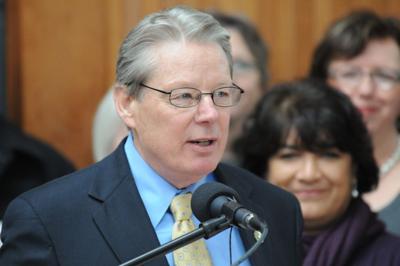

Dan Diaz probably never expected his face would appear on the cover of People magazine, or that his wedding photos would circulate all over the Internet. But Diaz, 43, has become a household name for his untimely loss. He moved with his late wife, Brittany Maynard, from California to Oregon last year, where she could legally get a prescription for a lethal dose of barbiturates. Maynard, who was 29 and battling terminal brain cancer, died Nov. 1.
Diaz is scheduled to appear alongside state senators Bill Monning, D-Carmel, and Lois Wolk, D-Davis, Wednesday at the state capitol to speak in support of legislation similar to Oregon’s Death With Dignity Act. Monning and Wolk intend to introduce SB 128, called the End of Life Options Act.
“We think the time is opportune to have this conversation in California,” Monning says. “We're looking at respecting the autonomy and choice of the patient.”
The last time the state Legislature considered a similar bill was in 2007; that bill died in committee.
Part of what’s changed, Monning says, is an evolving medical care system, and more lawmakers who’ve lost loved ones to extended, painful illnesses. Philosophically, he says he has no hesitation: “Any level of concern or discomfort was more tactical and political.”
The bill would allow adult patients who are mentally competent and have a terminal illness with no more than an estimated six months to live, based on an evaluation by two physicians, to seek a lethal prescription. Oregon, Washington and Vermont are the only three states with similar laws on the books.
Monning and Wolk have scoured the data from Oregon, where the voter-approved law went into effect in 1997. Since then, 1,173 patients have secured a prescription, and 752 have used it to end their lives. To Monning, that discrepancy is proof of patient choice: “We think there's also an aspect here of providing peace of mind and some comfort. If the suffering reached a certain point, they would have the option.”
That option historically has not sat well with several key stakeholders, and Monning has been checking in to see the bill’s odds of passing.
He’s met with Gov. Jerry Brown’s staff, and every member of the Senate judiciary and health committees, both of which he serves on.
He’s met with the Roman Catholic Archbishop of Los Angeles, José Gomez, and Bishop of Monterey Richard Garcia, for conversations he describes as “cordial and respectful.” Garcia did not respond to repeated interview requests.
The Catholic Church opposed similar ‘06 and ‘07 bills, and Monning expects they’ll position themselves the same way this time around, but he’s been careful to add language allowing doctors and hospitals to opt out; no physician would be mandated to prescribe lethal drugs.
Monning has also met with representatives of the California Medical Association, which opposed earlier bills. “Longstanding CMA policy is in opposition to physician-assisted suicide because it is fundamentally incompatible with the physician’s role as a healer,” spokesperson Molly Weedn writes by email.
If the bill fails in the Legislature, nonprofit Compassion and Choices has indicated it may lead the charge on gathering signatures for a ballot initiative in 2016.
“We have not ruled out any options,” California Campaign Director Toni Broaddus writes by email. “We are prepared to go to the ballot if that becomes necessary. We have no doubt that such an initiative would pass.”


(0) comments
Welcome to the discussion.
Log In
Keep it Clean. Please avoid obscene, vulgar, lewd, racist or sexually-oriented language.
PLEASE TURN OFF YOUR CAPS LOCK.
Don't Threaten. Threats of harming another person will not be tolerated.
Be Truthful. Don't knowingly lie about anyone or anything.
Be Nice. No racism, sexism or any sort of -ism that is degrading to another person.
Be Proactive. Use the 'Report' link on each comment to let us know of abusive posts.
Share with Us. We'd love to hear eyewitness accounts, the history behind an article.