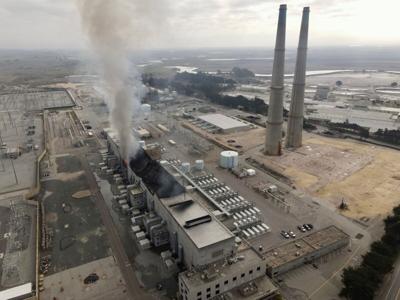

Within hours of a fire igniting on Jan. 16 at a Vistra’s battery plant in Moss Landing, some residents who live nearby or were downwind from the fire’s smoke began to experience symptoms that included a metallic taste in the mouth, headaches, sore throats and more.
And because of the fire’s fuel—an industrial building packed with lithium-ion batteries, which contain toxic heavy metals—there has been a heightened concern over the potential health impacts for those who inhaled the smoke, or people who live or work in the area.
Uncertainty about impact from the fallout—how toxic it could be to people and ecosystems—continued for weeks as scientists from the state Department of Toxic Substances Control analyzed samples taken at eight locations on Jan. 24. Last Monday, Feb. 24, DTSC finally completed its report, which is now viewable on the county’s website. The report includes precise details of the locations sampled and the methodology of collecting the samples, which were taken in both soil and water.
Ten days earlier, Feb. 14, the state Office of Environmental Health Hazard Assessment sent a letter to the County of Monterey Environmental Health Bureau providing DTSC’s analysis of the samples it collected, which showed six of the eight soil samples posed no hazard to public health—one of the samples had cobalt levels above public health standards, but evidence suggests it was not related to the fire. Another site had unsafe levels of two inorganic chemicals, and OEHHA recommended further testing of that site.
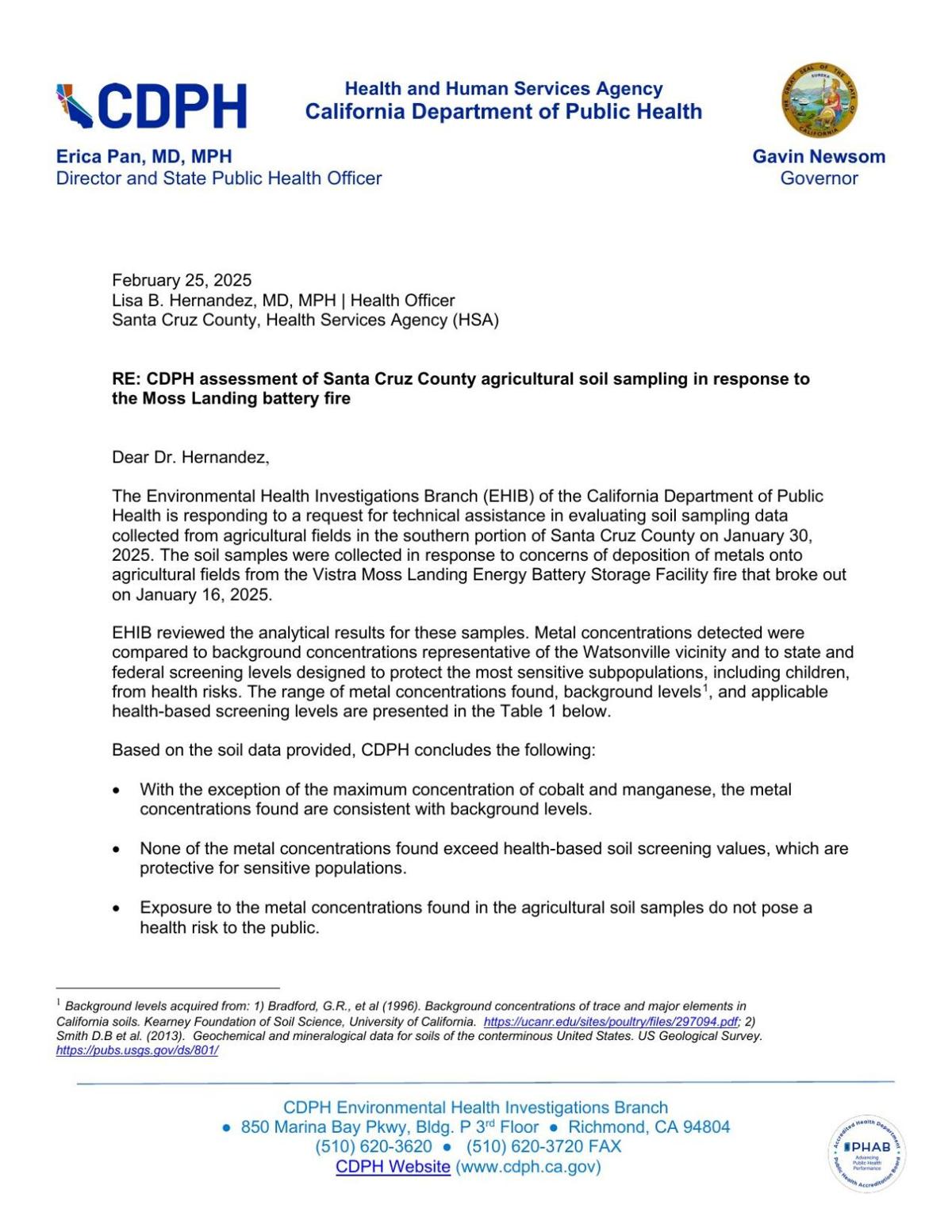
And on Feb. 25, the California Department of Public Health sent a letter to Santa Cruz County’s Health Services Agency to share the analysis of soil samples taken Jan. 30 in agricultural fields in southern Santa Cruz County. (You can read the letter below.)
Its topline findings are that, “with the exception of the maximum concentration of cobalt and manganese, the metal concentrations found are consistent with background levels; none of the metal concentrations found exceed health-based soil screening values, which are protective for sensitive populations [and that] exposure to the metal concentrations found in the agricultural soil samples do not pose a health risk to the public.”


(0) comments
Welcome to the discussion.
Log In
Keep it Clean. Please avoid obscene, vulgar, lewd, racist or sexually-oriented language.
PLEASE TURN OFF YOUR CAPS LOCK.
Don't Threaten. Threats of harming another person will not be tolerated.
Be Truthful. Don't knowingly lie about anyone or anything.
Be Nice. No racism, sexism or any sort of -ism that is degrading to another person.
Be Proactive. Use the 'Report' link on each comment to let us know of abusive posts.
Share with Us. We'd love to hear eyewitness accounts, the history behind an article.