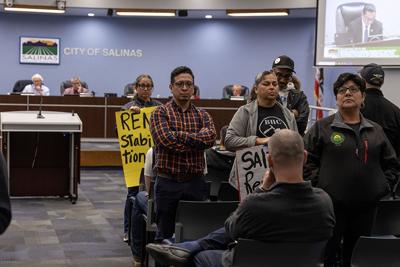

It was an emotional night at a Salinas City Council meeting on Tuesday, May 13. Dozens of people from a range of lived experiences—farmworkers, teachers, teenagers, doctors, most of them renters—shared their experiences how hard it was to make ends meet or collect enough money to pay their rent. They spoke about working 16 hours per day, subleasing, or deciding whether to attend college or stay home to make sure their family will still have a home. They also advocated to delay a vote or review each of four recently adopted tenant protection ordinances, instead of rescinding them.
“Regardless of the decision you make today, this will be part of a story the community will remember,” said Jesus Estrada, a local organizer with the nonprofit Center for Community Advocacy.
Landlords also shared stories about how it was hard for them to keep up with increasing costs of repairs, utilities and insurance, as well as struggles to evict tenants so a relative in need of a home could live there instead. Some also advocated for a rental assistance program.
Dozens of people showed up with signs for and against keeping the ordinances in place. Among the dozens of people who spoke up during the meeting were former councilmembers Carla Viviana González, Anthony Rocha and Orlando Osornio, who voted in favor of the ordinances.
“My hope is this City Council majority will do what you all ran on—which is seeking compromise, bringing people together and identifying an approach that does work for people—there can be common ground found, and I hope you all will do that on behalf of the residents you serve,” Rocha said.
Ultimately council proceeded with the direction they had given in April, voting 5-2 vote to repeal four ordinances. They are a rental registry, creating a database of all rental units in Salinas; rent stabilization, capping annual rent increases at 2.75 percent; tenant protection and just cause eviction; and a tenant anti-harassment ordinance. The opposing votes were councilmembers Andrew Sandoval and Tony Barrera; both voted in favor of these ordinances, and are the only two remaining members of that previous council.
Before the council did roll call to vote, councilmembers gave comments to explain their reasoning. During those remarks, several people in the chamber, angered by the remarks of Aurelio Salazar, Jr., Gloria De La Rosa and Jose Luis Barajas, turned their back to the council. Some people shouted, "Vote them out!"
De La Rosa and Bajaras said the city needs more housing to fix the housing woes the city is experiencing.
“We should not be forcing these small mom-and-pops out of renting their units again due to a well intended but poorly drafted ordinance,” Salazar said of the rent stabilization policy, saying it doesn’t take into account rising costs for landlords.
“They're not asking for charity. They're not asking for welfare, Section 8. They're asking for something fair,” Barrera said.
Barrera made a substitute motion to direct staff to return in five months with data and recommendations to revisit the rent stabilization ordinance, with meetings with stakeholders and the community members about this topic in between. That motion was rejected 5-2 and instead the vote to reject the four ordinances moved forward.
“Good policy has to work over the course of time. In my mind, it was clear this was not not a sustainable policy, and that it was important to be addressed sooner rather than later," said Mayor Dennis Donohue.
Adam Pinterits from the Monterey County Association of Realtors said since the ordinances became effective in January, properties for sale have increased in the city, especially in East Salinas. “We need to build our way out of the housing crisis," he said. "We cannot regulate our way out of it, because regulations do not create housing and regulations do not actually lower any rents.”
One point of contention was whether Salinas’ tenant protection and just cause eviction ordinance is unconstitutional. City Attorney Chris Callihan said the ordinance still stands since it was adopted last year, despite a press release by a property manager claiming a court has ruled Salinas' ordinance unconstitutional. “No court has found them to be either unconstitutional or illegal," Callihan said. "The city has not been put in a position since the adoption of these ordinances to defend any of these ordinances.”
Callihan added he reviewed the documents in the unlawful detainer case at issue. “It does not show up in the court's order as being a reason for the decision that they made, which was a procedural decision and not a legality decision,” he said.
The repeal will come back to council for a second vote to codify the decision on Tuesday, June 3. If the council moves forward, it will be effective 30 days later, on July 3.


(1) comment
One interesting 'feature' of the open months of discussion is that owners of houses in Salinas now cannot sell a house if the tenant does not want to leave and the seller cannot find a buyer who wants a tenant. This now seriously limits the seller’s rights and first time new home ownership as that home gets sold to an investor (instead of potentially to a first time home buyer) and as laws, rules, ordinances and regulations become more egregious/expensive fewer small business/family property owners will remain in the market. Housing will become more and more corporate owned. The multi unit (duplex or above) rental registration fees are exceptionally high at $170 per rented unit per year. This is not $170 for the whole building but $170 per individual rented unit in the building. In practice this means with the new annual rent control limit of 2.75% it will likely take three months of an average rent increase of approximately $55/month just to clear this new annual fee. Three months of the annual rent increase will not go to increased maintenance, insurance costs and other costs but will go to the city of Salinas to only cover this new regulatory expense. Potential landlords have already indicated they do not see Salinas as a good or even viable investment for them which again will bode well for corporate ownership. I would like to request the mayor to ensure there is accountability and transparency with how these fees are spent and this annual fee does not become another ever increasing larger burden in the time to come.
Welcome to the discussion.
Log In
Keep it Clean. Please avoid obscene, vulgar, lewd, racist or sexually-oriented language.
PLEASE TURN OFF YOUR CAPS LOCK.
Don't Threaten. Threats of harming another person will not be tolerated.
Be Truthful. Don't knowingly lie about anyone or anything.
Be Nice. No racism, sexism or any sort of -ism that is degrading to another person.
Be Proactive. Use the 'Report' link on each comment to let us know of abusive posts.
Share with Us. We'd love to hear eyewitness accounts, the history behind an article.