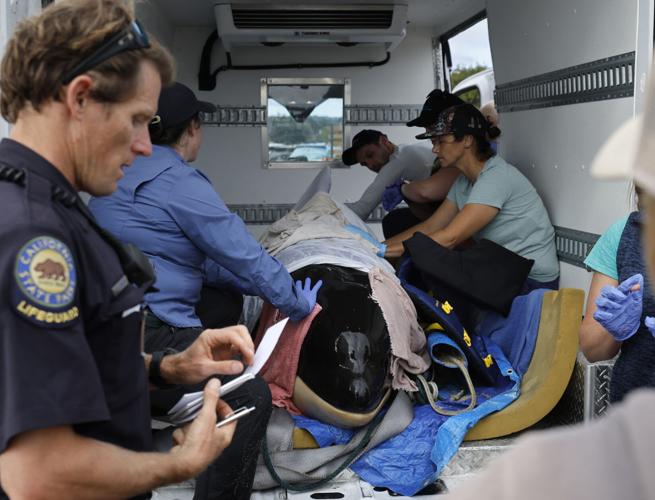


A stranded killer whale rescued at Carmel River State Beach on Tuesday, Sept. 10, died while in transport to Santa Cruz’s Long Marine Laboratory.
Around 9am Tuesday, highly trained personnel from the Marine Mammal Center arrived at the beach to assess the orca after receiving a call from beachgoers about an hour earlier. The orca, a female, is thought to be around 6 months old based on its size, which is measured to be around 10 feet long. The orca was on the beach for more than nine hours as a multi-agency response was underway to monitor and decide on the best response.
“They’re going to do a necropsy today [Sept. 11],” says NOAA Fisheries spokesperson Michael Milstein, who oversaw communications on the joint response, “as well as examine the carcass to determine if it was the stress of being stranded for that long, or if there was something underlying.”
The transportation required attention from California State Parks, the Marine Mammal Center and Long Marine Lab to manage the delicate operation. A bulldozer was needed to lift the animal from the shore and place it into a pickup truck, which then transferred it into an air-conditioned van for further transportation.
Bystanders watched as volunteers and Marine Mammal Center staff were dumping buckets of water over the animal to keep cool, breaking out in applause as the orca was lifted successfully into the pickup truck around 5:30pm.
Wendy and John England, a couple visiting from Colorado, had been at the beach for much of the day. Earlier in the morning, they recalled seeing a group of motorcyclists trying to help the animal by pushing it back into the ocean.
“It literally looked like a movie scene,” Wendy England says. “Everybody just wanted to come and help.”
Marine Mammal Center staff say that while these efforts are well-intentioned, they can do more damage than good.
“At that age, they are not independent enough to forage for themselves and hunt for themselves, and they're social animals, so they need to have the family dynamic. Releasing that animal solo back out into the water is not an ideal situation,” says Monique King of the Marine Mammal Center.
Orcas are the largest species in the dolphin family. King adds that if orcas are rolled onto their blowhole, they can suffocate.
While found all over the world, it is not uncommon to see orcas off the coast of California. Typically they are seen in groups traveling together and feeding off a variety of different fish species. They are apex predators, and serve an important role in maintaining marine ecosystems everywhere.
Nancy Black, CEO of the California Killer Whale Project, a nonprofit that studies local populations to help conservation efforts, says that their group has identified about 180 different killer whales in the area. They identify the animals by the marking on their dorsal fin and saddle patch, an area on their back below the dorsal fin.
“We saw a group on Saturday [Sept. 7], and this is not one that was in that group,” Black says.
In her 30 years observing these animals, Black says she had never seen a stranding like this, where the animal is alive.
The Long Marine Lab in Santa Cruz was determined to be the best place for the orca as it was the closest place with a pool big enough to hold such a large animal, Marine Mammal Center staff say.
If successfully transported, the intent was that blood tests would be conducted and the orca would be monitored and evaluated to determine the best next steps. The Marine Mammal Center, which typically responds to rescues for animals like seals, sea lions and otters, has smaller holding pools.
“We're not unfamiliar with responding to different types of dolphins and smaller species. This is probably the biggest one that I've responded to,” King says.
Stranded orcas, she confirms, are rare.
If you see a stranded animal on the beach, call the Marine Mammal Center hotline at 415-289-SEAL.
Katie Rodriguez is a California Local News Fellow.


(0) comments
Welcome to the discussion.
Log In
Keep it Clean. Please avoid obscene, vulgar, lewd, racist or sexually-oriented language.
PLEASE TURN OFF YOUR CAPS LOCK.
Don't Threaten. Threats of harming another person will not be tolerated.
Be Truthful. Don't knowingly lie about anyone or anything.
Be Nice. No racism, sexism or any sort of -ism that is degrading to another person.
Be Proactive. Use the 'Report' link on each comment to let us know of abusive posts.
Share with Us. We'd love to hear eyewitness accounts, the history behind an article.