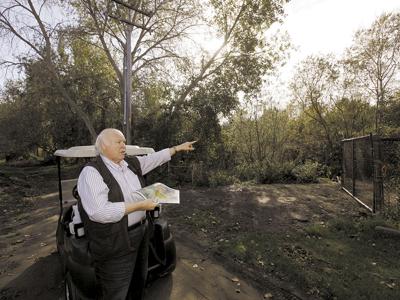

A Sixth District appellate judge handed a complete victory to the developers of a proposed Rancho Cañada housing subdivision in Carmel Valley, defeating the Carmel Valley Association, which had won its lawsuit in a lower court.
The ruling, issued on Wednesday, May 19, in essence tells Rancho Cañada Venture, LLC, that it can build a 130-unit housing project with 20-percent affordable housing based on approval by the Monterey County Board of Supervisors in December 2016.
"We are obviously disappointed," CVA President Pris Walton said in a written statement. "We believe strongly in good planning and affordable housing. The problem here was that the developer claimed that it was not economically feasible to build affordable housing and the county did not mandate the required affordable housing.
"This is a pity as anyone can now claim the same, hurting our collective efforts to create much needed affordable housing," Walton writes.
The ruling, written by Judge Franklin D. Elia, is also a win for Monterey County. CVA contended in its original 2017 lawsuit and a cross-appeal filed later that county officials violated their own affordable housing ordinance and had not established a promised Development Evaluation System in a timely manner.
Elia reversed the judgement of Monterey County Superior Court Judge Lydia Villarreal who in 2018 who ruled the county needed to set aside its approval of the 130-unit Rancho Cañada Village development. The appellate decision also reverses her ruling that the county needed to amend its affordable housing ordinance.
Rancho Cañada developers appealed, contending that Villarreal ruled in error that the project description for the development, as well as an analysis of the alternatives outlined in the environmental impact report, did not comply with California Environmental Quality Act, or CEQA. The developers also argued that Villarreal was wrong in ruling that the county approved moderate-income inclusionary housing without supporting substantial evidence.
The county also appealed the lower court ruling, arguing that the trial court was wrong stating the county had failed to amend its inclusionary housing ordinance to be consistent with its general plan. Villarreal had called it "arbitrary and capricious."
"We're still analyzing the full impact of the ruling but we're very pleased with the outcome," Monterey County Counsel Les Girard said in a statement.
It's unclear how the appellate court decision will impact the project now before the Monterey County Planning Commission, which now proposes making 28 percent of units affordable housing as opposed to 20 percent, after CVA negotiated with developer Alan Williams.
Commissioners heard several hours of testimony and discussed the project on May 5 but declined to take a vote that day, saying they needed more time. The matter is set to come back to the commission for a vote on June 9.
"CVA believes it has been instrumental in increasing the percentage of affordable units in the project from 20 percent to 28 percent," Walton states. "Although we did not win the lawsuit, we expect to continue working with the Rancho Cañada team on the affordable housing aspects of the project."
The CVA board is also evaluating next steps, including possibly appealing to the California State Supreme Court. Walton states they are still reviewing the opinion with their attorneys.
Williams did not return phone calls requesting comment.
Should developers stick with the 28 percent agreement, it would mean 40 new affordable rental units intended for workforce and service employees. "Carmel Valley deserves a high-quality affordable housing project that meets local socio-economic needs," Walton states.
The project has been in contention since 2008 when a draft EIR showed plans for 281 units, with 182 single-family homes, 64 townhomes and 35 condominiums. Half of all units, 140, would be deed-restricted affordable and workforce housing units, with the rest at market rate. The project also promised neighborhood parks and 39 acres of permanent open space.
The project was put on hold in 2009 as the county was preparing to amend its general plan. When that took effect in 2010, the new plan included changes to the Carmel Valley Master Plan that would only allow 266 new units total in the entire valley. The plan also called for requiring 25-percent affordable units for all new developments in the region.
CVA sued the county over the new general plan, and that litigation ultimately resulted in a settlement allowing only 190 total new units in Carmel Valley.
That left the Rancho Cañada Village developer Williams with a dilemma: Either start over with the EIR or push ahead with fewer units. He decided on the latter, proposing 130 units with 20 percent of them affordable, arguing the project would not be economically viable beyond that percentage.
The Planning Commission voted in split decision of 4-3 to approve the project in November 2016, followed by a 4-0 approval from the Board of Supervisors the next month.
When CVA sued a month later over that approval, the group contended that the county should have required a new EIR. Villarreal agreed. CVA also argued that the project should have included at least 25-percent affordable units.


(0) comments
Welcome to the discussion.
Log In
Keep it Clean. Please avoid obscene, vulgar, lewd, racist or sexually-oriented language.
PLEASE TURN OFF YOUR CAPS LOCK.
Don't Threaten. Threats of harming another person will not be tolerated.
Be Truthful. Don't knowingly lie about anyone or anything.
Be Nice. No racism, sexism or any sort of -ism that is degrading to another person.
Be Proactive. Use the 'Report' link on each comment to let us know of abusive posts.
Share with Us. We'd love to hear eyewitness accounts, the history behind an article.