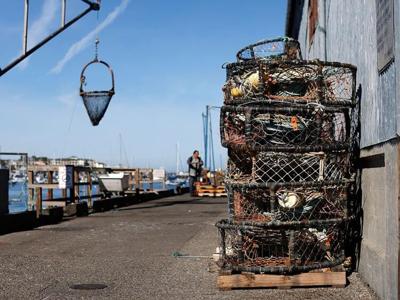

‘Tis a crabless Christmas season this year, again.
Today, Dec. 6, the California Department of Fish and Wildlife announced that the commercial Dungeness crab fishery will remain closed across the state through the remainder of the year in order to prevent whales, who are still feeding off the California coast in large numbers, from getting entangled in crab fishing gear.
In 2024, at least 34 whale entanglements, mostly humpbacks, were confirmed off the U.S. West Coast—the highest in six years—according to preliminary data from NOAA Fisheries. Additionally, a critically endangered Pacific leatherback sea turtle died last December after becoming entangled in crab fishing gear. With their populations so low, the loss of even one leatherback is a significant setback for the species' recovery.
Of all commercial fishing gears on the U.S. West Coast, the California Dungeness crab fishery is associated with the most confirmed entanglements.
“Part of the reason for that is, it's not necessarily that a single crab trap is more dangerous than a single other kind of trap,” says Dr. Geoff Shester, Oceana’s California campaign director and senior scientist. “It’s because in California, there's a lot more Dungeness crab traps than there are anything else.”
Historically the season off the central and southern California coasts began on Nov. 15 and the northern region would open on Dec. 1.
Interestingly, CDFW reported more whale entanglements in unidentified fishing gear—suspected to be California Dungeness crab gear—than in confirmed California commercial Dungeness crab gear.
About 75 percent of reported whale entanglements are fatal, according to the National Marine Fisheries Service, as whales can drag with them heavy fishing gear for months at a time, impacting their ability to dive and feed. As a result, this can lead to starvation, infections, damaged flukes, or even drowning due to severe injuries.
“It’s time to acknowledge that the current management system isn’t working,” said Shester in a press release. “Stronger pre-emptive actions along with gear marking, electronic vessel tracking and authorization of innovative pop-up fishing gear for large scale springtime use across California’s commercial Dungeness crab fleet is the ‘win-win’ for the future of the fishery and whales.”
Following a lawsuit from the Center for Biological Diversity in 2018 and new regulations restricting crabbing during the season, pop-up fishing gear, or “ropeless” crab traps have been pushed forward as a way to prevent these entanglements while still enabling fishers to fish for Dungeness crab.
So far, ropeless crab traps have been primarily experimental, requiring fishers to have a permit. These traps store the fishing line and the buoy with the crab pot until fishers send out an acoustic signal causing the buoy to “pop-up.”
The trial so far has proven successful, reports the CDFW, where the pop-up fishing gear was tested by 19 commercial California Dungeness crab fishermen who showed a 98-percent success rate in gear retrieval, landing a total of 292,000 pounds of crab (valued at $1.5 million).
“The whole test is a complete success: crabbing in the spring again in front of home, no dirty buoys to clean,” said Half Moon Bay crab fisherman Steve Melz in a press release, “not to mention the better price that is paid for the crabs.”
Next week, the California Fish and Game Commission is considering an expanded fishing permit, allowing more ropeless fishing gear to be tested next spring.


(0) comments
Welcome to the discussion.
Log In
Keep it Clean. Please avoid obscene, vulgar, lewd, racist or sexually-oriented language.
PLEASE TURN OFF YOUR CAPS LOCK.
Don't Threaten. Threats of harming another person will not be tolerated.
Be Truthful. Don't knowingly lie about anyone or anything.
Be Nice. No racism, sexism or any sort of -ism that is degrading to another person.
Be Proactive. Use the 'Report' link on each comment to let us know of abusive posts.
Share with Us. We'd love to hear eyewitness accounts, the history behind an article.