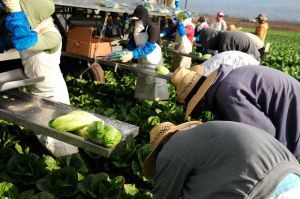

One trip through the Salinas Valley is enough to tell you that agriculture here is big: Ribbons of green streak for miles in all directions, and the smell of freshly cut broccoli or onions permeates the air.
A new report, released June 30 by the Monterey County Agricultural Commissioner 's office, puts a number to just how big the local agriculture industry is.
Ag Commissioner EricLauritzen and his staff tally the value of crops themselves each year. (In 2013, crop values approached $4.4 billion; the 2014 data will be published next week.)
But this analysis, competed by Middlebury Institute economists Fernando DePaolis and Jeff Langholz, calculates the economic impact of agriculture and ancillary industries, like packaging and trucking. The total annually: $8.1 billion.
That's down just slightly from three years ago, when DePaolis and Langholz co-authored the first study of its kind, showing an annual impact of $8.2 billion.
The report also found the industry and supporting industries provide the equivalent of 76,000 full-time jobs, more than one in four jobs in the county. (And because the study doesn't account for part-time or seasonal work, it's likely to represent even more workers than jobs.)
“Agriculture remains by far the largest single economic driver in this county,” Jim Bogart of the Grower-Shipper Association said at a press conference Tuesday morning releasing the study results. "I hope we can keep it that way."
One unknowable factor is a precarious labor situation, with federal lawmakers stalling on comprehensive immigration reform, and a current labor shortage leaving some local growers more reliant on contract labor than in the past.
The study was commissioned by Lauritzen for $16,500, and it tells the story of a diversified, resilient industry. The county grows more than 200 different crops, and 40 of them exceed $10 million a year in value.
While strawberries and lettuce get a lot of love around here, carrots are also a $10 million crop.
“We view diversity as an insurance policy against economic shocks,” Langholz said.


(0) comments
Welcome to the discussion.
Log In
Keep it Clean. Please avoid obscene, vulgar, lewd, racist or sexually-oriented language.
PLEASE TURN OFF YOUR CAPS LOCK.
Don't Threaten. Threats of harming another person will not be tolerated.
Be Truthful. Don't knowingly lie about anyone or anything.
Be Nice. No racism, sexism or any sort of -ism that is degrading to another person.
Be Proactive. Use the 'Report' link on each comment to let us know of abusive posts.
Share with Us. We'd love to hear eyewitness accounts, the history behind an article.