
Nearly a decade ago, a deadly outbreak of E. Coli linked to bagged spinach grown and processed on the Central Coast sickened more than 205 people and killed three.
The outbreak triggered some major changes to farming and food safety practices, originating on Salinas Valley farm fields.
Growers formed the Leafy Greens Marketing Agreement, a voluntary set of guidelines designed to prevent pathogens from coming into contact with salad greens.
Those guidelines are largely based on common sense: Ensure there are enough portable toilets and sinks for field workers at their work sites; don't pick salad greens from a flooded area; don't apply raw animal manure as compost.
The guidelines also call on growers to minimize intrusion of wild animals—rodents, rabbits, deer, birds—onto their fields.
In an outdoor system, it's impossible to ensure 100 percent, but many farms have responded by clearing vegetation adjacent to their fields.
Removing nearby animal habitat, the thinking goes, helps minimize the risk of animals walking into an agricultural field, pooping there, and contaminating a crop.
It's led to what some critics call a "scorched-earth" approach to food safety.
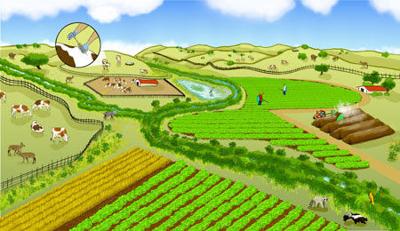
Growers have built fences, installed traps and cleared vegetation, all in an effort to keep wildlife away from crops.
But a new study, published Monday in the scientific journal Proceedings of the National Academy of Sciences, throws a wrench in that conventional wisdom.
Not only is the practice not helping food safety, the study says, but it might even be hurting.
Researchers at UC Berkeley analyzed more than 250,000 surveys of crops, irrigation water and rodents, looking at pathogen testing results taken from samples on 295 farms in the U.S., Mexico and Chile since 2007.
They found that since the '06 outbreak, the prevalence of pathogenic E. coli in leafy green vegetables has increased. The greatest increases in pathogenic E. coli and Salmonella were found on farmers that had removed the most vegetation.
"These findings contradict widespread food safety reforms that champion vegetation clearing as a pathogen mitigation strategy," according to the study. "More generally, our work indicates that achieving food safety and nature conservation goals in produce-growing landscapes is possible."
The study authors recommend leaving strips of vegetation between grazed land and cropland.
"Clearing surrounding vegetation is a costly, labor-intensive practice that threatens wildlife habitat," Daniel Karp, lead author and a post-doc research fellow in UC Berkeley's Environmental Science Department, said in a statement. "Since it does not improve food safety, there is no reason to continue this practice."
Large-scale vegetation clearing comes from pressure from risk-averse wholesale buyers, not the actual leafy greens guidelines themselves. According to the study, "Despite the lack of explicit regulatory language calling for its removal, a significant amount of the Salinas Valley’s non-crop vegetation has been cleared."
Karp and fellow researchers found that one factor that did correspond to a higher risk of pathogens was grazing land within 1.5 kilometers of a field. They advise planting vegetables that are cooked before eating—like artichokes or corn—in between grazing land and fields of leafy greens, which are generally eaten raw.


(0) comments
Welcome to the discussion.
Log In
Keep it Clean. Please avoid obscene, vulgar, lewd, racist or sexually-oriented language.
PLEASE TURN OFF YOUR CAPS LOCK.
Don't Threaten. Threats of harming another person will not be tolerated.
Be Truthful. Don't knowingly lie about anyone or anything.
Be Nice. No racism, sexism or any sort of -ism that is degrading to another person.
Be Proactive. Use the 'Report' link on each comment to let us know of abusive posts.
Share with Us. We'd love to hear eyewitness accounts, the history behind an article.