
The story of the mural began about 10 years ago, hatched from the mind of Monterey resident Richard Rucello, an active member of the city's Neighborhood Improvement Program.
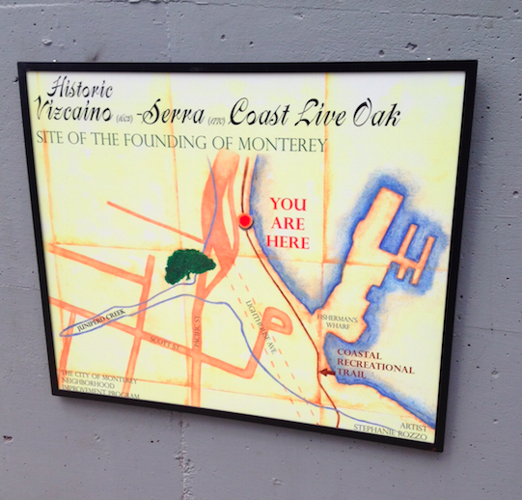
The subject of the mural—which is located on the Rec Trail just below Heritage Harbor—has a story that goes back more than 400 years.
In 1602, when Spanish explorer Sebastian Vizcaino came to Monterey (which he named to honor Spain's Count of Monte Rey), the friars that joined him held a mass under a stately oak tree on a creek by the coast. As part of the ceremony, Vizcaino claimed Monterey for Spain.
The tree, which has since become known as the Vizcaino Oak, was next seen by westerners in 1770 with the arrival of Junipero Serra and Gaspar de Portola. Again, a mass was held beneath the tree, and again, Monterey was claimed for Spain.
The tree was damaged by lightning in 1840, but it ultimately died when nearby construction caused the creek to flood the oak's roots. After eventually washing into the bay, portions of the tree were pulled from the sea after fishermen and displayed San Carlos Church.
After its death, a 1904 newspaper article stated, "The old tree, which stood for so long as a living monument commemorating the coming of Vizcaino [1602], . . . and of Serra, the man who brought [western] civilization to the American far west."
An article in 1905 said this of the iconic oak: "The old tree is probably the most noteworthy of California's landmarks."
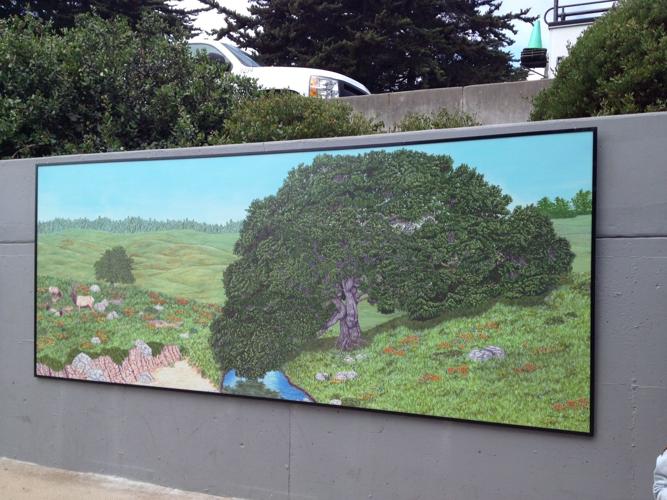
For years, the tree may have been unknown to many locals, but with the striking mural that now lines the Rec Trail, the Vizcaino Oak is landmark once again.
The mural was fabricated from a painting by Monterey artist and scientific illustrator Stephanie Rozzo, who worked with various experts to get the details right.
"The mural really is depicting what it would have looked like back when [Serra and Portola] saw it," Rozzo says. "It is a little bit idealized, but being a scientific illustrator, i tried to keep it as accurate as possible."
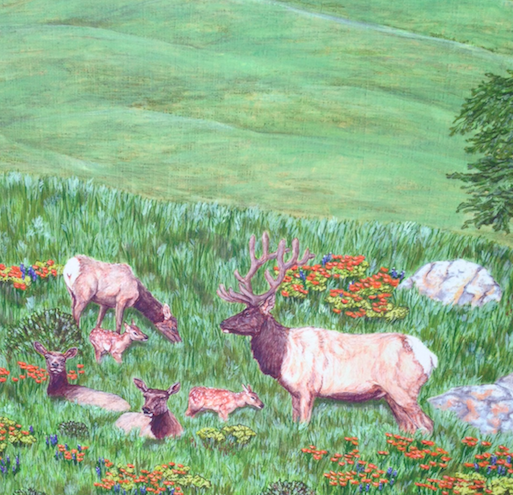
Those accuracies include tree details, what plants would have been there at the time and which animals. (The mural shows a few tule elk grazing across the creek from the tree.)
The project, paid for by the city's NIP fund, was budgeted to cost $60,000, but Monterey City Engineer Steve Wittry estimates the final cost at $37,000.
The mural—which is affixed to a retaining wall, not painted onto it—was fabricated onto a material that is said to be graffiti-proof.
To see remnants of the original tree, head to the Heritage Center Museum of the Royal Presidio Chapel, which has a portion of the trunk on display.


(0) comments
Welcome to the discussion.
Log In
Keep it Clean. Please avoid obscene, vulgar, lewd, racist or sexually-oriented language.
PLEASE TURN OFF YOUR CAPS LOCK.
Don't Threaten. Threats of harming another person will not be tolerated.
Be Truthful. Don't knowingly lie about anyone or anything.
Be Nice. No racism, sexism or any sort of -ism that is degrading to another person.
Be Proactive. Use the 'Report' link on each comment to let us know of abusive posts.
Share with Us. We'd love to hear eyewitness accounts, the history behind an article.