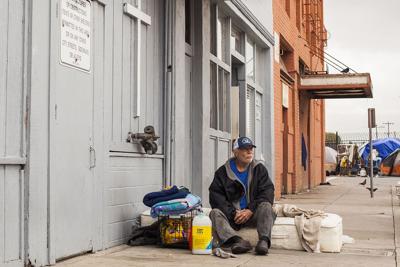

If you had the feeling over the past two years that there are more homeless people walking the streets and more tents popping up near roadways, it’s not your imagination.
Homelessness in Monterey County increased by 23 percent since 2015, according to the biannual point-in-time homeless count conducted on Jan. 25 by the Coalition of Homeless Service Providers.
The total number of homeless counted in shelters, cars, trailers, tents and other places considered not meant for human habitation was 2,837 people on that winter day—the largest number recorded in the past 10 years, according to information released by the coalition on June 23.
The cities with the biggest increase included Salinas, Marina and Del Rey Oaks.
The count does not factor in individuals who are couch surfing or packing into apartments and homes with multiple people, and captures only the homeless population visible to volunteers on one day—the nature of the "point-in-time" count.
The big jump in part is attributed to a focus on counting youth homelessness. The U.S. Department of Housing and Urban Development, which dictates how point-in-time surveys are conducted, required that agencies focus on intensive counts of youth this year, says Katherine Thoeni, the coalition’s executive officer.
The number of people under the age of 25 counted was 598, with 25 percent of them under the age of 18.
Of the total counted, 17 percent were under the age of 18, 16 percent were 18-24, and 67 percent were age 25 and above. The largest percentage age group was 41-50 years old, at 27 percent.
The percentage of homeless people over 50 did not change from the 2015 survey, with 15 percent between the ages of 51 and 60, and 8 percent 61 percent and above.
However, according to advocates of housing for older adults a targeted count specifically for that age group is urgently needed in Monterey County. They say that anecdotally they’ve seen the number of homeless, or near-homeless, increase in recent years.
Another significant number: 83 percent of all those surveyed claimed Monterey County as their residence before becoming homeless. Sixty-eight percent said they cannot afford to rent in the county, and 55 percent said they were experiencing a lack of employment or income.
About 43 percent said that financial issues forced them into homelessness, another 38 percent said alcohol or drug abuse, 24 percent said a fight or conflict precipitated their circumstances, and 20 percent blamed divorce, with another 20 percent citing legal issues. Only 15 percent said that mental issues were to blame.
Sixty-one percent of those counted were men, 37 percent women and 2 percent identified as transgender, according to the census data. The largest ethnic group represented was Latino at 45 percent, according to the data collected, 33 percent of those counted were white, 10 percent black and 8 percent multi-racial.
Of the total counted, 74 percent of the individuals were unsheltered, an increase of 71 percent since the last count in 2015. Of those, 10 percent were living in encampments, 32 percent in vehicles, 25 percent on the street and 7 percent in abandoned buildings.
If there was any good news in the report, they coalition reports a 22-percent decrease in the number of homeless veterans counted. The agency attributes that to a national effort to help veterans through the Supportive Services for Veteran Families rapid re-housing and homeless prevention funding, as well as a joint HUD-VA Supportive Housing program.
The count also found that the number of people considered chronically homeless remained about the same from 2015.
The coalition is presenting the full report at the County Board of Supervisors Tuesday, June 27, and the takeaway will be that increasing rents and low vacancy rates is making it difficult for those near the bottom of the economic scale to find affordable places to live.
“Social Security or disability income doesn’t begin to pay for a small apartment in our community,” Thoeni said in a statement. “A person has to work more than two full-time minimum wage jobs just to live here. We can, and should, do better.”
She said the long-term solution is going to take a “concerted multi-jurisdictional strategy to significantly increase the stock of affordable and safe housing,” as well as addressing the challenges of offering homeless services.
The full report will be available on the coalition’s website on June 27.


(0) comments
Welcome to the discussion.
Log In
Keep it Clean. Please avoid obscene, vulgar, lewd, racist or sexually-oriented language.
PLEASE TURN OFF YOUR CAPS LOCK.
Don't Threaten. Threats of harming another person will not be tolerated.
Be Truthful. Don't knowingly lie about anyone or anything.
Be Nice. No racism, sexism or any sort of -ism that is degrading to another person.
Be Proactive. Use the 'Report' link on each comment to let us know of abusive posts.
Share with Us. We'd love to hear eyewitness accounts, the history behind an article.