
Anticipating a possible surge in Covid-19 cases, Monterey County announced on April 14 where it might set up field hospitals for patients and temporary shelters for the homeless. Among the selected sites are the Monterey County Fairgrounds, Laguna Seca Recreation Area, and Joby Aviation’s property at the Marina Airport.
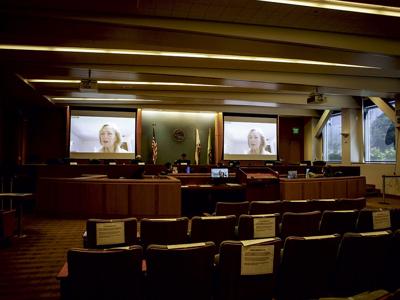
This announcement was part of the county’s coronavirus Care and Shelter Strategy, unveiled by the Emergency Operations Manager Gerry Malais. “We are in the deep throes of the planning effort,” he told the Board of Supervisors over video.
By coincidence, Malais’ office had a head start. That’s because, about six months ago, the county finalized a 200-page emergency care and shelter plan. “This is not something we had to come up with all of a sudden,” Malais said.
True enough. But a review by the Weekly of the county’s emergency preparedness more broadly reveals that several aspects of planning are up to a decade old and some areas do not appear to have been addressed at all.
The master document, known as the Emergency Operations Plan, was completed in 2014 and is due for an update this year. A county website says the plan should come with 25 annexes plus seven incident response plans; these supplements should specify how the county would handle various scenarios and challenges such as logistics, continuity of government and active shooter situations. But only six of the 32 supplements have been completed since 2014. The rest are outdated and unavailable online, or nonexistent.
"You would be hard-pressed to find any emergency agency in the country that has enough staff and funding to keep all their plans comprehensively up to date," Malais says. "But we are in a lot better shape now than we were three years ago."
Two supplements relevant to the current outbreak: the Pandemic Flu Incident Response Plan and the Mass Fatality Annex. The Weekly filed a request under the California Public Records Act for these reports. Many other regions in the country have refused to release such reports, but local authorities did so promptly. Experts say that making emergency planning documents available is important for improving public trust during a crisis.
Here’s what the county provided.
One report is a 23-page Pandemic Influenza Plan, updated in 2013, a few years after the H1N1 flu pandemic, which claimed nearly 12,500 lives in the United States. The plan provides guidance to only one county agency, the health department. The report asks, Is the department prepared?
“The simple answer is NO,” comes the response, “because few can ever be fully prepared. However, the more accurate answer is that we are more prepared today than we were yesterday, but not as prepared, as we will be tomorrow.”
At 276 pages, the other plan is much more comprehensive. It’s titled, Monterey County Catastrophic Incident Mass Fatality Plan, and it dates to 2010. One of the mass death scenarios that’s examined is an outbreak of a novel flu strain. The report foreshadows the current moment with a focus on how hard it would be to function under “social distancing” orders.
The first sentence of the section is “A severe pandemic influenza would result in a massive number of fatalities in Monterey County and the Bay Area region.” How many fatalities to plan for? The scenario selected by the report is the influenza of 1918, which suggests a mortality rate of 2 percent. In Monterey County, the report assumes that 1,600 people die over nine to 10 months.
If that happens, the implications are enormous. “The coroner, health care facilities, and the death care industry are overwhelmed and their resources quickly become exhausted,” the scenario in the report says. “They struggle to provide a minimum level of service.”
As a result, authorities might be compelled to ban funeral services. They would also have to consider digging mass graves and changing the laws to allow mass cremation, according to the report. Ice rinks might have to be used for temporary storage of dead bodies.
“With proper preparation, ice rinks and similar facilities are [options] for alternative temporary storage,” the scenario anticipates. “When using ice to lower the temperature of remains, it is important to ensure the remains are kept above freezing temperatures and not in direct contact with the ice to avoid disfiguring skin features used to identify the deceased.
“Social customs and perceptions, however, make it likely that once a community uses a facility to store human remains, it will no longer use the facility for its original purpose.”
In summary, the planners wrote, “Adoption of select Altered Standards of Death Care may disrupt culturally accepted means of processing decedents.”
To be clear, the mortality rate of Covid-19 in Monterey County is nowhere near reaching the 1,600 dead in the mass fatality plan. Of the 100 local confirmed coronavirus cases so far, there have been only three deaths.
Part of the reason that the two pandemic-related reports are seven and 10 years old is that the focus of emergency planners has been on dangers that seemed more pressing: power outages, sea-level rise, wildfires.
The county is in the process of updating its Multi-Jurisdictional Hazard Mitigation Plan, the most recent version of which came out in 2016; pandemic and infectious diseases are not considered at all in the plan. In preparing for an update due by next year, officials identified 12 potential hazards: agricultural, climate change/sea level rise, coastal erosion, dam failure, drought, earthquake, flood (including coastal storms), hazardous materials event, landslide, tsunami, wildland and fire windstorm. A pandemic is not among them.
“We are working on some plans right now that Covid-19 interrupted,” Malias says, pointing to areas like family assistance, community resilience, drought resilience, and financial recovery. “These plans are all in the works. A lot of dedicated people at the Office of Emergency Services are working hard on a complete cadre of up-to-date plans.”


(1) comment
We are way overboard on the figures they were wrong to begin with and have been adjusted downward nearly every couple of weeks. Rather than 2% deaths it is really closer to .01, but who knows for sure?
Welcome to the discussion.
Log In
Keep it Clean. Please avoid obscene, vulgar, lewd, racist or sexually-oriented language.
PLEASE TURN OFF YOUR CAPS LOCK.
Don't Threaten. Threats of harming another person will not be tolerated.
Be Truthful. Don't knowingly lie about anyone or anything.
Be Nice. No racism, sexism or any sort of -ism that is degrading to another person.
Be Proactive. Use the 'Report' link on each comment to let us know of abusive posts.
Share with Us. We'd love to hear eyewitness accounts, the history behind an article.