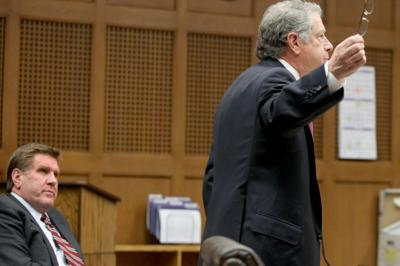
Monterey County Superior Court Judge Tom Wills was careful to spell the word “sole” to avoid any confusion with “soul,” the word people might more readily associate with the Roman Catholic Church. But at a Dec. 9 hearing, he was talking about how the California law treats churches as businesses with privacy rights, and he decided that privacy rights of Diocese of Monterey Bishop Richard Garcia aren’t enough to keep court documents from the public view.
“It’s a much larger organization than just a single individual,” Wills says. “This is not a small congregation meeting in a barn out in Prunedale.”
Wills ruled in favor of the Monterey County Weekly, which on Sept. 10 filed a motion to intervene in a 2011 civil lawsuit against the Diocese of Monterey and a former priest, Edward Fitz-Henry, seeking release of sealed documents. The plaintiff in that case, identified as John RJ Doe in his lawsuit, alleged that Fitz-Henry sexually abused him in Madonna Del Sasso church in Salinas beginning in 2005, when John Doe was a teen. Fitz-Henry later sued the diocese for throwing him under the bus.
Those two cases ultimately settled, but documents attorneys obtained in the course of those closed-door settlement talks have been secret, in keeping with an order Wills himself issued in 2011.
Of the decision to allow for the release: “It’s not been an easy decision to make,” Wills said.
Paul Gaspari, the attorney representing the diocese, argued Wills should protect the privacy of the church as if it were a single individual: “Whether it’s a megachurch down in Los Angeles on the 405, or a wandering church in Prunedale, those rights are significant, important.”
Wills wasn’t persuaded however, on the privacy grounds or any other arguments Gaspari raised. There was question about whether disclosing the confidential documents would be a matter of public good since Fitz-Henry is no longer with the diocese.
Roger Myers of San Francisco-based Bryan Cave LLP, representing the Weekly, said that’s irrelevant, and the matter at hand is about the institution’s response to allegations—not protecting potential victims from one alleged predator. “The public has an interest in knowing what the diocese knew, at what level, and what actions were taken,” Myers said.
Gaspari also argued that if the diocese had known earlier that the plaintiff would willingly hand over documents to the media, they might have been less generous with producing materials the plaintiff requested. “We might likely have adjudicated document by document, for fear that someday they might become part of the public record,” he said. Under Wills’ ruling, names and addresses of victims and witnesses will remain confidential.
Wills’ Dec. 9 ruling finalized a preliminary ruling issued last month, and allows for the release of documents beginning in 45 days to give Fitz-Henry and the diocese time to appeal to the Sixth District Court of Appeal in San Jose.
“We are seriously considering an appeal,” Gaspari says.
Fitz-Henry has never been convicted of, or charged with, any crime, which his attorney Daniel De Vries said was reason to keep the documents private. “There is no public interest because he wasn’t found to be guilty of anything,” De Vries said.
“If Father Fitz-Henry had been charged and convicted, I think the public has a huge interest in knowing that,” De Vries said. “But what if the man’s innocent? What if he’s as innocent as the driven snow? Then what?”
Myers argued Fitz-Henry’s innocence or guilt isn’t the matter at hand— the public’s right to know how the church handled allegations is. He cited a 2006 case in which the California Court of Appeal required the Dunsmuir Joint Union High School near Redding to turn over records on its handling of sexual harassment claims against a superintendent—despite that the superintendent was actually innocent.
Although neither law enforcement nor an internal diocesan investigation found evidence that John Doe’s complaints were true, the same internal investigation revealed a 1990 offense against two brothers at the Carmel Mission.
“Father Fitz-Henry didn’t have his day in court, didn’t have the ability to face his accuser and say, ‘This is ridiculous, I’m innocent, I didn’t do this,’” De Vries said.
Myers agreed that may be true, but that releasing the documents would only help Fitz-Henry prove that: “The public may say, ‘A good man was railroaded here.’ But they can’t know to make that determination unless they see [the documents].”


(0) comments
Welcome to the discussion.
Log In
Keep it Clean. Please avoid obscene, vulgar, lewd, racist or sexually-oriented language.
PLEASE TURN OFF YOUR CAPS LOCK.
Don't Threaten. Threats of harming another person will not be tolerated.
Be Truthful. Don't knowingly lie about anyone or anything.
Be Nice. No racism, sexism or any sort of -ism that is degrading to another person.
Be Proactive. Use the 'Report' link on each comment to let us know of abusive posts.
Share with Us. We'd love to hear eyewitness accounts, the history behind an article.