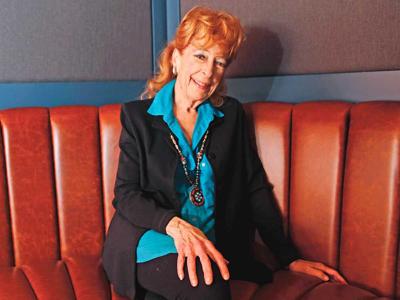

Jan Black had a zeal for life and activism, and relentlessly advocated for a more peaceful, understanding world. She pursued that mission and remained an optimist until she died at age 81 on Sunday, Aug. 15.
Black was an expert on Latin America, a peace activist, a dedicated Democrat involved in politics, a world traveler, and she was influential in the lives of hundreds of graduate students at the Middlebury Institute of International Studies, where she joined the faculty in 1991.
From MIIS, Black led regular international trips to destinations including Cuba (until travel restrictions prohibited that); Iran (forbidden by MIIS administrators, she went anyway—and told students if they wanted credit to register for independent study); Bhutan, just as it was opening for travel from the U.S.; Chile, where she had served in the Peace Corps; and representing Amnesty International to Taiwan where, in 1980, Black spoke out on behalf of an activist who’d been arrested for speaking at a human rights rally.
And it was at MIIS where Black launched the Jan Knippers Black Fund for Human Rights Protection in 2018, in a ceremony that at the time felt like an act of defiance. Black had cancer and her doctors told her she had only a little time left; the launch event, drawing some 200 people, felt in some ways like a memorial service for someone who is still alive—an opportunity to address countless admirers.
“My doctors have been telling me I’m living on borrowed time,” she told the audience. “I’m here tonight to embarrass the hell out of them.”
Black grew up in Tennessee in a political home, with a father who was, for a time, a state senator; she described her mother as a southern Belle. Black said she was shaped from an early age by her family: “It starts with a liberal family in an illiberal South."
Besides influencing her progressive politics, Black's southern upbringing was always apparent—she spoke with a southern drawl her entire life, and she was devoted to a particular look. She wore her red hair piled on top of her head and bold eye makeup even as she became ill in her later years, always dressed and made up as if she were ready for anything.
She was an early Peace Corps volunteer, serving in Chile from 1962-64, and planned to pursue a career in development in Latin America. But a stint in Washington, D.C.—"that’s where everyone in Peace Corps went"—changed her course. Specifically, falling in love with John Black, an attorney for the U.S. Senate then for the Democratic National Committee changed her course.
The Blacks settled in Washington, where she earned a PhD in international politics from American University. (She started out at Georgetown, but transferred after one semester. She said a professor there called her aside after class one day and showed her a picture he'd drawn of her legs—a reminder of how the odds were stacked against women in academia in those days, and Black's willingness to transfer rather than tolerate sexist behavior.)
But then tragedy struck. When Black was just 34, she was walking with her husband when he was gunned down on the street.
Despite the sudden loss, Black persisted with her studies, and completed her PhD. Her dissertation, titled United States Penetration of Brazil, was published as a book and aimed to prove a controversial thesis: that the U.S. was involved in the overthrow of democracy in Brazil. “That was a very subversive idea,” Black said. “It made me a lot of enemies too.”
She was fine with enemies, and in her long career, she saw the pendulum of politics swing back and forth a few times.
“I was born to be a troublemaker, and I wear it proudly,” she said. “But every other decade, I have to be a subversive. It’s such a blessing when I can just be a troublemaker.”
Black served on the board of Amnesty International from 2011-18, and she was also a political player—she was the longest-running member of the Monterey County Democratic Central Committee.
While she periodically mulled a run for political office herself, following in her father's footsteps, Black preferred to be an actor on the sidelines. But she stayed involved for her entire life. "I never gave up on my passion for politics," she said.
And she never gave up on her optimism even amid global turmoil, either. Even during Donald Trump's presidency, she saw past his leadership: "I have a hard time getting across sometimes, to the young people who are my students, that they can’t give up on government—that’s all we have," she said in a 2018 interview. "Government can be hijacked, but we have to get it back. It gets hijacked every other decade."
Black persisted in her work, and in her personal life. She was married again, in 1976, to political scientist Martin Needler. She expected he would outlive her after she was diagnosed with aggressive cancer, but he died before her, in 2019 at 86.
In a bio in 2017, Needler described Black as his "partner in mind and heart." Together they visited every continent and more than 150 countries.
In May 2018, I sat down with Black for a glass of wine at the Portola Hotel in Monterey. She'd gotten news from her doctor just the day before that cancer had returned, this time in her liver, and her prognosis was not a good one.
“When I was a teenager, I said, ‘I’d rather live for 30 years than exist for 100,’" she said. "I think that’s still true.”
It was true until the end. Black lived, really lived, and never settled just for existing, until she died peacefully in her sleep at her home in Monterey on Sunday, Aug. 15.
She is survived by her sister, Nancy Wilbanks; her brother, Ottis Knippers Jr.; her stepsons, Dan Needler. John Black and and Marc Black; as well as other family members.
Information about a celebration of life at MIIS is forthcoming.


(0) comments
Welcome to the discussion.
Log In
Keep it Clean. Please avoid obscene, vulgar, lewd, racist or sexually-oriented language.
PLEASE TURN OFF YOUR CAPS LOCK.
Don't Threaten. Threats of harming another person will not be tolerated.
Be Truthful. Don't knowingly lie about anyone or anything.
Be Nice. No racism, sexism or any sort of -ism that is degrading to another person.
Be Proactive. Use the 'Report' link on each comment to let us know of abusive posts.
Share with Us. We'd love to hear eyewitness accounts, the history behind an article.