
Shortages of housing and, in turn, labor continue to be the biggest headwinds facing the Monterey Bay region’s economic growth, economist Christopher Thornberg said at a presentation Thursday sponsored by the Monterey Bay Economic Partnership.
Speaking during MBEP’s 2023 Regional Economic Outlook virtual event, Thornberg—the founding partner of Los Angeles-based economic research and consulting firm Beacon Economics—expressed his belief that a narrative of “miserabilism,” driven by persistent inflation and higher interest rates, has permeated the discourse around U.S. economic conditions.
Rather than being in or on the brink of a recession, Thornberg said data shows that the U.S. economy is fundamentally sound and growing—with consumer demand and industrial production at historically high levels and unemployment at its lowest rate since the late 1960s. All signs, Thornberg added, point to an economy “that seems to be picking up momentum rather than losing it.”
Thornberg did acknowledge that inflation is indeed a factor, one caused in his view by the Federal Reserve’s “excessive” stimulus measures in the wake of the pandemic. Still, he noted that “the underlying economy today looks phenomenally strong,” while the “conditions of consumers today are about as good as they’ve ever been”—including higher household wealth and lower credit delinquencies. That’s been particularly true for those in the “bottom 50 percent” of earners, he added, resulting in steady declines in income inequality.
“Inflation is a monetary phenomenon…Consumer demand turns to inflation when the economy isn’t able to meet that demand,” Thornberg said, describing the current economy as being in a “hangover period” from pandemic-era stimulus. “[Consumers] feel like they have a bunch of money; they want to go and spend it, and they’re finding prices are up.”
The “real worries,” he noted, should be around housing shortages impacting workers in places like California, which are contributing to the “enormous issue” of labor shortages that are hurting businesses. That’s led to California’s declining population and lower net migration pattern in recent years, which have affected the Monterey Bay region’s economy.
“Labor force availability has not been growing rapidly in the tri-county region, [which] comes back to the housing shortage,” Thornberg said. “The real California story has been a lack of house-building.” He pointed out how, despite the population decline, housing vacancy rates in California have continued to drop, with the Monterey Bay area no exception.
That supply-demand imbalance has raised housing costs while contributing to an increase in homelessness, according to Thornberg. He noted that measures like subsidized affordable housing and rent control alone are not the solution, but rather a significant increase in new housing supply.
“We don’t have a shortage in affordable housing; we have a shortage of housing, and that impacts affordability,” he said. “The [Monterey Bay] area desperately needs multifamily space. We need to do a lot more to get more housing built…I appreciate that it’s the hardest way to deal with it, but in many ways it’s the only way to deal with it.”
To address that issue, Thornberg suggested policy changes that would “speed up the permitting process” for new residential projects, such as the increased adoption of by-right zoning by counties and municipalities. He criticized efforts like the state of California’s Regional Housing Needs Allocation plan—countering that “there’s always going to be an ability for cities to push back” legally against such mandates. “You’re never going to beat the cities into building more housing…It has to be a local effort.”
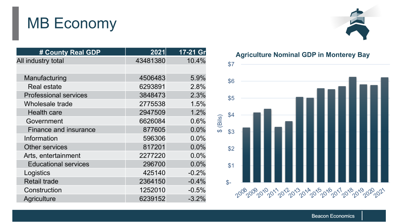
Otherwise, Thornberg said the Monterey Bay region’s economy has benefited from a growing manufacturing sector that saw nearly 6 percent GDP growth from 2017 to 2021. That offset a “struggling” agricultural economy that saw a 3.2-percent decline in GDP during the same period. Still, he noted that the local ag sector has begun to see job growth return, boding well for the future.
“The Central Coast’s only issues are labor and housing,” Thornberg added. “The economy’s just going to continue to grow.”


(0) comments
Welcome to the discussion.
Log In
Keep it Clean. Please avoid obscene, vulgar, lewd, racist or sexually-oriented language.
PLEASE TURN OFF YOUR CAPS LOCK.
Don't Threaten. Threats of harming another person will not be tolerated.
Be Truthful. Don't knowingly lie about anyone or anything.
Be Nice. No racism, sexism or any sort of -ism that is degrading to another person.
Be Proactive. Use the 'Report' link on each comment to let us know of abusive posts.
Share with Us. We'd love to hear eyewitness accounts, the history behind an article.