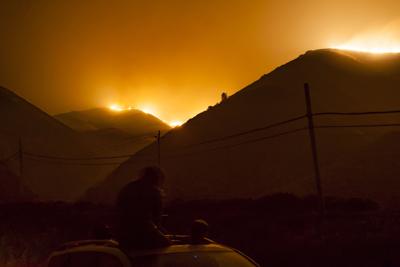

The U.S. Forest Service released plans at least six years in the making Jan. 25.
Their aim is to reduce the fire risk for local communities around the Los Padres National Forest, which also happen to be the same communities impacted by the Soberanes Fire this past summer.
On Jan. 27, the federal Environmental Protection Agency published a notice of intent of the Forest Service's environmental impact statement for a project that would re-establish and maintain 24 miles of historically used fuel breaks in the Los Padres National Forest.
Just over 10 miles of those breaks are in federally designated wilderness, which means that, under the Wilderness Act, using mechanized equipment for non-emergency fire abatement is illegal unless otherwise approved.
The proposed plan does call for such an exemption, but also lists potential alternatives that include doing nothing, utilizing hand tools or, in one case, also using herbicides.
The options laid out in the EIS come after a years-long collaborative effort between locals, environmental organizations and federal, state and local agencies called Firescape Monterey.
Per the USFS website, the proposals (aside from no action) aim for the "establishment and maintenance of fuel breaks [that] would include removal of medium (light brush and small trees) and heavy (dense brush) fuels, leaving a vegetative ground cover of grass, forbs and small shrubs, with the existing overstory intact."
The four options, per the EIS, are:
Under the No Action (Alternative 1) no fuel breaks would be re-established or maintained to accomplish the purpose and need. During wildfire emergency response, fire line construction would likely continue with heavy equipment along the strategic ridge lines.
The Proposed Action (Alternative 2) would re-establish and maintain 24 miles (approximately 542 acres) of historically used fuel breaks—all of which originated as fire lines—extending inside and outside of designated wilderness. Non-wilderness treatments include a combination of handheld motorized tools, mastication, machine or hand piling, and prescribed fire. Wilderness treatments include a combination of handheld motorized tools and traditional tools. This alternative includes a monitoring plan that will assess the project over time and identify any necessary management adjustments.
Alternative 3 is a non-motorized wilderness treatment alternative. It is the same as the Proposed Action with the exception of the wilderness treatments, which would be completed utilizing traditional hand tools only.
The Preferred Alternative (Alternative 4) is the same as the Proposed Action, with exceptions: herbicide treatment would be allowed on non-wilderness fuel breaks, and traditional hand tools will be emphasized in wilderness with the option to use handheld motorized tools.
Public comment on the EIS is open until March 12, and can be sent to: comments-pacificsouthwest-los-padres-monterey@fs.fed.us
Meetings will be held to discuss the plan on Feb. 15, 5:30pm-7:30pm at Big Sur Station, 47555 Highway 1, Big Sur, and at on Feb. 16, 5:30pm-7:30pm at the USFS Monterey District office in King City at 406 South Mildred Ave.


(0) comments
Welcome to the discussion.
Log In
Keep it Clean. Please avoid obscene, vulgar, lewd, racist or sexually-oriented language.
PLEASE TURN OFF YOUR CAPS LOCK.
Don't Threaten. Threats of harming another person will not be tolerated.
Be Truthful. Don't knowingly lie about anyone or anything.
Be Nice. No racism, sexism or any sort of -ism that is degrading to another person.
Be Proactive. Use the 'Report' link on each comment to let us know of abusive posts.
Share with Us. We'd love to hear eyewitness accounts, the history behind an article.