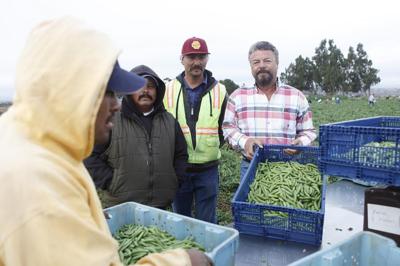

For a story last week on the rise of class-action lawsuits against farm labor contractors, the Weekly spoke to Guadalupe Sandoval, director of the California Farm Labor Contractor Association in Sacramento. Here's what he had to say about the court decisions that are changing the legal playing field for piece-rate work, and where the industry is headed.
Weekly: I’ve heard farm labor contractors liken these lawsuits to questionable abuses of Americans with Disabilities Act lawsuits by plaintiffs’ attorneys. Is there a similarity?
Sandoval: It reminds me of these lawsuits I’m seeing up and down the [San Joaquin] Valley here, by one or two people who are handicapped, and they go up and down the valley seeing if restaurants don’t have handicapped bathrooms. They filed lawsuits against every little mom and pop restaurant, facility and gas station in the region.
Companies do their best to comply. There are a variety of reasons there are little errors made.
Two recent court decisions—Bluford v. Safeway and Gonzalez v. Downtown LA Motors—change the way non-productive time is measured and compensated. What does it mean for farmworkers and labor contractors?
Neither of these cases were in ag, but they talk about when you’re doing work you’re not paid for—the off time when [truck drivers and auto mechanics, respectively] are sitting and waiting, just killing time, traveling from one job to the next, or stretching. You’re not really producing, but you’re on the job.
One thing is, they didn’t really specify the payment rate. They just said, if they’re on the job, make sure they get paid.
How did piece-rate agricultural work square with minimum wage payments before these decisions were handed down?
The concept was, as long as the work you’re providing more than minimum wage [on average for the entire workday], then you have complied. These legal decisions have told us, let’s make sure you also pay the workers not just when they’re producing, but for the 10 minutes when you ask them to start the day with exercise, so they don’t have an injury, or that 5-minute tailgate meeting you hold to remind them of heat and safety.
The concern is, are you not only making sure they make their wages for the day, but that every minute of the day they’re on the job is being compensated? Some people are taking that to an extreme, which makes it almost impossible to comply with the law.
How can farm labor contractors track the harvest time and non-productive time separately?
It’d be impossible. I don’t know a viable way to track every minute of every day for every worker. I don’t know where it ends. I’m not even sure where it starts.
I've heard contractors say that to address this, the industry will transition from piece-rate to hourly pay. Do you think that will happen?
That’s the phenomenon we’re starting to see, just to avoid the slew of wage claims that are coming in.
The most common option to avoid these types of claims is one that will reduce the liability for employers, but probably also reduce the wages for workers, which is a straight hourly rate, plus a production bonus.
Some workers will see their wages decline. Some workers will do fine under it. Workers want to make their good money. The way you make your money is not by dawdling around in the bathrooms or stretching.
Slow workers are gonna do great, because they’re going to get the basic minimum wage, regardless of how slow they are. Really fast people probably aren’t going to make as much.


(0) comments
Welcome to the discussion.
Log In
Keep it Clean. Please avoid obscene, vulgar, lewd, racist or sexually-oriented language.
PLEASE TURN OFF YOUR CAPS LOCK.
Don't Threaten. Threats of harming another person will not be tolerated.
Be Truthful. Don't knowingly lie about anyone or anything.
Be Nice. No racism, sexism or any sort of -ism that is degrading to another person.
Be Proactive. Use the 'Report' link on each comment to let us know of abusive posts.
Share with Us. We'd love to hear eyewitness accounts, the history behind an article.