
In the weeks after Christina Williams disappeared while walking her dog in her neighborhood, witnesses say the man eventually charged with raping and killing her was on a mission: Find an alibi for the hours around the time the 13-year-old girl went missing.
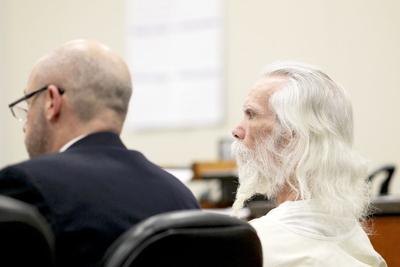
That testimony, from a former girlfriend of Charles Holifield and a retired FBI agent who worked the case, came on the second day of the suspect's trial in Monterey County Superior Court trial. Holifield, a twice-convicted rapist whose previous victims were also petite teenage girls, was almost immediately identified as a suspect in Williams' June 1998 disappearance.
Her remains were found seven months later, hidden in a densely wooded grove on a remote section of Fort Ord. But it wasn't until 2016, when an FBI cold case squad reopened the case and retested Christina Williams’ clothes for DNA evidence that Holifield was charged with her rape and murder.
An ex-girlfriend of Holifield who testified on Wednesday described an often violent relationship with him, one that included several instances of forced sex, strangulation, blows to the body and threats of harm. She was also unaware he had previous convictions for rape; he told her his previous trouble with the law stemmed from a bar fight in which someone was hurt.
The woman was working at Pelican Pizza in June 1998—just two weeks after Williams disappeared, she testified—when Holifield came in and asked her if she would vouch for his whereabouts.
"I looked at him and said, 'What did you do wrong?'" she testified. "I thought it was something minor. He wouldn't tell me what he did wrong…he never, ever told me. I told him he wasn't with me and therefore I could not give him an alibi."
He told her he would ask another girlfriend to provide the alibi.
The witness said she and Holifield spent a lot of time exploring remote areas of Fort Ord. Holifield, she said, liked to run off stress on a particular dirt road while she drove his truck behind him. It was the same road that led to the area where Williams’ skeletal remains were found in January 1999.
She noted that after Williams disappearance, Holifield's demeanor changed, from "nice (and) happy-go-lucky to any word you say might make him upset." And it was on one of those Fort Ord treks that Holifield suggested he thought about killing her.
"'With your bad, sorry family life, you're already miserable, why would I kill you?'" she said Holifield mumbled at her as they left Fort Ord that day. "'It seemed like him and (the other girlfriend) discussed before he ran on who should be alive and who shouldn't be alive. It blew me out of the water."
She said his words scared her: "I thought he would harm me."
On cross examination, Deputy Public Defender Michael Belter questioned the woman's memory of the timeline, as she insisted Holifield's alibi request came after Williams' disappearance. The woman's ex-husband also had called an FBI tipline—there was a reward on offer for information about Williams’ whereabouts—but the woman said she never sought out the reward after speaking to the FBI multiple times.
"It was blood money to me," she said.
Retired FBI agent Richard Lack, who now teaches interrogation techniques and counterterrorism at the Police Academy and also consults with the San Jose Police Department, launched the investigation into Williams' disappearance three days after she went missing.
On June 15, 1998, Lack said he and other agents decided to "enter into the investigation wholeheartedly." They found that Presidio of Monterey Police were treating Williams as a runaway who left her home voluntarily, but Lack said it appeared to him to be a stranger abduction case.
"She had never lived in the continental United States in her life," Lack testified, when asked why he believed it was an abduction. Williams, whose father was a chief petty officer in the U.S. Navy, was born in Japan and had lived there, and in the Phillippines and Hawaii, before arriving to the Monterey Peninsula, where her father was stationed at the Fleet Numerical Meteorology and Oceanography Center.
"Based on the information I gleaned, I was sure in no way was this a runaway," Lack said.
Lack testified that the FBI tipline received about 10,000 calls, and with the exception of a few that were dismissed as too outlandish to be believed, each tip was investigated. The bureau established a command post locally and it ran for several months, 24 hours a day, seven days a week.
"We had agents working leads day and night. We didn't care if we had to wake people up," he said. "This was an urgent situation."
In December 2002, Lack interviewed Holifield, who was incarcerated on an unrelated crime in Southern California. Lack said Holifield told him the night Williams went missing, he was at the home of another girlfriend and that he, the girlfriend and her mother ate dinner together and watched television after.
He had never seen Christina Williams before, Lack said Holifield told him, but he admitted to spending a lot of time in the area where Williams body was found.
The night Williams disappeared, Holifield had left his job as a cabinet shop in Sand City early, telling his boss he had to meet his girlfriend to look at an apartment in Carmel Valley.
Rick Stemple, who owns that apartment building, testified he had an appointment scheduled to meet Holifield and his girlfriend that same evening at 6pm but that the couple never showed up.
The next day, they made new plans to view the apartment. A man who lived in one of the units there testified that he had his door open that summer morning, and overheard Holifield and the girlfriend "in a pretty serious argument" about where Holifield had been the night before.
Frank Johns testified the woman was demanding to know where Holifield had been, and that Holifield told her, "None of your business." It was the same girlfriend that Holifield told Lack, the FBI agent, that he was dining with and watching TV that night.
That woman also figured into the testimony of the day's first witness, a former Bureau of Land Management law enforcement ranger who twice encountered her and Holifield on restricted areas on Fort Ord.
During the first encounter, in the fall of 1997, Ranger Ronnie Lewis testified he found Holifield and the woman fishing in a manmade pond. He told them it was illegal to fish there, but before he could run their driver's licenses to see if they were wanted for anything, he was called to assist an injured bicyclist on the Salinas side of Fort Ord.
On the second occasion, he found them fishing at the same pond. Lewis was patrolling with his K9, a German Shepherd named Nando, when he encountered the pair. He asked for their identification and after running checks on them, found the woman had "an active restraining order" against Holifield.
Holifield was handling something in the bed of his pickup truck when Lewis went to his police vehicle to run the checks on them; when Lewis received word of the restraining order, he released Nando from the vehicle, told Holifield to put his hands on the hood of the truck and patted him down before handcuffing him.
In the bed of the truck, Lewis testified, Holifield had a BB gun that looked like a Colt .45-automatic handgun. Holifield would later be arrested for brandishing a weapon at a woman and trying to force her into his vehicle.
He was also arrested that day, for violating the restraining order.
Lewis and Nando later played a role in the search for Williams. He was called to her house the day she went missing; Nando was given a piece of Williams‘ clothing to smell, and then he tracked her scent for about a half-mile away from her home before losing the trail.
On July 5, 1998, just weeks after Williams disappeared, Lewis walked in a report on Holifield to the FBI command post.
"Because of what had been going on and my prior knowledge of him, I knew he had some previous arrests for committing acts of rape, particularly on young girls in the Fort Ord area," Lewis testified.
Holifield faces life in prison without the possibility of parole if convicted. Judge Pamela Butler is hearing the trial after Holifield waived his right to a jury, in exchange for prosecutors taking the death penalty off the table.
Christina Williams’ parents, who testified about their youngest child's disappearance on the trial's opening day, have sat through all of the testimony thus far.
The trial resumes at 9am, Thursday March 5.


(0) comments
Welcome to the discussion.
Log In
Keep it Clean. Please avoid obscene, vulgar, lewd, racist or sexually-oriented language.
PLEASE TURN OFF YOUR CAPS LOCK.
Don't Threaten. Threats of harming another person will not be tolerated.
Be Truthful. Don't knowingly lie about anyone or anything.
Be Nice. No racism, sexism or any sort of -ism that is degrading to another person.
Be Proactive. Use the 'Report' link on each comment to let us know of abusive posts.
Share with Us. We'd love to hear eyewitness accounts, the history behind an article.