
This week's cover story describes in depth much of the history around the controversial issue of beach fires on Carmel Beach, and how numerous meetings (one activist counts 22) on the issue, plus countless hours invested by public officials and citizens have not yielded a clear path forward.
There's consensus around the idea that an unlimited number of wood-burning fires directly on the sand cannot be allowed to continue unabated, but there's continuing debate about how many wood fires, and in what form (a city-provided fire ring? a portable basket to remove coals from the beach? a simple metal fire ring?) would be appropriate.
Even petitioners asking for Carmel to reinstate wood-burning fires agree there's a problem: Some 440 signatories to a change.org petition are asking for a limited number of portable fire pits, so users would remove their charcoal and extra logs.
The current policy direction for Carmel is zero wood-burning fires, and instead an all-out conversion to propane. It's not yet clear what the city's pilot program might look like, though a public workshop may be scheduled on the matter for as early as this month.
But Public Works Director Rob Mullane gives a few hints: City staff may recommend opening up more of Carmel Beach to propane fires (fires have long been forbidden north of Tenth Avenue), allowing them to spread out more.
They'll consider maybe a half-dozen city-provided propane fire pits, set up on the beach only seasonally. "We can't have anything permanent there, because in the wintertime, the beach often erodes out," Mullane says.
Carmel Public Works is testing different styles of propane-burning devices, how long they burn on different tank sizes, and various features of each unit.
Beyond the city-provided component, there will be other propane-burning devices allowed as well.
"We're pretty clear that the pilot program will include an unlimited number of user-supplied units," Mullane says.
Bobby Richards, a hotelier and member of the Carmel Communities and Cultural Activities Commission—and also a candidate for City Council—has long been a proponent of propane alternatives. (Though he's open to a few city-operated wood-burning community fires, as well.)
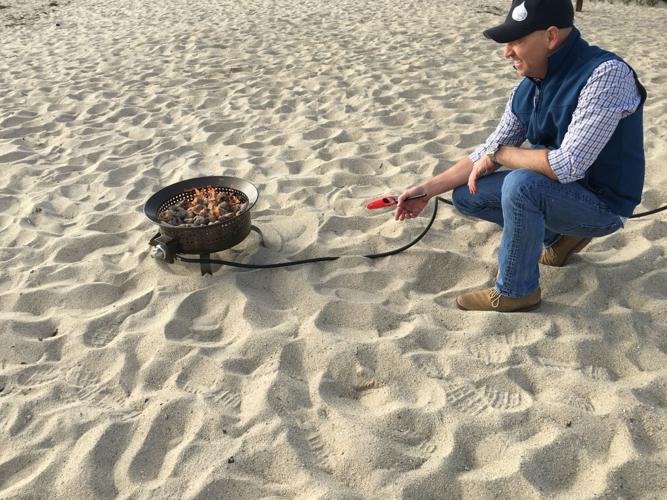
Richards built a simple propane fire ring himself, starting with a propane tank from a barbecue. It's heavy, but portable—not less portable than a stack of wood, if more dangerous to transport. Second, he rigged up a simple piping system to attach to it, with a pipe about 6 feet long, for a safe distance between the propane tank and the flames.
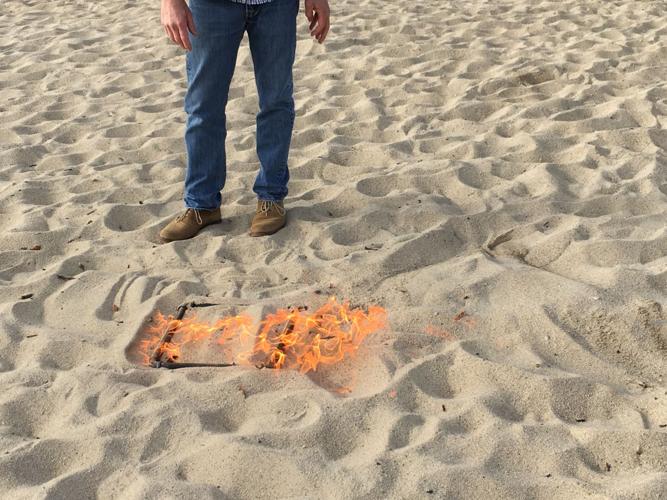
One end connects to the propane tank. The other is a square, about 1 foot by 1 foot, with small holes poked in it. Richards turns the knob on his propane tank, then holds a lighter to the square and it lights up, with flames shooting up from the sand. (You can even bury this option, and it creates the effect of sand burning.)
Richards has also been using a small device he bought from Lowe's for about $100, which he connects to the same propane tank with a provided hose.
Besides a still-divided community and City Council—the balance of which could change after the April 12 election—there's a lingering controversy between Carmel officials and California Coastal Commission officials about the future of fires.
The Coastal Commission is charged with protecting public access to California's coastline, and has long celebrated beach fires as a form of affordable public recreation on beaches.


(0) comments
Welcome to the discussion.
Log In
Keep it Clean. Please avoid obscene, vulgar, lewd, racist or sexually-oriented language.
PLEASE TURN OFF YOUR CAPS LOCK.
Don't Threaten. Threats of harming another person will not be tolerated.
Be Truthful. Don't knowingly lie about anyone or anything.
Be Nice. No racism, sexism or any sort of -ism that is degrading to another person.
Be Proactive. Use the 'Report' link on each comment to let us know of abusive posts.
Share with Us. We'd love to hear eyewitness accounts, the history behind an article.