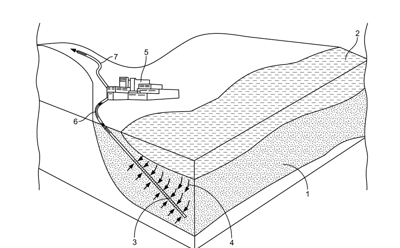

Last night, the Weekly broke news that California American Water has temporarily shut down its test slant well in north Marina, which is an early step in Cal Am's pursuit of a seawater desalination plant.
The company's permit requires it to halt the test well if groundwater elevation at a nearby monitoring well drops more than 1.5 feet. The groundwater fell more than 1 foot earlier this month, according to a report from the project's Hydrological Working Group, and Cal Am shut off the well June 5.
But the hydro group quickly lifted blame off Cal Am, concluding that nearby crop irrigation, and not the test well, drew down the aquifer.
Almost immediately, local desal watchdogs started questioning that group's conclusion, and pointing out what they view as a potential conflict of interest.
In a letter published in a local newspaper yesterday, Monterey resident Charles Cech noted that Dennis Williams, president of Geoscience Support Services—the company that prepared the hydro group's June 16 test well monitoring report—holds a patent for slant wells.
The Weekly could not reach Williams for comment Wednesday morning, but confirmed he actually holds three related patents: two for "slant well desalination feedwater supply system and method for constructing same," filed in March 2010 and January 2011; and one for "desalination subsurface feedwater supply and brine disposal," filed in November 2011.
"It would seem that using the same company whose president owns the slant well patent to do the slant well testing and data modeling for the [draft environmental impact report] is a major conflict of interest," Cech wrote in the letter. "Misinterpretation of the test data could have a significant impact on the success or failure of this project."
Also skeptical: Ron Weitzman, president of the Water Ratepayers Association of the Monterey Peninsula, who compares the Geoscience issue with the debacle that tanked Cal Am's last desal proposal, the Regional Desalination Project. In that case, then-Monterey County Water Resources Agency board member Steve Collins took money from a project consultant while serving as a public decision-maker for the project.
Weitzman suggests the Geoscience situation is worse. "How can anyone rely on the evaluation of Cal Am’s slant well by a hydrology working group led by the slant-well patent holder?" he writes by email.
"That is the question, the question whose answer should lead this project to the same fate as the regional project Collins put together, but for better reason."
An appendix to the project's draft environmental impact report states that Geoscience developed the "North Marina Groundwater Model" in 2008, later updating it and using it to evaluate the Water Supply Project's impacts.
Rich Svindland, Cal Am’s vice president of operations, says Cal Am has known for years that Williams has patents on slant well technology. But for the Water Supply Project's test well, he says, Cal Am didn't use any of his patented techniques.
But other parts of Williams' patents discuss methods to control the flow from the aquifer so the well draws in 96 percent ocean water, Svindland adds. "That’s very important to us.”
Svindland says Cal Am has not paid Williams for use of his patented technologies, directly or indirectly. But Williams is involved in the project in several ways. The California Public Utilities Commission (PUC) contracts with Williams to do the modeling work on the test well, Svindland says, and Cal Am reimburses the PUC for those bills.
And Williams is one of four hydrogeologists on the project's Hydrological Working Group, though he represents the PUC, not Cal Am.
Significantly, Svindland says, Williams' firm, Geoscience, did design Cal Am's test well installed in north Marina—just not, to Svindland's knowledge, using any of Williams' patented techniques. Geoscience also monitors the data collection onsite.
Asked whether Williams or others at Geoscience have an incentive to show their own slant-well technology is working, Svindland says he understands why some people would allege that.
“I say no," he says. "They’re professional, licensed hydrogeologists in the state of California, and they have to abide by the state ethics. No one wants to lose their license for manipulating data.”
But Svindland's not surprised by the question. “The more this thing proves itself," he says of the test well, "the more we’re getting attacked.”


(0) comments
Welcome to the discussion.
Log In
Keep it Clean. Please avoid obscene, vulgar, lewd, racist or sexually-oriented language.
PLEASE TURN OFF YOUR CAPS LOCK.
Don't Threaten. Threats of harming another person will not be tolerated.
Be Truthful. Don't knowingly lie about anyone or anything.
Be Nice. No racism, sexism or any sort of -ism that is degrading to another person.
Be Proactive. Use the 'Report' link on each comment to let us know of abusive posts.
Share with Us. We'd love to hear eyewitness accounts, the history behind an article.