
Last night, St. Louis County Prosecuting Attorney Robert McCulloch announced that a Missouri grand jury decided it would not indict Police Officer Darren Wilson for shooting and killing 18-year-old Michael Brown last August in Ferguson, Missouri. The announcement sparked a groundswell of anger and riots in that city—and protests in major cities around the country, including Oakland, where protesters shut down Interstate 580 for hours starting at 8pm.
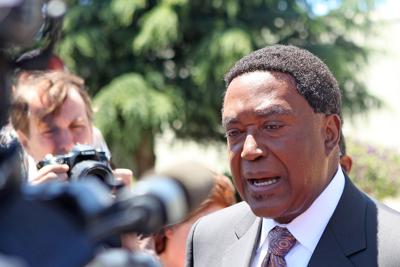
Famed Oakland-based civil rights attorney John L. Burris, who is representing the family of Carlos Mejia who was shot and killed by Salinas police this past May, spoke to the Weekly about what is happening in Ferguson and what it means for Salinas and the rest of the country.
Weekly: You're representing the family of [Carlos Mejia]. What similarities and differences are there in that case and the Michael Brown case?
John Burris: The difference is, of course, that Mejia had grass cutters. The officer interpreted that as being a weapon. Michael Brown was unarmed. Another difference is there was a fight in Michael Brown's case, physical contact. That was not the case with Mejia. It wasn't a fight. There was a pursuit, which is similar in both cases. The officer pursued Mejia and shot him. In Michael Brown's case, the officer pursued and shot him. [Both officers] were in a position of safety. With Mejia they were, in fact, following him, put themselves up close to him, saw a small movement and shot and killed him. With Michael Brown the officer had been in a fight and shot at Michael Brown as he was running. When [Michael Brown] stopped and turned around, they we don't know if he turned back to surrender or what.
The similarities are two men are dead that shouldn't be dead and the officers used [deadly] force at a time when they didn't have to use [deadly] force. In the Michael Brown case the outcry is far greater. But there was a sense of outrage in both. I requested the federal government look at [Mejia's] case as well as police practices in Salinas, as has been done in Ferguson. I think other similarities are that no criminal charges were filed in both. The families will have to deal with it as a civil matter. I'll file the civil case here.
Have you heard that Michael Brown's family is going forward with a civil suit?
Oh, I know those boys—the lawyers—I know they're going to file.
Did the finding of the Ferguson grand jury surprise you?
It did not surprise me. There had been a leak. I'm not surprised there wasn't [an indictment]. I'm surprised there was not a charge of involuntary manslaughter. In my view, when [Michael Brown] was running away, the officer should not have shot at him. He could have called for support. They could have pursued him later. It's a small town.
Why did the Ferguson District Attorney pursue the grand jury route?
The grand jury took the position that it was complicated matter. [The DA] put all the matter before the grand jury. He could have gotten a preliminary hearing [before a judge] instead. It was a bit surprising. The method was a little surprising because he essentially became an advocate for the police. Rarely do you have the defendant testify to the grand jury. Even character evidence was presented. There was an effort to disqualify the DA because his father [a former police officer] was killed by a black man. He refused to bring in an independent prosecutor. The community wanted that.
It seems as if police shootings are on the rise. Are they?
There are a lot. No doubt about it. A high number. I think they're getting more attention with video [and phone] cameras driving people's awareness.
What's the answer?
I don't have an answer. I represent a lot of people beaten up and killed by police. That's my practice. There are always efforts to cover up police misconduct. Rarely do they acknowledge it. The community has to demand and hold police chiefs accountable.
How?
Protest. Obviously you shouldn't tear up your own place. That doesn't make sense to me. But [rioting] is an expression of rage and hopelessness. If the only [legal recourse] you have to rectify a wrong doesn't give you the results you think you deserve, that turns to anger. I don't condone it but it's not surprising.


(0) comments
Welcome to the discussion.
Log In
Keep it Clean. Please avoid obscene, vulgar, lewd, racist or sexually-oriented language.
PLEASE TURN OFF YOUR CAPS LOCK.
Don't Threaten. Threats of harming another person will not be tolerated.
Be Truthful. Don't knowingly lie about anyone or anything.
Be Nice. No racism, sexism or any sort of -ism that is degrading to another person.
Be Proactive. Use the 'Report' link on each comment to let us know of abusive posts.
Share with Us. We'd love to hear eyewitness accounts, the history behind an article.