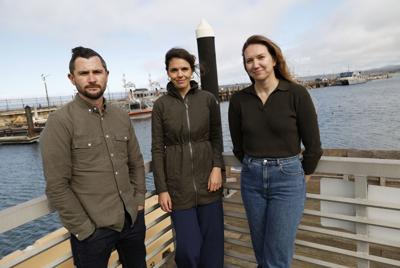

At least six local employees within the National Oceanic and Atmospheric Administration (NOAA) were among the hundreds nationwide who were terminated on Thursday, Feb. 27.
Three people each were terminated from the National Weather Service's Monterey office and NOAA Fisheries' Monterey office. (It appears no employees were fired from the local office of the Monterey Bay National Marine Sanctuary.)
All six were employed for less than one year in their most recent roles, so were probationary employees—the standard probationary period for civilian federal employees is one year. Emails they received on Thursday included the language: “The agency finds that you are not fit for continued employment because your ability, knowledge and/or skills do not fit the agency’s current needs.”
The three employees at the National Weather Service station—which serves an 11-county region population by some 8 million people—received termination emails at about 1:30pm, notifying them their jobs were ending at 5pm eastern time, leaving them just about 30 minutes to pack up.
"The employees got the emails they were being terminated before their supervisors were even aware," says Dalton Behringer, speaking in his capacity as the union steward for the Monterey office of the NWS Employees Organization.
The impacted NWS employees are one meteorologist, one administrative assistant and one facilities technician, who also serves other NWS stations throughout California, repairing and maintaining equipment.
When staffed at 100 percent, Behringer says the Monterey NWS office has 27 employees, including 14 meteorologists. There was one vacancy prior to the firings, leaving 12 meteorologists on staff.
"It may not be noticeable to the public right away, but it will be down the road," he says. "We may not notice degradation in service right away, but down the road we will start to see issues."
Behringer notes that some other NWS offices that were already understaffed have relied on help from Monterey meteorologists during major weather events, but with less bandwidth everywhere, that kind of boost will be less likely. He is also concerned about the loss of ongoing equipment maintenance.
At NOAA Fisheries, two scientists and a communications professional were terminated. Six federal employees remain on staff, plus six affiliates who are employed by partner agencies, such as UC Santa Cruz, working out of the NOAA office.
The three who lost their jobs describe themselves as cooperative links in a chain. One major project they worked on was the Climate Ecosystems and Fisheries Initiative (CEFI). Allison Cluett is a physical scientist working on sophisticated ocean modeling with projections that go out as far as a century; Heather Welch is a marine biologist looking at what those climate models and ocean warming events could mean for species presence and interactions; and Matthew Koller is a specialist in converting that science into understandable laypeople's terms. (A disclosure: Before attending graduate school in environmental science with a focus on communications, Koller was an intern at the Weekly.)
"We are getting ready for the next 'blob,' and trying to be better prepared. That was a perfect storm, and so many things went wrong," Welch says of the 2019 ocean warming event.
Part of their work was to develop better predictions for when events like The Blob are coming, as well as studying why things like red crabs or velella velella (also known as by-the-wind sailors) wash up on shore in large quantities.
"A federal job is the dream in this line of work," Koller says. "You are working with top-notch scientists. It’s a stable career serving the American people, doing good science that makes the world a better place."
A federal spokesperson for NOAA declined to respond to specific questions, but writes by email, "Per long-standing practice, we are not discussing internal personnel and management matters. NOAA remains dedicated to its mission, providing timely information, research, and resources that serve the American public and ensure our nation’s environmental and economic resilience."
Of the National Weather Service, Behringer says, "Even with the rumors, I thought it wouldn’t happen to us. We usually have pretty good bipartisan support. We are deemed essential, even in a shutdown."
Koller worries about the long-term impact not just to NOAA, but federal agencies in general as employees who started within the past year face widespread terminations. "It’s hamstringing the agency’s future ability to do its mission. We are the future as people move on and retire," he says. "Probationary employees represent the future of the civil service."


(0) comments
Welcome to the discussion.
Log In
Keep it Clean. Please avoid obscene, vulgar, lewd, racist or sexually-oriented language.
PLEASE TURN OFF YOUR CAPS LOCK.
Don't Threaten. Threats of harming another person will not be tolerated.
Be Truthful. Don't knowingly lie about anyone or anything.
Be Nice. No racism, sexism or any sort of -ism that is degrading to another person.
Be Proactive. Use the 'Report' link on each comment to let us know of abusive posts.
Share with Us. We'd love to hear eyewitness accounts, the history behind an article.