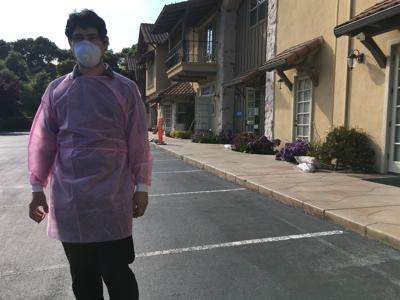

ARCpoint Labs is located in a rather sleepy neighborhood, Laguna Seca Office Park just off Highway 68, at the end of a cul-de-sac. For the past two years since they opened, the lab was used to seeing about 20 patients a day for a range of specialty tests—things like micronutrient tests, fertility tests, tick-borne disease tests—alongside more standard thyroid and STD tests, and drug tests.
Starting on April 1, it became the destination for some 300 customers a day, lining up in their cars. The ARClabs team set up cones in the street with signs to say they were open by appointment only.
The surge in demand was for a new test for antibodies to Covid-19, something the U.S. Food and Drug Administration has not yet approved, but which the agency fast-tracked into commercial use because of the public health crisis.
"I am authorizing the emergency use of your product," FDA Chief Scientist Denise M. Hinton wrote in a letter April 1 to the manufacturer.
In the days since, ARCpoint in Monterey became one of about 70 labs nationwide to start administering the antibody test, also known as a serological test.
"Serological tests can play a critical role in the fight against Covid-19 by helping healthcare professionals to identify individuals who have overcome an infection in the past and have developed an immune response," according to the FDA. "In the future, this may potentially be used to help determine, together with other clinical data, that such individuals are no longer susceptible to infection and can return to work.
"In addition, these test results can aid in determining who may donate a part of their blood called convalescent plasma, which may serve as a possible treatment for those who are seriously ill from Covid-19."
The idea is that because symptoms range so widely, and testing to diagnose Covid-19 has been so limited, people who suspect they might've been sick can determine whether or not they had the virus, and are now immune. The serological test is estimated to be about 97-percent accurate.
Spenser Smith, a phlebotomist who co-owns ARCpoint with his brother and their parents, scrambled to raise money to buy personal protective gear and serological test kits and scale up. He's an assistant phlebotomy teacher at Monterey Peninsula College, and hired on six phlebotomy graduates he knew from MPC, an increase from their normal staff size of one.
They've been at capacity administering 300 tests a day to customers in a drive-thru setting; they reach through the window for a finger-prick blood sample, never leaving their car. It's what's known in the industry as a "point-of-care" test, and ARClabs charges $68.31—insurance does not cover it. (Customers get their results via email at the end of the same day.)
The lab has reserved 30 to 40 percent of reservations for healthcare workers and first responders. Smith won't give an exact number of how many tests were positive for the presence of antibodies, but says it's under 10 percent, and the positives have traveled to known hot spots—none were community transmission cases in Monterey County. (Nobody on ARCpoint's staff tested positive for antibodies.)
They also offer a less popular version of the serological test—it requires getting out of the car for a blood draw from the arm, and costs about $150, and takes a couple of days to get results because the sample gets processed in New York. It's more accurate than the finger-prick "point-of-care" test," but based on the FDA's newest guidance, Smith says it's all they will be allowed to administer for the time being.
"The upshot is, the FDA reclassified it into the high-complexity category," he says.
The lab reports its findings to individual customers, but not yet to the county Health Department , so there's no publicly available data on immunity testing at this point. "There's a question about how accurate this test is or how much faith to put in it," Smith says.
He's hopeful that they can bring down the price of the more complex arm draw test, and that FDA approves the easier finger-prick option as an accurate way to learn if someone has immunity.
"This test is helping us fill in the history," Smith says. "The virus was already circulating before testing [to diagnose Covid-19]. There's a blank spot. And at some point, workers are going to have to go back to work."
For now, today, April 11, is their last day offering the finger prick serological test, and they're reserving as many spots as possible for first responders and health care workers.


(0) comments
Welcome to the discussion.
Log In
Keep it Clean. Please avoid obscene, vulgar, lewd, racist or sexually-oriented language.
PLEASE TURN OFF YOUR CAPS LOCK.
Don't Threaten. Threats of harming another person will not be tolerated.
Be Truthful. Don't knowingly lie about anyone or anything.
Be Nice. No racism, sexism or any sort of -ism that is degrading to another person.
Be Proactive. Use the 'Report' link on each comment to let us know of abusive posts.
Share with Us. We'd love to hear eyewitness accounts, the history behind an article.