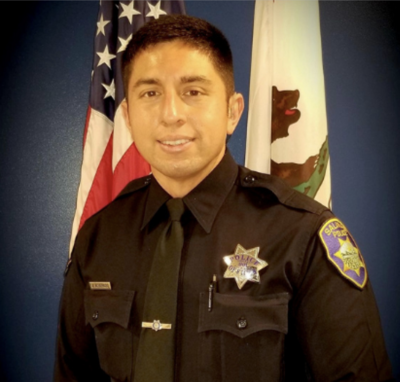


The trial of the man charged with murdering Salinas Police Department officer Jorge “JD” Alvarado last year began on Monday, Oct. 9 and continued this week, with prosecutors laying out their case against defendant Gustavo Morales.
The first three days of the trial included testimony from Morales’ father and a family friend who were called to the stand to testify about events on the night of Alvarado’s death.
Morales’ father, Arturo Morales, was questioned on Wednesday, Oct. 11, about what happened after Morales showed up at his parents’ Salinas apartment on the night of Feb. 25, 2022—when he allegedly shot Alvarado a dozen times during a routine traffic stop less than a mile away from their Hebbron Street home.
Answering questions through a Spanish-language interpreter, Arturo Morales said he was “in shock” when he saw his son at the door of the apartment, bleeding from his hand. He recalled smelling alcohol on his son’s breath and piling into the family’s white Dodge Caravan with his wife, Morales, and another of his sons, as they urged him to go to the hospital.
Yet Gustavo Morales refused, and instead they made their way to the home of Octavio Cruz, whose son Freddy was an old friend of Morales. “At his house, we tried to convince him to go to the hospital,” Arturo Morales testified. Still, Morales resisted, his wounded hand wrapped in a rag.
Gustavo Morales eventually checked into Salinas Valley Health hospital that night, where he was arrested and later charged with Alvarado’s murder. After dropping him off at the hospital, Arturo Morales went home and straightened out his son’s poorly parked 1986 Honda Accord, he said. In the car, he found a gun, which he took inside and wrapped in aluminum foil before stashing it away in a dresser so his other children wouldn’t find it, he testified: “I didn’t know whose it was.”
Prosecutors say that gun—a black Taurus 9mm semi-automatic pistol that they later recovered when searching the Moraleses’ residence—is the weapon Gustavo Morales used to shoot and kill Alvarado that night.
The graphic violence of the killing itself was the subject of testimony on Thursday, Oct. 12 when prosecutors called Dr. Venus Azar to the stand. Azar, a physician, is a forensic pathologist who conducts autopsies for the Monterey County and Solano County’s sheriff/coroner’s departments. She completed an autopsy on Alvarado on Feb. 28, 2022, two-and-a-half days after he was killed.
Azar described 12 bullet wounds, and Deputy District Attorney Christopher Puck showed the jury graphic images of Alvarado’s body that were included in her autopsy report. Moving from his head down, Puck and Azar reviewed the 12 bullet wounds in detail, six of which Azar described as potentially lethal. Any one of them alone would have been enough to kill somebody, she said, and quite fast—within seconds. When Puck asked if any amount of medical attention that arrived fast enough could have saved Alvarado’s life, Azar simply answered, “no.”
He was shot in the face, just below his left eye; the left side of his head; his neck; his upper back; his shoulder blade; his left arm and hand.
Morales, wearing a black collared shirt rather than a jail jumpsuit for his trial, sat next to his defense counsel throughout the first three days of the trial. Prosecutors sought to establish through evidence and testimony proof that Morales was the shooter. This was done through sometimes redundant video footage—surveillance cameras from El Pollo Loco facing the street show one angle, surveillance footage from Frank’s Auto Sales shows another—combined with cell phone records of Morales contacting his sister and father.
Footage from a Ring video on his parent’s home showed Gustavo Morales arriving and the family loading into the Dodge Caravan at 10:41pm; footage from a Salinas Valley Health camera shows Arturo escorting his son from the van up the ramp toward the emergency room. The footage shows Gustavo’s hand is wrapped up.
Beyond the basic facts, Arturo Morales said he remembered little about the evening in question. He said his son never told him what happened as they drove around Salinas and its outskirts trying to figure out what to do, beyond noting that he “had an altercation” and that “the police wanted to do something to him.”
Octavio Cruz testified that the younger Morales had asked to buy a car from him that night and said the suspect wanted to leave for Tijuana, Mexico, even asking Cruz to drive him there.
Cruz said he had been asleep at his home on Old Stage Road, outside of Salinas, when the Morales family arrived just after 11pm. Like Morales’ father, he is in his 50s, has lived in Monterey County for some 30 years and works in the Salinas Valley’s farm fields. Their sons were old school friends, and the Cruz residence was where the Moraleses turned to when they were in need of assistance that night. Cruz said the Moraleses never told him what had occurred, but saw Gustavo Morales’ bloody hand wrapped in a “T-shirt or something” and heard him say, “We’re screwed.”
“We found out through the news what happened,” Cruz testified. “We asked him. They never said anything.”
Cruz said the Moraleses left his home some 30 to 60 minutes after arriving, having convinced their son to go to the hospital after they couldn’t stop the bleeding. The next day, Salinas Police Chief Roberto Filice described Alvarado’s actions as heroic, having fired off a shot at his attacker that led to Morales’ arrest. (Hospital officials notified law enforcement of a gunshot patient, as is standard protocol.)
In the first three days of the trial, prosecutors also called law enforcement and criminology witnesses who testified about the investigation. They included California Department of Justice forensic analysts who testified that Morales’ DNA was found in blood at the crime scene, and that the bullets which struck Alvarado were fired only from the Taurus handgun found at the home of Morales' parents.
Salinas Police homicide detective Alex Zamora testified that Arturo Morales had told him that his son “told him he had been in a shooting with the police on the way to the hospital”—an interview captured on the detective’s body camera. Zamora and Leo Gomez, an investigator with the Monterey County District Attorney’s Office, both testified that Arturo Morales had never told them that his son was afraid of the police or feared that they “wanted to do something to him”—an argument made by Morales’ defense attorney, Michael Belter, who claims his client has been a victim of police brutality and acted out of fear for his life.
After the prosecution rests, Belter will have the opportunity to make his case on behalf of Morales to the jury. During this phase of the trial, his remarks have been limited to cross-examination, during which Belter has stuck mostly to brief questions on basic factual matters.


(0) comments
Welcome to the discussion.
Log In
Keep it Clean. Please avoid obscene, vulgar, lewd, racist or sexually-oriented language.
PLEASE TURN OFF YOUR CAPS LOCK.
Don't Threaten. Threats of harming another person will not be tolerated.
Be Truthful. Don't knowingly lie about anyone or anything.
Be Nice. No racism, sexism or any sort of -ism that is degrading to another person.
Be Proactive. Use the 'Report' link on each comment to let us know of abusive posts.
Share with Us. We'd love to hear eyewitness accounts, the history behind an article.