
It is not a threat. It is an order.
On May 16, the State Lands Commission sent a letter to Cemex—the Mexico-based cement manufacturing giant—informing the company that it must immediately submit a lease application to the commission to continue operations at its sand mine in Marina, or else shut the mine down.
Importantly, a lease application would be subject to review under the California Environmental Quality Act, which would most certainly require an environmental impact report. An EIR is a costly and lengthy process that would require the company to describe in detail the mine’s environmental impacts and ways to mitigate those impacts.
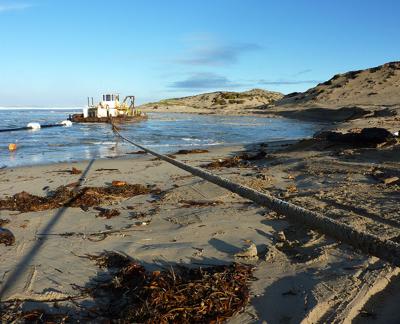
The Cemex mine is the last remaining coastal sand mine in the country, and scientists have argued for years it is primary reason southern Monterey Bay has the highest coastal erosion rate in California. Ed Thornton, a retired coastal engineer with the Naval Postgraduate School, has studied the operation for decades, and in a recent, peer-reviewed paper, he concluded the mine is causing an average coastal erosion rate of roughly 4 feet annually from the Salinas River to Monterey.
The fight to shut the mine down dates back to the mid-1980s, when the State Lands Commission shut down other sand mines in Sand City and Marina that used draglines, giant claws that scooped up sand from the surf zone. In shutting those mines down, SLC exercised its jurisdiction over public trust lands seaward of the mean high tide line.
But the operation at the Cemex mine—commonly known as the “Lapis” mine, which Cemex acquired in 2005—has dodged regulation for decades because it exists in a man-made dredge pond above the mean high tide line.
The California Coastal Commission has been investigating the mine as a potential violation of the Coastal Act for the last seven-plus years, and after increasingly vocal and persistent pressure from activists, the agency threatened to issue a cease-and-desist order—citing several alleged violations of the Coastal Act—in March of 2016. Cemex and the Coastal Commission have been in negotiations ever since, as the commission seeks to reach a resolution rather than risking litigation.
It is widely expected the agency will announce some form of action related to the Cemex mine in advance of its July 12-14 meeting, but for local activists advocating to shut down the mine and slow erosion, Tuesday’s letter from the SLC gives added reason for optimism.
Local Surfrider Foundation board member Ximena Waissbluth, who’s been publicly advocating to shut the mine down since late 2015, calls it “huge” and “phenomenal news,” and hopes it will help spur activists to attend the Coastal Commission meeting in July.
Katherine O’Dea, executive director of Santa Cruz-based Save Our Shores, which has championed the issue for more than a year, says, “It’s very exciting, and the most promising action that we’ve seen since any of us have been involved in trying to get the sand mine shut down.”
Gary Griggs, a coastal engineer at UC Santa Cruz who, along with Thornton, has decried the mine’s erosion impacts for decades, says, “It’s rewarding to find there’s value and there’s impact through working your way through the science.
“If you do good science, it’s true whether or not you believe it,” Griggs says.
Thornton, who, along with other activists, attended SLC’s April 20 board meeting in Berkeley to advocate for the agency to shut the mine down, laughed upon being told of the news.
At the April 20 meeting, he argued that the sand—though it is drawn from a lagoon—is actually a state resource because it travels down the coast, below the mean high tide line, before waves wash it into the lagoon. That is the exact argument cited in SLC’s letter to Cemex to shut the mine down.
“My goodness,” Thornton says, unable to contain his joy. “This is an order, which implies that they need to get an [environmental impact report]. That’s what my objective always was: It’s not defensible in an EIR.
“I feel vindicated,” he adds. “It will be an environmental triumph—the people won.”
In a May 16 statement, Lt. Gov. Gavin Newsom, chair of the SLC board, says, “Stealing public resources for private profit without a lease is a violation of the state constitution.
“This mine is a relic of an era that California and the nation rejected a long time ago,” he continues, “and it is past time that Cemex engage in a dialogue on the future of operations.”
The statement says the recreational value of southern Monterey Bay beaches are estimated to be over $13 million annually.
Broadly speaking, the letter argues the sand Cemex is mining is a state resource—an argument Thornton has long made—and because a former company operating at the site let their lease with the agency expire in 1969, Cemex has no lease, and is therefore in violation of state law.
Lisa Haage, chief of the Coastal Commission’s enforcement division, is happy to see SLC join the fray.
“We look forward to working with [SLC] and Cemex,” she says, adding that she’s not surprised by the action given SLC’s mandate to protect state resources. She also is clear that the Coastal Commission remains firmly committed to addressing the mine and its impacts. “This is one of our highest-priority cases, and we’ve been working on it very seriously over the past year or so. We’re deeply committed to it.”
She adds that public activism has been key in advancing the cause.
“We’re really grateful,” she says. “Public involvement has been very helpful, and critical in getting us to where we are.”
Cemex spokesman Walker Robinson says the company is currently reviewing the letter, and is not able to comment on it at this time.
He adds in an email that the mine "has been in consistent operation for more than 111 years. That the operation is a vested right and has all required entitlements to operate, has been repeatedly confirmed over the last 50 years by numerous government entities."
--
Editor's Note 5/16/17 (1pm) - This story has been updated from its original form to include a response from Cemex, and to correct an error: The State Lands Commission letter and statement was sent May 16, not May 15. The Weekly regrets the error.


(2) comments
I'm happy, but cynical they will just submit a lease application and years more mining will go on...
It's about time California finally orders Cemex back to it's home base, but being California, Cemex can disobey the law and remain here illegally operating knowing California doesn't deport.
Welcome to the discussion.
Log In
Keep it Clean. Please avoid obscene, vulgar, lewd, racist or sexually-oriented language.
PLEASE TURN OFF YOUR CAPS LOCK.
Don't Threaten. Threats of harming another person will not be tolerated.
Be Truthful. Don't knowingly lie about anyone or anything.
Be Nice. No racism, sexism or any sort of -ism that is degrading to another person.
Be Proactive. Use the 'Report' link on each comment to let us know of abusive posts.
Share with Us. We'd love to hear eyewitness accounts, the history behind an article.