
How do you make a steakhouse better?
After all, a cut of quality meat brought to rare or medium rare is definitive. Everything else is a matter of hospitality and presentation.
Despite the rhetorical aspect of the matter, Kevin Phillips and Chef Pete Martinez of Whaling Station Steakhouse decided to pursue a solution. And they found it in American Wagyu.
Now, American Wagyu beef is served at several restaurants. And recently a few—including Whaling Station—added Japanese Wagyu to menus, often as specials. But the team at Whaling Station went to Snake River Farms in Idaho, which began producing the prized meat back in the 1980s, when only a few head of the cattle existed in the U.S. And then they took things a step further.
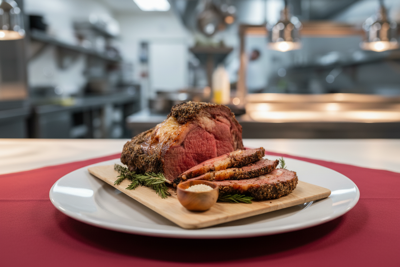
Beginning this evening, Nov. 7, the Monterey steakhouse offers prime rib from American Wagyu as a nightly feature on the menu.
“It’s something I’ve wanted to do for a long time,” says Phillips, the owner of Whaling Station. “It makes a good quality statement.”
The restaurant has specialized in aged prime beef since 1997, the USDA’s highest grade based upon marbling. American Wagyu from Snake River Farms exceeds federal standards.
In ribeye form, the Whaling Station’s 1,100-degree broiler caramelizes the fat into a sheer crust that lends a tantalizingly rich smoky hue to buttery meat that tends to fall away on the palate. Prime rib from the heavily marbled beef is another matter.
Instead of the quick sear required for steaks, Chef Martinez roasts the prime rib for more than three hours. With a cut sold riddled with fat, the process took some testing.
“This one had better flavor, this one had better texture,” he says, recalling his decision on which direction to go. “Both were amazing. I’m going to go both ways.”
There is, of course, another matter Phillips and Martinez were sensitive to. In an era of rising food costs and general inflation, such a high-end cut of beef might be considered a rare treat, rather than a nightly option. A four-bone American Wagyu prime rib from Snake River Farms retails for around $500.
The solution was to offer an eight-ounce cut at $59, in addition to 12 ounces ($79) and 16 ounces ($99). And Martinez adds that guests are free to share, making the largest size less expensive than the eight-ounce for two people.
Wagyu has a short history in the U.S. Four Japanese Wagyu bulls arrived in the U.S. in 1976, used for cross-breeding. It was almost 20 years before a ranch brought three Japanese female Wagyu cows into the country.
Before Japan clamped down on Wagyu cattle exports in 1997, fewer than 200 head had arrived on U.S. soil.
According to the American Wagyu Association, only 40,000 “Wagyu-influenced” cows exist in the U.S. The term Wagyu-influenced accounts for cross-breeding.
A cow must grade at least 50 percent genetically Wagyu to achieve the designation in this country. At over 93 percent, the cow is considered purebred.
The AWA estimates that fewer than 5,000 fullblood Wagyu cattle are being raised in the U.S.
With those numbers in mind, a nice Wagyu prime rib is improving the steakhouse experience. As Martinez says, “If we’re going to do this, go big.”
Whaling Station Steakhouse, 763 Wave St., Monterey. (831) 373-3778, thewhalingstation.com.


(0) comments
Welcome to the discussion.
Log In
Keep it Clean. Please avoid obscene, vulgar, lewd, racist or sexually-oriented language.
PLEASE TURN OFF YOUR CAPS LOCK.
Don't Threaten. Threats of harming another person will not be tolerated.
Be Truthful. Don't knowingly lie about anyone or anything.
Be Nice. No racism, sexism or any sort of -ism that is degrading to another person.
Be Proactive. Use the 'Report' link on each comment to let us know of abusive posts.
Share with Us. We'd love to hear eyewitness accounts, the history behind an article.