
Ah, St. Patrick—the patron saint of binge drinking and salt-cured beef, recognized by Rome for his untiring zeal during spring break keggers.
Just a quick double-check of the facts and…
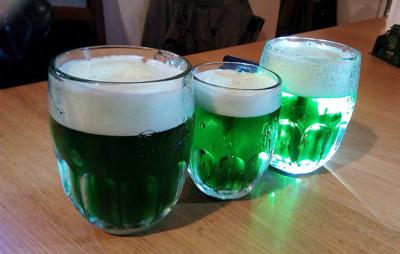
What the hell? All St. Patrick did was risk a nasty martyrdom while converting much of Ireland to Catholicism and taking a stand against British mistreatment of the Irish people. So why does much of the western world—Catholics, non-Catholics, even the British—celebrate his achievement? More importantly, what does the ritual of defacing perfectly good beer with blue die to turn it a glimmering green have to do with any of this?
The first bit is easy. St. Patrick’s is a Catholic feast day that just so happens to occur during Lent. That’s like shouting “no rules!” before a pickup game of street hockey. With self-denial and guilt lifted for one day, people are free to guzzle as much as they please.
Throw in a little cultural appropriation and you have a global bash.
As they say, everyone is a bit Irish on St. Patrick’s Day. London Bridge Pub in Monterey is going green. So are Sly McFly’s and Cooper’s Pub on Cannery Row. Waypoint Bar + Kitchen at the scenic and ritzy Quail Lodge will be pouring free-flowing Guinness (though it’s probably not free). Peter B’s, Baum & Blume, Poppy Hall—just about every place gives a nod to Ireland’s patron saint in some form or other.
And Mulligan Public House in Carmel must really think highly of his work.
“We’re doing the whole weekend,” reports Mulligan staffer Melissa Karasek. “We always do.”
So that’s three days of beer specials, corned beef, cocktails and Irish anomalies, such as potato-based nachos and green pizza...um…”It’s actually really good,” Karasek assures us. And, yes, they’ve stocked up on dye for the anticipated rush on green beer.
Think “rush” is an overstatement, that sensible people would scrunch their faces at the thought? Well, even at Peter B’s Brewpub in downtown Monterey’s Portola Hotel & Spa, staff members are bracing themselves.
“We had 200 glasses of green beer to start last year,” recalls Portola’s Food and Beverage manager Brian Hein. “When we ran out, we still had three hours to go before closing.”
According to a survey conducted by Prosper Insights & Analytics for the National Retail Federation, 72 percent of Americans under the age of 35 plan to party in some fashion—or at least pick at some corned beef—on March 17 this year. And more than half of those in the 35-54 age group expect to get a little tipsy.
Those over 55 will likely be in bed.
But there are enough young folk to pick up the slack. WalletHub estimates that for this coming St. Pat’s, Americans will down 4.2 drinks, on average. And some reports suggest that for more than 50 percent of partygoers, at least one of these will be a green beer.
And it may be best to stand on one green beer.
“It’s usually pretty unattractive after two or three,” Karasek points out. “The mouth turns green.”
Which is actually good advice, though it does little to advance us toward an answer. Maybe more reading on St. Patrick?
Hmm...Take a quick flip through his Confessio and you’ll find nothing about green beer. Plenty about the voices in his head, but not a word about the miracle transformation of regular pale ale to glorious green.
Obviously there is a relationship between the color and the nation in the popular mind. Shamrocks, green grow the lilacs, Lucky the Leprechaun, Notre Dame’s football jerseys—all bright green.
OK—not all. What’s up with the dark blue, when the Notre Dame mascot is decked out in kelly?
It’s a common assumption that green beer began as a peculiarly American homage. In a 2017 episode of Jimmy Kimmel Live, actor Colin Farrell told the host he never heard of the stuff until coming to this country and asked “Who wants to drink green beer?”
When Kimmel pondered the question at hand, Farrell drew a blank.
“I can tell you that if he was Irish, they were three generations removed,” Farrell said.
The heartthrob may be on to something. Many of those stern, horn-rimmed scholars dedicated to academic research on the matter credit Thomas H. Curtin, a doctor—of medicine, according to some versions, but a coroner in others—and patron of the Schnerer Club in New York. At the venue’s ode to St. Patrick in 1914, the good doc slipped a little mickey into the brew: a bit of “wash blue,” which was a nice marketing way to say poisonous solution used to whiten fabrics and textiles.
Yeah. Maybe “good doc” wasn’t the best turn of phrase.
Another set of researchers cast doubt upon this story, however. They unearthed a 1910 article from the Spokane, Washington, paper The Press mentioning green beer—and it was front page material. The account tells of a bar called God Rist His Sowl (not many high school graduates in Spokane back then) pouring the stuff from taps on St. Patrick’s.
In this breaking news piece, the journalistic sleuth speculates that arsenic may be involved, but admits “Nobody but the bartender knows how it happened, and he won’t tell.”
People who drop arsenic into someone’s beer rarely do.
Yet the writer was impressed enough to pen this: “It tastes like beer and looks like paint, or rather like the deep green waves in mid-ocean with the sun striking them through.”
You can tell exactly when the arsenic kicked in.
So—arsenic, wash blue. No wonder the green beer phenomenon didn’t really begin to take off until the 1950s. By the early part of this century, though, demand increased to the point that craft brewery Dogfish Head put Verdi Verdi Good on the market, which drew its color from spirulina algae.
Uh...The idea of a dose of simple chemical dye suddenly seems appealing.
And that should be enough to settle the Burning Question for this week. A couple of guys playing recklessly with harmful contaminants introduced green beer to America. It’s our one contribution to the global party.
Well, that and corned beef.


(1) comment
Good on beer, tho green beer is rare in Eire; why waste your time with pale stuff when Guinness flows so freely? (Even if it's owned by a Brit family.)
But the history a bit skew-wiffed. It wasn't the Brits but Gauls/Celts who invaded Ireland around 6-500 BC and wiped out the indigenous languages and much of the Eireann culture. They'd done the same to the Brits and most of NW Europe on thier migration north. Very successful , well-armed warrior tribesmen but no match for the disciplined Roman armies who took over after 100BC. Yet, unlike Latin, the language is still spoken here and there and the names and culture are everywhere.
As for the religion, the ultimate Romano-Brit shackle: the Irish people seem to have finally thrown off the legacy of Rome and re-established their ancient ways of dealing with the gods. Maybe it's time for this Brit slave boy to be de-sanctified.
Welcome to the discussion.
Log In
Keep it Clean. Please avoid obscene, vulgar, lewd, racist or sexually-oriented language.
PLEASE TURN OFF YOUR CAPS LOCK.
Don't Threaten. Threats of harming another person will not be tolerated.
Be Truthful. Don't knowingly lie about anyone or anything.
Be Nice. No racism, sexism or any sort of -ism that is degrading to another person.
Be Proactive. Use the 'Report' link on each comment to let us know of abusive posts.
Share with Us. We'd love to hear eyewitness accounts, the history behind an article.