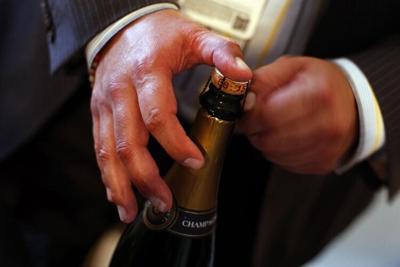

Brunch may or may not have been invented as an excuse to down a few drinks before noon.
There are a couple of points against the notion. For one, the clever little portmanteau refers specifically to meals, not drinks. Secondly, no one should ever be apologetic about a morning cocktail or three—unless it’s to the editor, but that’s really more about blowing deadlines than the three-martini breakfasts.
But there is one thing that makes a strong case in favor of brunch as a means for getting an early start. Bottomless mimosas.
No, not every restaurant offers free flowing mimosas. Yet the blend of orange juice and sparkling wine has become synonymous with brunch, beating out old standards like the bloody mary or the French 75.
“It’s light in alcohol and it has orange juice,” says Katie Blandin, owner of the Monterey cocktail destination Pear Hour, adding that the mimosa is a quick turnaround at the bar. “It’s easy. Boop, boop. Pour one thing in, pour the other in.”
The drink—purists will tell you, without the courtesy of a boop, that mimosas don’t qualify for cocktail status—indeed relies on just two ingredients. And there’s no reason to uncork the fancy sparklers. Cheap stuff works. And bartenders pay so little heed to mimosa tradition they don’t hesitate to play with its flavors.
“With mimosas we offer orange juice, blood orange, cranberry, pineapple, hibiscus—it allows you to be creative,” Patrick Fischer, bar manager at Rio Grill in Carmel’s Crossroads, points out.
What about peach? Well, there’s a problem.
You see, the refreshing combination of peach puree and sparkling wine—prosecco, to be precise—qualifies as a bellini, which for some reason is a brunch also ran to the pedestrian mimosa.
Why? I mean, “bottomless bellinis” would bring welcome alliteration to the chalkboard advertising restaurant specials.
“I prefer them,” observes Allison Peach—yeah, she would—of Tarpy’s Roadhouse in Monterey. She adds that while not as popular, once customers try a bellini they tend to remain on the bellini side of the brunch divide.
There is, however, a couple of hurdles. While bartenders happily toss aside tradition when it comes to the mimosa, they are more likely to hold the bellini sacred.
“The mimosa is customizable,” Blandin says. “The bellini has a recipe.”
A proper bellini involves peeling mounds of peaches (a pound, say, for a round at home), blending them with ice and sugar before straining the resulting puree. It’s also important to have raspberries on hand, just in case the peaches haven’t peaked on the color wheel.
“Peaches can be harder to get some times of the year,” Fischer adds. “Orange juice is year round. We could buy a puree, but it’s not the same.”
And again, it calls for prosecco, not just any random sparkling wine.
Yeah, it’s a finicky drink. And it used to be a seasonal one, as well.
Peach season in Italy lasted June through September. And as we learn in Harry’s Bar: The Life and Times of the Legendary Venice Landmark, bar owner Giuseppi Cipriani favored the white ones.
“So much so, in fact, that he kept wondering whether there was a way to transform this magic fragrance into a drink he could offer at Harry’s Bar,” Arrigo Cipriani, Guiseppi’s son, wrote.
The younger Cipriani also linked the cocktail’s name to a work by Giovanni Bellini, the 15th century Italian painter.
“I had no idea at the time that the pink glow my father had so admired in one of Bellini’s paintings would be the inspiration for his famous cocktail,” Cipriani said.
The time was 1948—or possibly earlier. Harry’s opened in 1931. While popular with the bar’s globe trotting patrons, the bellini really took off in this country after the Cipriani family branched out to New York in 1985.
By then the mimosa was well established. What’s less certain is how it came to be.
Cocktail historians—dream job—often point to a bartender at the Ritz in Paris, who in 1925 tweaked the recipe for the Buck’s Fizz...well, all Frank Meier did was add more OJ to the existing recipe, hardly an accomplishment.
But there’s a hitch. In the 1930s, Meier published a recipe book titled The Artistry Of Mixing Drinks, listing some 300 concoctions, somehow without conjuring the word “mixologist.” He was proud enough of his own creations to highlight them in the book.
The mimosa is there under the uncertain heading of “Mimosa or Champagne Orange.” Buck’s Fizz is also there. Neither bears Meier’s signature.
His inclusion of the Champagne Orange is, however, quite telling. Some mix of sparkling wine and fresh squeezed orange juice had been around long before. Bartender’s simply appropriated the drink and provided a new name.
No wonder modern barkeeps are so free with the mimosa. Even celebrities mess with the drink. It is said that Hollywood director Alfred Hitchcock took credit for its popularity. A 1966 article in the London Express caught him “in fine form, drinking mimosas and smoking an eight-inch cigar.”
Actually, the reporter inserted a parenthetical explanation—”Champagne and orange juice”—so the mimosa was not yet a brunch sensation. But it was in play and, as we know, would win out.
“There’s a brunch culture,” Peach says. “And people enjoy them.”


(0) comments
Welcome to the discussion.
Log In
Keep it Clean. Please avoid obscene, vulgar, lewd, racist or sexually-oriented language.
PLEASE TURN OFF YOUR CAPS LOCK.
Don't Threaten. Threats of harming another person will not be tolerated.
Be Truthful. Don't knowingly lie about anyone or anything.
Be Nice. No racism, sexism or any sort of -ism that is degrading to another person.
Be Proactive. Use the 'Report' link on each comment to let us know of abusive posts.
Share with Us. We'd love to hear eyewitness accounts, the history behind an article.