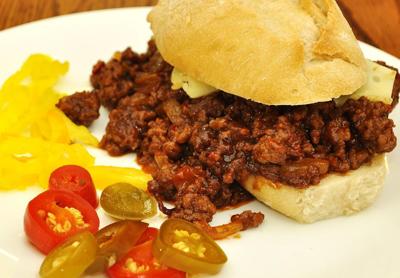

When you think about it, a sandwich is just a sandwich.
Baby Boomers who spent enough time in front of a television set will be able to finish the thought. Add a can of a certain product marketed by Hunt’s throughout the ‘70s and you have yourself a meal.
OK, so I was easily swayed by advertising slogans as a kid. I can still recite the Big Mac’s list of ingredients and sing along to that annoyingly reassuring “buy the world a Coke” tune. And before I actually tried one, it’s quite probable that I believed Miller beer had a taste you wouldn’t want to hurry through.
But there was a time when the BLT, the grilled cheese and perhaps even the vaunted hamburger itself were just mundane sandwiches. What every kid wanted was a big, dripping mound of ground beef slathered in tomato sauce and glopped on a bun.
“I looked forward to sloppy joe day,” recalls Tim Wood, chef at Carmel Valley Ranch.
That’s right, the sloppy joe. Parents set aside a special day of the week—perhaps two—for the sandwich. When schools served them at lunch, kids would desperately trade sacks stuffed with bologna and refrigerator pudding or just dump them in the bin.
So what happened? Other comfort foods from the ‘50s, ‘60s and ‘70s were rediscovered by chefs at upscale restaurants. Tater tots, Twinkie-style cakes and even the lowly grilled cheese appear regularly on menus—dolled up, but still recognizably homey. Why, oh why, have chefs forsaken the sloppy joe?
As it turns out, chefs aren’t really sure. “I think that unlike a burger, wrap, or burrito they are not as mobile,” offers Paul Blackerby of the Hyatt Regency Monterey, home of destinations like Knuckles Sports Bar and TusCa Ristorante. “I just wonder what the bun would be like after sitting for more than ten minutes.”
Yes, the sloppy joe is...well, sloppy. It was based on a Midwestern staple called the loose meat sandwich, a pile of ground beef steamed in its own, um, juices. Sometime during the Great Depression, a chef named Joe at a place in Iowa decided to stretch his meat supply by adding sauce.
Unless, of course, you tend to believe the other common tale of the sloppy joe’s beginnings—this one a little less humble. It seems that Ernest Hemingway frequented a Havana bar named Sloppy Joe’s, where they prepared ropa vieja, which is merely shredded beef stewed in a tomato broth. As the story goes, Papa introduced the thing to the U.S., convincing his new favorite drinking spot in Key West not only to serve the sandwich, but also to change its name to Sloppy Joe’s.
There’s another, but it just explains why in New Jersey the sloppy joe appears in double-decker form, and with deli meat stacked over cheese, slaw and Russian dressing—a popular sandwich invented at a place called Town Hall Delicatessen.
Can’t remember which exit.
To confuse matters further, the sauced up loosemeat isn’t called the sloppy joe everywhere. Even in Iowa, which claims both sandwiches, some people will stare blankly if you refer to a sloppy joe. Say you ratted on someone and witness protection sent you to the northeastern part of the state (can’t think of another reason you’d be there), you’d have to order a “tavern.” In West Virginia it’s a “steamer.” In that remote slab of Pennsylvania south of Erie they say “wimpy.” Residents scattered around western North Dakota call it a “slushburger.”
Which brings up another Burning Question: Why would you order something called a slushburger? But I digress.
Wood, who directs food service for the Valley Kitchen, The Clubhouse Grill and River Ranch Cafe at the property, explains that chefs would treat the simple combination to a culinary shopping spree. They would start with heirloom tomatoes, sweat onions, toss in freshly picked herbs, maybe brown up some Wagyu and suddenly, the innocent sloppy joe is picking the debit card clean.
“Why would I pay $22 for a sloppy joe,” Wood asks, mimicking what he believes would be a common diner’s response. “I would say it’s more popular at home.”
Indeed, Wood confesses to preparing sloppy joes at home on a regular basis. He even keeps a can of Manwich—it’s a meal—in his pantry. (“I just use a bit to get that nostalgia,” he says.) And Blackerby occasionally serves sloppy joes as a staff meal during the lull before dinner service. So they’ve never really gone away.
“It would be great late night after bar food, for sure,” Blackerby adds.
And that’s the thing. Once chefs began pondering this week’s Burning Question, fond memories begin to stir. The idea of a remade, chef-driven version of the sloppy joe began to take hold.
Shortly after professing his secret love for the sandwich—and just moments after doubting customers would shell out for the thing, chef Wood reconsidered. “It would be fun to do a sandwich at The Clubhouse—a monthly special,” he says. “You could have fun with it, take the concept and make it a little more gourmet.”
Philip Wojtowicz at Poppy Hall, a new and popular spot on Lighthouse in Pacific Grove, points out that he ran a stuffed cabbage special one recent evening and the dish sold out.
“Comfort foods should make a comeback,” Wojtowicz observes. Turning to the sloppy joe, he says “I don’t want to be too confident, but I think we could make it work. Open face—it would be a smash.”
So whatever happened to the sloppy joe? Well, it may be poised for a big culinary revival.


(0) comments
Welcome to the discussion.
Log In
Keep it Clean. Please avoid obscene, vulgar, lewd, racist or sexually-oriented language.
PLEASE TURN OFF YOUR CAPS LOCK.
Don't Threaten. Threats of harming another person will not be tolerated.
Be Truthful. Don't knowingly lie about anyone or anything.
Be Nice. No racism, sexism or any sort of -ism that is degrading to another person.
Be Proactive. Use the 'Report' link on each comment to let us know of abusive posts.
Share with Us. We'd love to hear eyewitness accounts, the history behind an article.