
This shouldn’t be too difficult.
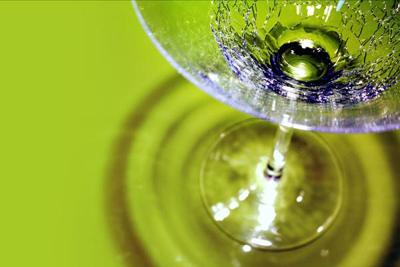
After all, the cocktail of literary, film and television lore dates back before the turn of the last century. Cold and crystal clear, with a broad shouldered elegance about it, the martini has an aura that envelopes those who raise its distinct glass. Historian Bernard De Voto singled it out as “the supreme American gift to world culture.” Ernest Hemingway wrote “They make me feel civilized.”
As it turns out, however, to raise a simple question about the martini is rather like asking mathematicians to prove that 2+2=4—warning: don’t ever, ever do it; while we know it all adds up neatly, gremlins strike when equations and numerals dissolve into theorems and subtheorems. So with something as fundamental as “what is a martini?” even veteran mixologists can stumble over the answer.
“It’s evolved,” says Anthony Vitacca of Bar Napoli and neighboring Little Napoli in Carmel, before reversing himself. “The martini has devolved, not evolved.”
From its origins in Martinez—or San Francisco, or New York; more in a moment—the martini has changed for better or worse from a blend with gin and heavy on the vermouth to one with just a whisper of the aromatized wine. Some early recipes call for a 50-50 mix, but it is said the postwar Hemingway cheekily preferred what he called a “Montgomery”—20 parts gin to one of vermouth, the odds he said were necessary for Britain’s military hero to win in battle.
Eventually vodka took over as the spirit of choice, with vermouth left dusty on the shelf, replaced by fetid olive juice.
“A lot of people order it dirty,” observes Sergio Vasquez of Pangaea Grill in Carmel. “We only put a drop of vermouth in the glass and swirl it.”
As the spirit of choice shifted from gin to vodka, people became more liberal in their interpretation of the cocktail. Pangaea Grill serves a standout coffee martini. There are examples decked in chocolate or gussied with lavender. The menu at Monterey Cookhouse lists flavors such as mango, strawberry, lemon drop and more. Bartender Marcos Zemponcteca struggles to tick them off. “We have too many flavors,” he says with a chuckle. “Once in a while I have people who call for scotch.”
And it can get weird. Zemponcteca claims that on more than one occasion, customers have asked for a dirty martini sharpened with grenadine.
“I don’t know what it tastes like,” he admits. “I don’t want to taste it.”
There have always been offshoots of the martini. The Gibson, for instance, is a dry martini spiked with a pickled pearl onion. A vesper features gin, vodka and—in its original form—kina lillet, a liqueur no longer available.
Over the past three decades, the trend has been for greater flair, for mixologists to twist the classics just a bit. And as Toby Ward of Woody’s at the Airport in Monterey explains, the introduction of new gins showcasing different botanicals and of more sophisticated vodkas encourage creativity.
“We keep it pretty traditional,” Ward says. “But there’s a lot of experimentation. It’s really opened up.”
What bartenders can agree on, Vitacca allows, is that when it comes to the martini, “there’s nothing that’s a semblance of the original.”
Naturally, there are questions about the original. According to one of the more accepted stories, a gold miner loaded with nuggets popped into a bar in Martinez, looking for a celebratory toast of Champagne—not readily available in a small California gold rush town. Instead, the crafty bartender compensated by picking from his shelves: gin, vermouth, maraschino liqueur, bitters and lemon.
In The Martini: An Illustrated History of an American Classic, Barnaby Conrad III sided with a competing tale. Again involving a miner, this one has the fortunate man bellying up to a San Francisco bar on his way to Martinez.
Some versions have the miner asking famed bartender Jerry Thomas in his San Francisco bar, for a Martinez, only to have the dean of all mixologists craft a better version.
Either way, the “Martinez” made it into Thomas’ seminal Bartenders Guide, the first edition hitting bookshelves in 1862.
So Martinez figures in two or three of the main origin stories—a fact not lost on that city or “the city.” A court in San Francisco once ruled in favor of the city by the bay, only to have the decision overturned by a judge in Martinez.
Hey, the cultural critic H.L. Mencken pinned the martini as “the only American invention as perfect as a sonnet.” No wonder cities are eager to stake a claim.
An 1888 edition—Bartender’s Manual by Harry Johnson—includes a cocktail now called the martini involving gin, sweet vermouth and other ingredients. Simon Difford in the authoritative Difford’s Guide notes that the first recorded recipe for a dry martini dates to 1904 from the bar at Paris’ glitzy Ritz Hotel.
“The story I believe is the Martinez,” Vitacca says, referring to the impromptu creation in that town.
Clearly what became the martini has always been in a state of evolution—or devolution. From sweet vermouth to dry, from half and half to a scant swirl and toss of vermouth. What first set the cocktail on the trail to the many and varied versions found today was a scene repeated in popular film.
“The classic martini was a stirred cocktail,” Vitacca insists. “A pure spirits cocktail should never, ever be shaken. But that is where we are today because of Bond’s famous line.”
Yep. Shaken, not stirred. And James Bond called for vodka—although the pendulum may be about to swing (again) on the spirit of choice.
“People had gotten away from gin,” Ward points out. “But it’s coming back. You have a lot of high quality gins now.”
So to answer this week’s Burning Question may be impossible, as it stands. We know, in our purest of hearts, that gin and vermouth are the foundation. As Zemponcteca at Monterey Cookhouse observes, however, with any cocktail “it’s about the customer, not the drink.”
And the people have spoken, changed their minds then broadened their perspective. Fortunately, there’s a way out of this mess, a different way to phrase the question.
“Is it a martini because it comes in a martini glass?” Vitacca asks.
The martini has endured, in whatever form, Ward says, because “it still has that classy elegance to it.” And that remains, no matter how it is dressed.
“It’s really a chill drink,” Zemponcteca concludes. “That’s what it is.”


(0) comments
Welcome to the discussion.
Log In
Keep it Clean. Please avoid obscene, vulgar, lewd, racist or sexually-oriented language.
PLEASE TURN OFF YOUR CAPS LOCK.
Don't Threaten. Threats of harming another person will not be tolerated.
Be Truthful. Don't knowingly lie about anyone or anything.
Be Nice. No racism, sexism or any sort of -ism that is degrading to another person.
Be Proactive. Use the 'Report' link on each comment to let us know of abusive posts.
Share with Us. We'd love to hear eyewitness accounts, the history behind an article.