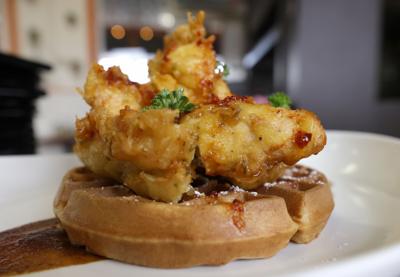

Chefs have heard the comparison, perhaps more often than the rest of us. And they get it—people need a reference for unfamiliar food, particularly if the meat is pale, perhaps a bit exotic and definitely on the bland side.
And no, this isn’t about Kenny G.
The comment is particular to alligator and rattlesnake, iguana and rabbit, even a type of mushroom known as hen of the woods, among other things. Do so many foods really taste like chicken?
“Well, it’s an interesting question,” says Todd Fisher, who as a chef, butcher and owner of The Meatery in Seaside is well placed to provide an answer. “Everyone’s default is to compare items to chicken.”
It may be more like several questions within a question. For one, why implicate chicken?
That may be the easiest bit to answer. President Herbert Hoover—current day voters aren’t the only ones with poor track records—set the bar for prosperity when he promised a chicken in every pot. And since then, Americans have made the bird a staple, to the tune of consuming over 100 pounds a year per capita, according to a report from the Kansas State University department of agricultural economics.
And while the dour Hoover would have confined tastes to boiled meat, chicken is served fried, broiled, smoked, in soups, stir fries, curries, as nuggets—you get the picture. According to Fisher, it’s that familiarity that led Americans to settle on chicken as a reference point.
“When people say that, they’re saying chicken has a neutral flavor,” adds Chef Jerry Regester of Spotted Duck in Pacific Grove.
Chicken wasn’t always America’s preferred protein, however. The KSU study found that consumption of chicken in this country increased by 160 percent between 1970 and 2020. Per capita, the amount we eat more than doubled in that span.
Perhaps the old yardbird was not to everyone’s liking. The growing popularity of chicken coincides with its turn toward blandness.
The mass market bird found in grocery stores has been bred for white meat in sizable portions. Its flavor is a secondary concern to a quick growth spurt that allows producers to dispatch the chicken at seven or eight weeks and get the meat to the shelves. So the flavor is indeed rather tepid.
Writing in Slate, Jackson Landers notes the result of this commercial manipulation: “Our idea of what chicken tastes like seems to be as informed by our expectations as by our palate.”
We are left, then, with a second problem. What does—maybe “did” is more apt—chicken actually taste like?
Without addressing the actual flavor, Landers points out that there is a marked difference between a roasting hen held in a pen and slaughtered young for market and a bird of heirloom breed left to roam for two or three years.
Several years ago I dined at a three Michelin Star restaurant in Brussels. When it came time for the entree, the waiter recommended chicken. Of course, there was no way I wanted dull white meat, even from a decorated chef—expectations set.
I gave in, fortunately. The breast meat was dark with a rich savor—earthy and nutty, with an impression of fall leaves.
“I’d say that in my opinion, pheasant and quail taste like chicken,” observes Fisher, penciling in the flavor of real chicken next to game birds.
Other wild creatures have been slapped with the “tastes like chicken” label, such as rattlesnake and iguana.
Hang on. Just who the hell eats…never mind. Different question.
A few years ago, Reader’s Digest drew up a short list of foods that resemble the ubiquitous bird. The lineup included the expected, like rabbit, frog legs, rattlesnake and Cornish game hen.
Wait…What?
Landers recalls in his Slate article the time he asked Facebook friends if Cornish game hen tastes like chicken. Many insisted they had completely different flavor profiles—not realizing, of course, that Cornish game hen is a marketing phrase for very young chicken.
It’s easy to wander off track when addressing the matter. In her book Tastes Like Chicken: A History of America’s Favorite Bird, Emelyn Rude describes the outbreak of violent crime directed at kosher chicken merchants in New York in the early decades of the 20th century. As she related in an Epicurious interview, “Apparently kosher chicken was one of the most violent rackets in New York City history.”
Crack in the ’80s pales by comparison.
There’s an oft-repeated tale of Christopher Columbus sampling iguana on his exploration of the New World and reporting that—well, you know what. Of course, the incident does not appear in the admiral’s 1492 log book. Yams do, and fish. And the crews for some reason believed sharing their ship’s fare with the indigenous locals would put them in good stead.
But another question raised has been lost to time. Who first uttered the “tastes like chicken” phrase? Any stab at a date is hedged. Those who attempt an answer generally settle on the late 1800s. But, hey—the Columbus story is a better one.
Keeping in mind, however, that heirloom breeds left to roam the yard actually have a distinct character, the comparison may be relatively recent. Google registers a spike in literary usage starting in the early 1980s.
To our original purpose, scientists have suggested reasons why so many things taste like chicken. Their responses, however, include lengthy descriptions of the physiological characteristics shared by descendants of the prehistoric diapsids—you know, those dinos with the temporal fenestrae—as well as the nonenzymatic reaction of their meat under thermal degradation. We’re just not going to go there.
So what tastes like chicken?
“Veal sweetbreads have been confused for chicken at times,” Fisher says, employing an important disclaimer.
In other words, some foods are similar in flavor to the grocery store white meat. Sampled out of context, the differences are not readily apparent. There are also vegan substitutes manipulated to mimic the flavor of the common chicken. Good free range chicken allowed to mature, however, has a taste all its own.
Or, as Regester puts it, “Rabbit tastes like rabbit, chicken tastes like chicken.”
And that sounds pretty definitive.


(0) comments
Welcome to the discussion.
Log In
Keep it Clean. Please avoid obscene, vulgar, lewd, racist or sexually-oriented language.
PLEASE TURN OFF YOUR CAPS LOCK.
Don't Threaten. Threats of harming another person will not be tolerated.
Be Truthful. Don't knowingly lie about anyone or anything.
Be Nice. No racism, sexism or any sort of -ism that is degrading to another person.
Be Proactive. Use the 'Report' link on each comment to let us know of abusive posts.
Share with Us. We'd love to hear eyewitness accounts, the history behind an article.