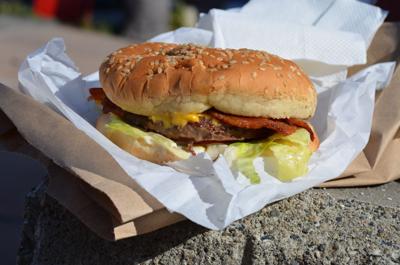

To smash or not to smash, that is the question.
Shakespeare pondered the eternal burger quandary in an early draft of Hamlet in which the main character was a troubled line cook and…Not buying it?
Well, the question remains—whether ’tis nobler to leave the burger untended, to suffer the slings and arrows of the grill, or just take fate into your own hands and mash the patty flat.
“I’m a fan of both,” says Todd Fisher, owner of Seaside’s The Meatery—where they grind the best burger meat in the county—rather unhelpfully.
Yet he’s also right. The no smash camp and the smash camp defend the perceived advantages of their favored technique.
Writing in Serious Eats, J. Kenzi López-Alt praised the flattened patty as a way to provide “maximum crust.” By smashing, the meat gains more contact points with the surface of the pan or flattop.
“Sometimes you want that crispy vibe, that surface area, all that crunchy,” Fisher observes. “You get that maillard reaction.”
Yeah—the what?
Weekly editor Sara Rubin is known to throw the Merriam-Webster dictionary at us from time to time, so there’s one handy. It simply refers to the process that leads to caramelization—also the folks at Merriam-Webster throw words like “nonenzymatic” into the definition. We should check on that while we’re here, and look up “fardels” too.
Anyway, there’s a distinct bittersweet char from a seasoned grill and the textural contrast can be welcome. So also claim smashing the meat allows it to fry in its own fat, for an additional level of savor.
But there’s another side to the story.
“No smashing, that’s what I say,” exclaims Jose Miguel, owner of American Burger on Lighthouse Avenue in Monterey. “You want to let the meat cook slow. You want the juices.”
Fat, as they say (whoever “they” are), is flavor. The hamburger became part of the American culinary pantheon because it is an experience. All that rendered fat dribbles from a nice, thick patty, coating the palate with a rich, rugged character that lingers.
Smashing, the nay camp points out, is a quick cooking technique. A plump burger demands greater care.
“Take your time,” says Thomas Keller, famed chef of The French Laundry in Yountville and owner of many Michelin Stars. “There’s no reason to damage food by cooking it quickly.”
Yes, this week’s Burning Question is of such importance that we consulted culinary royalty. Keller adds that he prefers a loosely packed patty—no bruising of the meat.
There can also be a practical aspect, depending upon one’s kitchen or outdoor grill set up. American Burger, for instance, starts their discs of meat on an open flame broiler to develop that Maillard thing before transferring them to the griddle. Smashing over an open flame? Not the best idea.
But Fisher sticks with his “depends” position. Ground beef at 80-20 meat to fat ratio or higher—Fisher’s grind is more in the neighborhood of 70-30—is what he refers to as a steak burger and should be flabby. But lean meat? Do what you will.
“It would be a shame to smash a Wagyu burger,” he explains. “Lower fat content—that’s where smashing comes in.”
Still, an entire chain is built around the idea (and yes, we presume the folks at Smashburger in Marina would be on the pro side, so no reason to ask). So the method is clearly popular.
“The idea has been around forever,” Keller says.
That’s a pretty long time. Let’s see, there’s a claim dating to the 1920s when a line cook at a diner in a Kentucky hamlet found that pummeling the patty with a no. 10 bean can—that’s how the story goes—made for a great tasting burger.
An Oklahoma tradition known as the onion burger also can be traced back to the same era. The style calls for pressing a patty onto a spread of thinly sliced onion until the meat absorbs the caramelized shards.
To Fisher’s point about lean meat, a post on Xtreme Foodies cites onion-smashed burgers as a necessity during the Depression. Onions, the text explains, were cheap. Meat, on the other hand, was costly. By using a lot of root vegetable and a little red meat, the owner could cap his burgers at 5 cents.
But we’re still only back about a century, hardly a quietus made.
The debate over the first burger has never been settled. There’s the 1904 St. Louis World’s Fair version, where a vendor borrowed buns from another to make a sandwich, much to the delight of fair crowds. Another—though more questionable—version places the momentous occasion at the 1885 Erie County Fair in New York, when two brothers ran out of pork sausage and turned to ground beef.
Then there’s the 1885 Seymour Fair in Wisconsin. It is said—by the person claiming the title of first, Charlie Nagreen—that by smashing a meatball between two slices of bread, the first burger was created.
If true, we have the smashed burger in the 19th century, at least.
However, the Library of Congress stands behind Louis Lassen. In 1900 at a New Haven, Connecticut restaurant that still stands—and still uses the ancient flame grill—called Louis’ Lunch, Lassen placed a patty between slices of toasted bread.
But purists demand a bun, even though diners were slapping burgers onto white bread throughout much of the 20th century. So into the mix comes Oscar Bilby, who on a Fourth of July in 1891 in the town of Bowden, Oklahoma, celebrated with a hamburger tucked into a bun.
Credit actually goes to his wife, Fanny.
All such claims have born the whips and scorns of time, as well as doubters. But we do know this much. A reference to Hamburg steak—as in a breadless ground beef patty favored in Hamburg, Germany, appeared in its first English dictionary in 1802. And we know that many claim that ground beef in tartare form was a staple of the Mongol hordes as they pillaged the Steppes.
The technique involved is key, here. Horsemen placed slabs of beef under their saddles, pulverizing them as they rode.
That’s smashed. Keller was right.
As for this week’s question, Miguel of American Burger concedes that Fisher was right all along.
“Cook it the way you cook it,” he says.
Either way. There’s the rub.


(0) comments
Welcome to the discussion.
Log In
Keep it Clean. Please avoid obscene, vulgar, lewd, racist or sexually-oriented language.
PLEASE TURN OFF YOUR CAPS LOCK.
Don't Threaten. Threats of harming another person will not be tolerated.
Be Truthful. Don't knowingly lie about anyone or anything.
Be Nice. No racism, sexism or any sort of -ism that is degrading to another person.
Be Proactive. Use the 'Report' link on each comment to let us know of abusive posts.
Share with Us. We'd love to hear eyewitness accounts, the history behind an article.