
“It will never be unanimous, damn it.”
That was a sentiment uttered by John Adams in the musical 1776, which is a pretty good refresher course on the Founding Fathers. Separate from the British crown? Form their own nation? Hell, these guys couldn’t even agree to open up a window.
With that in mind, I never expected unanimity in the response to this week’s Burning Question. Someone—some chef—must be a little freaked out by baconnaise, bacon soda or bacon taco shells.
When asked if bacon really does make everything better, however, there was no dissent from the kitchen. Even chefs hesitant to endorse what happens on the fringes of the long-running bacon craze agree.
“Yeah, of course it does,” says chef Paulo Kautz at Patria in Salinas. “I always buy bacon.”
Now keep in mind that Kautz is a man who values tradition. He doesn’t see the point of wasting the meat on dessert or infusing it in vodka. He prefers an old school flammenkuchen, an Alsatian tart of onions and bacon.
But Todd Fisher, chef at Carmel’s Seventh & Dolores, has actually pushed the matter. While taping his television series The United States of Bacon, he decided to find a combination that would nauseate the crew. So he wrapped strips around maraschino cherries, figuring it would turn stomachs. Nope.
“It was delicious,” Fisher reports.
Bacon and caviar? “Sublime—it was incredible.”
Smothering the delicate taste of truffles? “A truffle-bacon omelet, I’d do that any day of the week.”
OK, how about sprinkling shards of bacon over breakfast cereal? “It works,” Fisher says. “Try it some time with Honey Nut Cheerios—it’s a perfect complement. It will change your life.”
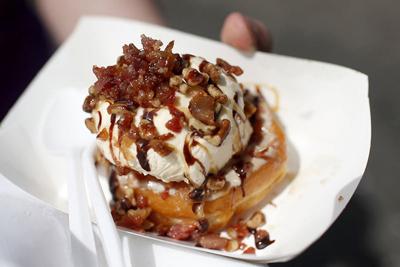
Um...maybe later. But the trend is clear. Over the past two decades, daring chefs have successfully introduced bacon to ice cream and milkshakes. Maple bacon doughnuts were presented to consumers and became a nationwide hit. Novelty items such as bacon Sriracha lollipops went viral. There is bacon jam, bacon and chocolate, bacon and peanut butter…
That gives me an idea. Better call Reese’s.
So what makes the rustic pork belly cut so versatile?
“There are a lot of pluses to it,” observes Tony Baker. “The combination of sweet and salty and savory—it has craveability, it has that umami effect.”
Baker should know. Not only does he serve as chef at Montrio Bistro in downtown Monterey, he also cures pork for his own Bakers Bacon, which ships nationwide. And he headlines Monterey BaconFest, which takes place at the Monterey County Fairgrounds Aug. 11-12.
Deployed properly, bacon brings something to almost any—I mean, definitely any—dish. Considering the type of cure (dry cure with a rub, smoked, etc.), the thickness, cooking method and such, it can introduce elements that boost the profile of other flavors. Salt is necessary, even in most dessert dishes, so a touch of pork product wouldn’t hurt. Fat lends depth and richness. Smoke works with many ingredients. The crisp texture helps an ailing salad.
It goes on and on. Of course, bacon wasn’t always so revered. In centuries past, any curing was performed in small batches on the farm. Clint Eastwood socked away a full side of it for mere convenience in The Outlaw Josey Wales. Like jerky, the cure could withstand life on the trail. Still, it wasn’t until the invention of sliced bacon (and some slick marketing on the importance of a hearty breakfast) that it became a staple. And even then, its use was generally limited to mornings, BLTs and burgers.
Then came some hard times.
“In the ‘80s nobody wanted to touch bacon because of the calories,” Kautz recalls. Just like butter succumbed for a time to margarine, coffee suffered from a rash of decaf and red meat was clubbed to near death by Oprah, misguided health trends stalled bacon sales—but just for a spell.
The ‘90s and especially the 2000s saw pork belly become a national obsession, with all the attendant craziness. Bacon vodka, chicken fried bacon, bacon lip balm, uses of bacon that have no business in an...um…responsible family publication—yeah, that’s it—grabbed national attention.
The National Pork Board reports that the volume of bacon sales compared to all food services grew by just about 25 percent between the years 2001 and 2009, even as the great recession sapped income. Yet the late ‘00s, trend watchers were convinced the fad had taken an ill-considered water ski ride over a marine animal.
After all, when fast food chains advertise bacon-flavored shakes, it’s all over.
But bacon defied the experts. Even after the trend was declared done and dusted with bacon salt by some writers in 2009, sales continued to soar at an annual growth rate of 2.4 percent.
Yes, while unanimous in their appreciation of bacon, many chefs do scoff at some of its sillier uses. “Some people put bacon in a martini,” Kautz says. “But is that really what you want?”
Baker notes that chefs are turning to classic technique rather than alarming combinations. “You see a lot more chefs braising and confitting and cooking low and slow for hours and hours,” he points out.
So has the fad ended? “Nah,” says Fisher. “It is as strong as ever.”
That’s settled, then. Bacon really does make everything better.
Wait a sec. Weekly news reporter David Schmalz may have found something. “I don’t think it would be good in a Mexican beer,” he says. “Some beers, but not a Mexican beer.”
Now that sounds like a reason to skip out and do some research.


(0) comments
Welcome to the discussion.
Log In
Keep it Clean. Please avoid obscene, vulgar, lewd, racist or sexually-oriented language.
PLEASE TURN OFF YOUR CAPS LOCK.
Don't Threaten. Threats of harming another person will not be tolerated.
Be Truthful. Don't knowingly lie about anyone or anything.
Be Nice. No racism, sexism or any sort of -ism that is degrading to another person.
Be Proactive. Use the 'Report' link on each comment to let us know of abusive posts.
Share with Us. We'd love to hear eyewitness accounts, the history behind an article.