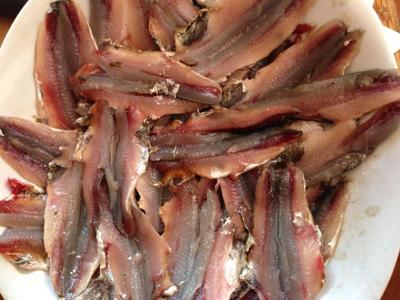

Mention the lowly anchovy to just about anybody and the response will likely involve some form of visible recoil. Suggest a Caesar salad without the infamous fish, however, and just as many will bristle with astonishment.
What gives?
"Anchovies can be polarizing," observes Travis Childers, chef and owner of The Cork & Plough in King City.
Perhaps not polarizing on a red-state, blue state level. As far as we know, there are no crackpot culinary populists out there calling on us to build a net, no angry accusations of sardine spies infiltrating the can. It’s just that some people favor the intense garum inflection anchovies can bring to a dish, while others remember salty, pungent slivers dripping with oil—filets capable of ruining pizza and putting hair on a man’s ears.
Yet this acrimony fades when it comes to the classic Caesar salad. David Stember, longtime chef at The Whaling Station in Monterey, polled waitstaff and found that only one out of every ten guests waves off anchovies when ordering the salad.
“The saltiness, the fishiness—that’s why people order a Caesar salad, for the dressing,” agrees chef Fabrice Roux of Carmel Valley Chophouse and the eponymous Roux, both in Carmel Valley.
Chefs say the trick is to downplay the hoarse savor of the fish, while still allowing it to reverberate through the salad—not an easy task, given the lineup of strident ingredients.
The Caesar combines crisp romaine with croutons, the shear blade of lemon juice, the biting tang of Parmigiano-reggiano cheese (or parmesan, at some joints), the earthy hue of Worcestershire sauce, mustard and a rich blanket of egg—raw in most modern dressings, coddled in the original. There’s a lot to contend with.
“You have a lot of strong flavors, so you have to balance them,” Stember explains. “When it’s correct, nothing stands out.”
At The Whaling Station, waitstaff prepare the Caesar tableside—the traditional way—so guests can ask for the anchovy to be tempered or amped up to taste. At other restaurants, chefs may dress the plate with a few anchovy filets.
“We use an anchovy puree,” Childers points out. “It’s a subtle, underlying note.”
So there’s general agreement: anchovies definitely belong in a Caesar salad. But hold on a moment…
It’s quite possible the original recipe did not call for the fish at all. According to accounts citing Rose Cardini, daughter of the chef who claimed the salad (Caesar Cardini, hence the name), the plate was first prepared tableside—without anchovies—in 1924 at the family’s restaurant in Tijuana for Americans escaping the scourge of Prohibition. The family later patented the dressing, again without the addition of fish.
Of course, there’s another tale that gives credit to Caesar’s brother, Alex. In this story, the salad—also served to American guests, although this time all former World War I pilots—included anchovies. Caesar Cardini himself is said to have suggested that the unique salty-umami taste of Worcestershire fooled people.
So are anchovy lovers wrong?
Not so, said former New York Times restaurant critic and Gourmet magazine editor Ruth Reichl in an NPR interview. She pointed out that Worcestershire contained anchovies at the time, so even though none were added to the dressing, the sauce left an impression.
“Somebody said it would be better if the anchovies flavor were stronger,” Reichl continued. “And actually, I think it is better.”
The Burning Question is not going to dispute Ruth Reichl. Besides, echoes Childers, “it’s not the same without it.”


(0) comments
Welcome to the discussion.
Log In
Keep it Clean. Please avoid obscene, vulgar, lewd, racist or sexually-oriented language.
PLEASE TURN OFF YOUR CAPS LOCK.
Don't Threaten. Threats of harming another person will not be tolerated.
Be Truthful. Don't knowingly lie about anyone or anything.
Be Nice. No racism, sexism or any sort of -ism that is degrading to another person.
Be Proactive. Use the 'Report' link on each comment to let us know of abusive posts.
Share with Us. We'd love to hear eyewitness accounts, the history behind an article.