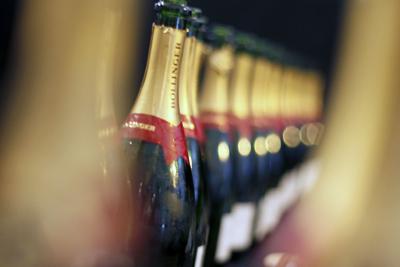

Somewhere out there a conspiracy theory perhaps exists linking Korbel with New Year’s Eve festivities. Industrial operations pumping out ten buck wine, it says, first hooked us on party favors then gave us cause to use them—picking a random day at the end of December and declaring it a worldwide reason to get down.
Maybe. I mean, it’s plausible considering other outlandish stuff shared on social media. The Cubs won a World Series? Yeah, right. Pass the Kool-Aid.
But for the sake of argument, what if someone doesn’t want to pop a few corks to toast the holiday season? Farfetched, sure—yet there must be options. Are there other wines out there suited to celebration?
“That’s a tough one,” says Joe Crivello, a wine counselor with Bargetto Winery at their Cannery Row tasting room. “Sparkling wine is so traditional.”
Sure—now. Think about it, though. How did people celebrate before the advent of Champagne and other sparkling wines?
Let’s see...Alexander the Great got smashed on the Macedonian equivalent of Mad Dog and drilled a spear through his best friend. Alcibiades guzzled whatever was handy then went on a rampage, defacing public statues throughout Athens—well, deface might not be the most accurate description here, but I can’t for the love of Hemingway think of another word. Beowulf’s comrades conked out after a night of heavy lifting, only to be drawn and quartered by Grendel.
It’s pretty clear that until Champagne was first delivered to New Year’s celebrations and other gilded fetes, parties weren’t officially over until the body count.
Yeah, I know—just three examples, but there are more. Remember what happened when they passed the bottle around once too often at that Last Supper shindig? Three is a fair enough sampling (by Burning Question standards) to declare that with no fizzy wine civility was out of the question.
So Dom Perignon clearly deserves some sort of honorary Nobel Peace Prize.
Fortunately there are plenty of local options. Caraccioli Cellars is famed for their sparklers. Scheid Vineyards, Scratch Wines, Windy Oaks Estate and others produce wines by methode champenoise.
“Champagne has that marque of celebration,” Alex Lallos, tasting room manager at Chesebro Winery in Carmel Valley points out. “But wine and holidays go hand in hand.”
Oh, yeah—the question at hand. Non-sparkling options. Sure.
Wine experts encourage stocking up on several options, such as easy drinking white or red blends. Chardonnay and maybe a Sauvignon Blanc came to mind for some. Grenache and perhaps a Syrah were recommended by others. Wines with spicy notes, unique options not featured other times of the year—old vine Mourvedre, for example—entered the conversation, as well.
And there’s the obvious: Pinot Noir. In other words, there are plenty of options.
“One that is interesting is Viognier,” says James Schultze at the Windy Oaks tasting room in Carmel Valley. “It’s a nice, floral, crisp—it’s a real crowd-pleaser.”
When selecting still wines for a holiday party, food pairing and approachability seem to be the key, at least according to those in the know. Yet they are also willing to look to the fringes of winemaking.
“Dry ciders are lightly effervescent,” Lallos observers, reaching for a handy bottle of Chesebro Cider. “You picture baking spices and apples—the aromas are pervasive in the holidays.”
Sure, he’s plugging a winery product. But he has a point. Cider produced by methods learned through winemaking rather than the common brewery share the same midnight revelry and colorful streamer spirit as sparkling wine.
“Most people hear ‘cider’ and they picture Angry Orchard,” Lallos ads. “But this is made in Basque style, so it’s bone dry. It’s not a pub cider.”
The sparkling mead produced by Bargetto under their Chaucer’s label is along the same lines—lean and bright, with just enough effervescence to liven up a toast.
Mead and cider are ancient drinks. Given the right circumstances, they might have become the celebratory bottles of choice. Apart from the imaginary Korbel theory, what explains the dominance of sparkling wine? After all, Champagne began as a ghastly mistake.
You see, secondary fermentation—the event responsible for all those bubbles—was once considered the result of clumsy winemaking. It caused fizzy, murky and often explosive wines (literally, as frail glass bottles could not stand up to the pressure).
France’s Champagne region was subject to fall cold spells that could also ruin a decent vintage by bringing fermentation to an unexpected halt. When temperatures warmed, yeast would spring back to life and create havoc.
Fortunately, the English weren’t so finicky. French winemakers shipped much of this unwanted bubbling wine over the channel.
During the 1700s, however, Champagne began to catch on in courtly manors in France, as well. Sturdier bottles and a lot of science—names like Cliquot (who came up with riddling and disgorgement, clearing sparkling wine of all that dead gray yeast), de Lavoisier (who traced sugars to alcohol content and carbon dioxide) and Pasteur (known for defining the role of yeast, and something else that just doesn’t come to mind right now. Probably not important).
By the 1800s, Champagne was favored by nobility across Europe—and catching on here in the New World. In her book When Champagne Became French: Wine and the Making of a National Identity, Kolleen Guy references the growth of Champagne consumption during New Year’s and other festivities throughout the century.
In 1850, people bought six million bottles of sparkling wine. In 1900, consumption flowed to almost 30 million bottles.
Hey, drink more wine, make France great again. Sure beats a wall.
So there it is. Champagne appropriated New Year’s thanks to French scientists. Well, and that it’s fun. In a piece written for Imbibe, Wayne Curtis cites a 19th Century New Year’s Eve in New York, the streets echoing with “guns and pistols from evening till morning, and with champagne corks from morning till evening.”
Or maybe it was the other way around. Anyway, sparkling wine is traditional—and sounds like NRA approved gunfire. It is entrenched, like wings at a sports bar or the Raiders and...wherever.
“In the month leading up to now, people stock up,” Lallos says. “A house feels warmer when there’s wine inside.”
Indeed. Some scotch and a few different vodkas might be needed, too.
In answer to this week’s Burning Question, it’s just once a year so shelling out for a decent sparkling wine makes sense. But yes, there are other wine, cider and mead options.
Just no Bud Light. And don’t believe all that Korbel nonsense.


(0) comments
Welcome to the discussion.
Log In
Keep it Clean. Please avoid obscene, vulgar, lewd, racist or sexually-oriented language.
PLEASE TURN OFF YOUR CAPS LOCK.
Don't Threaten. Threats of harming another person will not be tolerated.
Be Truthful. Don't knowingly lie about anyone or anything.
Be Nice. No racism, sexism or any sort of -ism that is degrading to another person.
Be Proactive. Use the 'Report' link on each comment to let us know of abusive posts.
Share with Us. We'd love to hear eyewitness accounts, the history behind an article.