
A contingent from the Henry Miller Memorial Library has just returned from their much-promoted trip to Paris to "retour" to the footsteps of Henry Miller's former stomping grounds. While in Paris, the library's Executive Director Magnus Toren and company held poetry readings, opened a pop-up bookstore, took pictures, ate (presumably) French food and drank French wine, chopped it up with literati like Miller's former English editor John Calder, and shot footage for a crowd-funded documentary.
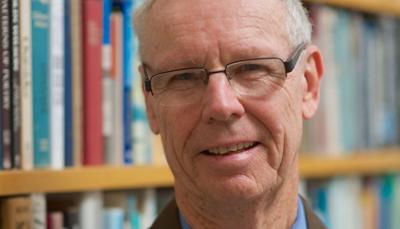
They came back yesterday, in time to welcome the speaking engagement, 4pm Saturday at HMML, of author Arthur Hoyle, who's written a biography of Miller called The Unknown Henry Miller: A Seeker in Big Sur. (He also appears 3pm Sunday at River House Books, 208 Crossroads Blvd, Carmel, 626-2665.) Ironically, Hoyle picks up Miller's journey from the time the late author, like the library crew, left France and eventually made his way to Big Sur.
Hoyle says he wrote the book for several reasons. In the 1990s, after reading "just about everything" that Miller wrote, then reading existing biographies and correspondence, Hoyle felt there was a disconnect between the two.
"The books Miller wrote himself—almost all are autobiographical," Hoyle says. "He's creating a fictional version of himself. He's wearing a mask. It's not the real Henry Miller. It's in the first person and it's 'Henry Miller' on the page, but it's a mask. To get around that portrait, you need to read his correspondence. There he's not wearing the mask."
So he took these two primary sources—his own books and the letters he exchanged with Anaïs Nin, Lawrence Durrell, Alfred Perlès, James Laughlin, Wallace Fowlie, Huntington Cairns and Emil Schnellock—and merged the two. Hoyle also notes that there hasn't been a biography on Miller since 1991. In fact, he says Miller's been unjustifiably absent from the canon of American literature and anthologies, which has effects that people who live in the same county as the Henry Miller Memorial Library may not be aware of.
"He can't be assigned to college students," Hoyle says. "He wasn't in the required reading list, even for students specializing in 20th century American literature. When I was in college at UCLA in the '60s, he was living 20 minutes from campus in Pacific Palisades and had given all his papers to the campus."
Today Hoyle lives in Pacific Palisades.
If Miller isn't taught in colleges and universities, it stymies scholarly study and relegates him to the literary fringe. People find his books and read them on their own, Hoyle says, but Miller fought long to pull his books out of the dismissed, stigmatized and obscure company of censored material considered too graphic or pornographic. Hoyle says Miller was on a mission upon arriving in Big Sur, to finish a trilogy called The Rosy Crucifixion, in which the antagonist is his second wife, June, and to find "spiritual self-realization." Hoyle seems to be on a mission, too—to revive serious consideration of Miller among academic circles.
"Why the editors [of anthologies] have chosen not to include him, I do not know," he says. "Conspiracy? I wrote an email to the woman who edits the Norton anthology: 'Why include Jack Kerouac but not [Miller], a greater writer who influenced him?' She did not answer me."
In a book jacket blurb, Magnus Toren writes of the book's "unexpected data…wonderful new insights, or familiar insights freshly turned…I look forward to the discussions and commentary that are sure to follow."
Hoyle's account follows Miller from his storied time in Paris from 1930 to 1939, when he left for fear of the German invasion. He lived on the island of Corfu in Greece with his friend Lawrence Durrell and wrote Colossus of Maroussi there. He left Greece because the Italians were going to invade, and arrived back in the U.S., whereupon he embarked on a cross-country road trip commissioned by a publisher who wanted him to write about America. Miller turned in what would become The Air Conditioned Nightmare.
"The publisher turned it down because it was quite critical of American culture and it was wartime. It was later published by another publisher. That trip brought him to Southern California [and] was also the beginning of his residence in Big Sur."
Hoyle says that Miller—who was born and raised in Brooklyn (if you remember, the Henry Miller Library did a literary sojourn to Miller's Brooklyn haunts last year), worked in Manhattan, and had lived in Paris—thought of himself as an urban writer until he got to Greece and found an appetite for the spiritual in nature. That appetite was fed by the wilds of Big Sur, where he lived from 1944 to 1961. While writing The Rosy Crucifixion trilogy, Miller took breaks by writing other books, like Big Sur and the Oranges of Hieronymus Bosch.
"He flourished as a writer in Big Sur because he had the tranquility he needed. He had also built up his personal life: two marriages, he fathered two children, had a small but very devoted following of people who believed in his message, in his example."
Maybe it stems from an under-read shared conventional wisdom that the impression of Miller's "example" seems to revolve around hedonism. That's wrong, Hoyle says. Or, not quite right.
"I think [hedonism] is the wrong word. Yes, he certainly enjoyed the pleasures of the senses. He wasn't squeamish about sex. He wasn't ashamed of his physical appetites. For him, to embrace the instinctual part of yourself was necessary if you were going to develop your spirit. That has a long tradition in Eastern philosophies in Hinduism and Buddhism, which influenced him. He dropped out of college but he was probably a genius. He read Spengler, Dostoyevsky, Rabelais, Newt Hanson. He was drawn to Emerson, Thoreau and Whitman—especially Whitman—who was another writer who embraced the sensual side of life. Hedonism implies someone totally carnal."
Like the Henry Miller Library crew, Hoyle's been traveling, too. His book was published March 14 by Arcade Publishing and the subsequent book tour has taken him through independent bookstores and libraries in Los Angeles and San Diego. Yesterday he did the UCLA Research Library, where many of Miller's papers are archived. Then he's coming northward—Big Sur and Carmel, San Rafael, Sacramento and Davis. Hoyle, who earned a Bachelors and Masters in English from UCLA, just began blogging for the Huffington Post. His first blog, posted today, is called "Remember Henry Miller? Censored Then, Forgotten Now."
Maybe not for long.


(0) comments
Welcome to the discussion.
Log In
Keep it Clean. Please avoid obscene, vulgar, lewd, racist or sexually-oriented language.
PLEASE TURN OFF YOUR CAPS LOCK.
Don't Threaten. Threats of harming another person will not be tolerated.
Be Truthful. Don't knowingly lie about anyone or anything.
Be Nice. No racism, sexism or any sort of -ism that is degrading to another person.
Be Proactive. Use the 'Report' link on each comment to let us know of abusive posts.
Share with Us. We'd love to hear eyewitness accounts, the history behind an article.