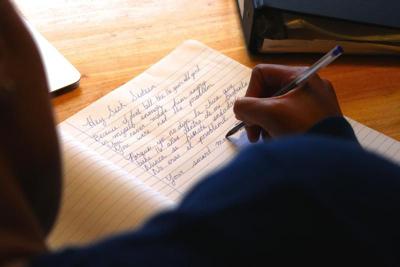

Jimmy Santiago Baca lived a hard knock life, including abandonment as a toddler by his parents, placement in an orphanage, homelessness, drugs, violence and incarceration. But he found salvation in literacy and words, finding his voice in the depths of prison. Poetry turned his pain into power, and helped him climb out of the inarticulate anger and sorrow that had driven his life before.
He's since published his poetry and memoir in 26 books, won an American Book Award, gotten films made from the material, visited the White House, and taught and mentored countless others to help guide them to their own stories. He's doing that now, in fact, at Cesar Chavez Library in Salinas. Like, today.
On Monday, Baca began a two-week memoir writing workshop series, totally free for the 20-25 Salinas residents who signed up earlier (it's no longer open to the public). He's using his latest book, Feeding the Roots of Self-Expression and Freedom as a template to help participants write their own compelling memoirs.
It's coordinated by Garland Thompson, who works for Salinas Public Libraries.
"It's going great," Thompson says. "Yesterday there was some really intense stuff that came up. He's giving [the participants] writing exercises. It's a nice mixture of age, gender and race, from college kids, to people in their 30s, to older folks in their 50s."
Baca isn't the only person conducting a writing workshop in Salinas this week.
California State University Monterey Bay social action creative writing student Selena A. Gonzalez is starting up a poetry workshop, to happen 3-4pm on Fridays, starting Sept. 12 and running til Oct. 24. It's also at Cesar Chavez Library.
She says she didn't know about Baca's memoir workshop. But the two poet's inspiration, similarly, come from tough sources.
"I was doing poetry for myself based on experiences in high school and college that were painful," Gonzalez says. "I wrote about things I didn't want to talk about—abuse, sexual assault, manipulation, verbal abuse. I considered myself a hardcore feminist, but I wasn't living up to that if I wasn't talking about those things."
She talked to friends first. Together, they decided to create a film documentary, inviting other women to speak on their own painful stories on camera. But so many signed up that it grew outside the bounds of what a feature length film could reasonably contain. So the project, under the umbrella organization Not a Pretty Girl Project, branched out. The website has a page to accept submissions of visual arts, film and writing.
Writing had helped Gonzalez, so she wanted to give that gift to other women and teen girls. She's bilingual and can conduct the poetry workshops in English and Spanish. She knew, from her CSUMB community service learning work, that the libraries were important to the Latino populations they serve, so she decided to hold her workshops there.
"I wanted it to be a safe spot for women," she says. "No filming of the workshop. It's just for women and teen girls, absolutely. Even if the content can be very heavy, these are things I experienced as as teen—abuse, eating disorder, sexual abuse—it can happen to teens."
There's going to be new topics each week, peer review, editing, reading aloud, watching videos of other women poets reading. It's set up like a serial, but if she sees new faces each weeks, she's prepared to change the curriculum to accommodate.
"There are so many women should be able to express their voices, even if it's not historically a 'good Latino woman' thing to do," she says.


(0) comments
Welcome to the discussion.
Log In
Keep it Clean. Please avoid obscene, vulgar, lewd, racist or sexually-oriented language.
PLEASE TURN OFF YOUR CAPS LOCK.
Don't Threaten. Threats of harming another person will not be tolerated.
Be Truthful. Don't knowingly lie about anyone or anything.
Be Nice. No racism, sexism or any sort of -ism that is degrading to another person.
Be Proactive. Use the 'Report' link on each comment to let us know of abusive posts.
Share with Us. We'd love to hear eyewitness accounts, the history behind an article.