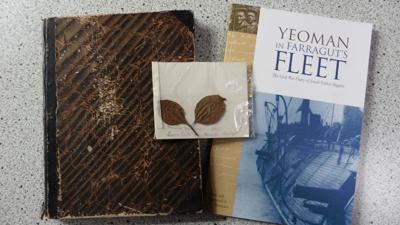

This Saturday, Elaine Herrmann, a local nurse in her 60s, will be at Old Capitol Books 4-6pm this Saturday. She has a story to tell. Or, as she might put it, she is the bearer of a story that found her.
With help from her mother, Herrmann bought and moved into her house in Monterey in the 1980s with her two kids. The house had belonged to her mother's friend, an elderly woman who could no longer inhabit it alone and who subsequently moved into a convalescent home.
While Herrmann was cleaning out the basement, she found a dusty cardboard box of stuff—a woman's straw hat, gift wrap, a couple of carefully annotated photo albums of travels all over Europe and the Middle East. Under that were a couple of ledgers. Or at least that's what Herrmann thought they were.
"It was in beautiful handwriting," she says. "I took the box to the convalescent home to give to my mom's friend. But she gave it back to me. 'What am I going to do with this?'"
She took the box back home. Every now and then Herrmann, who worked as a nurse at local hospitals, would take out the ledgers and look at them. But the faded longhand cursive eluded easy reading.
Years passed.
Then one day she was looking at one of the ledgers and a word "jumped out." That word was Farragut.
"Holy cow!"
She knew that word. It was the name of an admiral in the Union Navy during the Civil War. She remembered it from history class. She began at the beginning and started reading more carefully.
The book opened with a preface: "Dear Diary, it is only with you I can share my thoughts. I cannot share them with these drunken sailors who fall on their swords."
What Herrmann had found was the Civil War diary of a young man named Josiah Parker Higgins, which chronicled the 21-year-old's life from January 1862 to July 1864, including his time as a yeoman (a ship's record-keeper) aboard the gunboat Kennebec under the command of Admiral Farragut.
"I had no interest in military history, but I realized this was a historic document. I had to transcribe it," Herrmann says.
She says she felt like the ghost of this young man had crossed the country and set his hand on her shoulder, tasking her with keeping his story alive. Once she became used to the stylized penmanship, she began transcribing with painstaking patience. And zeal.
"It was like a TV series," she says. "After work, I couldn't wait to get home and see what happened next."
She became engrossed in the story. Time flashed by when she read and transcribed it. Toward the end, she didn't want it to end. She timed the very last word that she transcribed to coincide with midnight on New Year's Eve.
Starting on January 1, 1862, Higgins wrote entries about every two to three days during that period. He writes about his misgivings about working in his father's shoe store in Boston. Higgins was born in Maine and moved when young, but remembers the beauty of the farms, the horses' breath in the snowy cold, the lights of his town.
He writes about his longing to "make [his] life worthwhile." He goes to abolitionist meetings, the Boston Library, the statehouse, political events, a forum on the status of women in Russia. He's well-educated and relatively progressive. He's also religious.
By February, he's joined the Union Navy.
He wrote about the beauty of the Mississippi River, about hearing women on the banks singing: "I had not heard anything so lovely since I left Boston." Herrmann says he recorded gale storms, repairs and deaths, including that thousands who died at Gettysburg. During his ship's attack on Vicksburg, the river was so low they couldn't get their ammunition over the banks of the river.
Herrmann says that he wrote "I can't wait to get out of this war, but if it brings an end to slavery it's worth it…to do something valuable in God's eyes."
During his service, he received letters from his family in Boston. It took weeks for them to arrive and sometimes, as when he received news that his sister was gravely ill, he dreaded their arrival.
He writes of sailing up and down the Eastern Seaboard, from Boston to the Gulf of Louisiana and up the Mississippi River. He records the mission of his ship into one of the most pivotal battles of the Civil War—the Battle of New Orleans.
Here is an entry Herrmann transcribed from Monday, April 21st, 1862:
"We commenced the bombardment of Forts Jackson and St. Philips last Friday morning and are at it now, with what execution we do not now. Thursday night the rebels sent down a fire raft which did no damage whatever."
Herrmann says, "The bombardment of [Confederate forts defending] New Orleans by ships like [Higgins'] broke the back of the Confederacy. The commanders of the two fallen forts came aboard his ship to surrender."
Asked if she's had the diary authenticated, Herrmann says she was not sophisticated enough to think of it. But she did corroborate diary entries with letters by Farragut at the Naval Postgraduate School Library and the National Archives. She sent the transcript to a couple of publishers, both of which expressed interest but wanted her to edit it extensively. After spending so much time transcribing it, she didn't feel up to the task.
But then she got into a fateful car accident which broke her arm.
"Even as the paramedics were pulling me out of the car, I was so grateful," she says. "That accident bought me the time to work on the edits."
She did the edits with typing with one hand. The book, Yeoman in Farragut's Fleet: The Civil War Diary of Josiah Parker Higgins was published in February of 2000.
As to how a rare naval Civil War diary from the East Coast came to live in a basement in a home in Monterey, Herrmann only has remnants of clues she's pieced together. She may expound on that more in her talk on Saturday.
And, there is a second diary. One that an 18-year-old Higgins kept from July 1859 to July 1860, the period of Abraham Lincoln's election.
Herrmann reads one significant passage from that one, a passage that precedes and might explain the young man's quest for a deep, moral and meaningful mission:
"This day I think will ever be memorable in American History. For today, a quarter past 11 o'clock, John Brown was executed for insurrection among the slaves of Virginia. He died nobly, calmly, bravely. All men, whether they believe he was right or wrong, cannot but admire him, all through his trial, through his imprisonment, unto the scaffold. For helping men to freedom, he has forfeited his life and now is free from all slavery and is in the liberty of heaven."


(0) comments
Welcome to the discussion.
Log In
Keep it Clean. Please avoid obscene, vulgar, lewd, racist or sexually-oriented language.
PLEASE TURN OFF YOUR CAPS LOCK.
Don't Threaten. Threats of harming another person will not be tolerated.
Be Truthful. Don't knowingly lie about anyone or anything.
Be Nice. No racism, sexism or any sort of -ism that is degrading to another person.
Be Proactive. Use the 'Report' link on each comment to let us know of abusive posts.
Share with Us. We'd love to hear eyewitness accounts, the history behind an article.