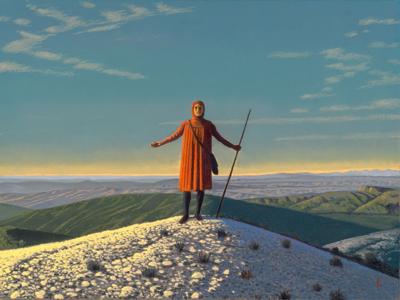

For artist David Ligare, Tuscany is a second home, and the place he has been visiting annually for years. The region is known as the epicenter of the Italian Renaissance and the philosophy of humanism that permeates Ligare’s work and thought.
On Friday, Oct. 2, Ligare’s painting of early Renaissance poet and visionary Francesco Petrarch aka Petrarca (1304-1374) was accepted to the Petrarch Academy of Letters, Arts and Science in Arezzo, the birthplace of Petrarca, about 50 miles southeast of Florence.
Works by Ligare can be found in the collections of the best museums in the world, including the Uffizi Museum in Florence. In 2013, the artist was elected to the Accademia delle Arti del Disegno in Florence. But this honor is special, because Petrarch is so special to Ligare.
“He has been an important conceptual influence on my work for a very long time,” Ligare wrote in an email. “As a scholar, his teaching into the deep past for knowledge, especially his study of Cicero, informed his philosophy of humanism—a system of belief that we very much need today.”
Not thought about in American schools, to Ligare’s great concern, 14th century Petrarch became an icon when it came to poetry and philology. In 1341, he was crowned poet laureate on the Capitoline Hill in Rome. We owe him a discovery of crucial ancient texts, such as Cicero’s Letters.
But Ligare—and he is hardly alone—is most inspired by Petrarch’s thinking, arguably the beginning of modern thinking. In the famous letter he sent from Provence, another region important to Petrarch’s complex biography, he claimed himself to be the first person since antiquity to have climbed a mountain for the view. The mountain was Mont Ventoux; the act of conquering it “for a view” is often interpreted as the first gesture of modernity.
“It is my first belief that, as a culture, we are in need of a renewed passion for knowledge,” Ligare shares. “Petrarch actively sought the ancient wisdom and thought that helped to create the Renaissance. He also invented beautiful new structures in language and, maybe most importantly, he embraced the philosophy of Humanism that, among other things, encouraged ethical behavior, rational thinking, kindness toward others, forgiveness rather than vendetta.”


(0) comments
Welcome to the discussion.
Log In
Keep it Clean. Please avoid obscene, vulgar, lewd, racist or sexually-oriented language.
PLEASE TURN OFF YOUR CAPS LOCK.
Don't Threaten. Threats of harming another person will not be tolerated.
Be Truthful. Don't knowingly lie about anyone or anything.
Be Nice. No racism, sexism or any sort of -ism that is degrading to another person.
Be Proactive. Use the 'Report' link on each comment to let us know of abusive posts.
Share with Us. We'd love to hear eyewitness accounts, the history behind an article.