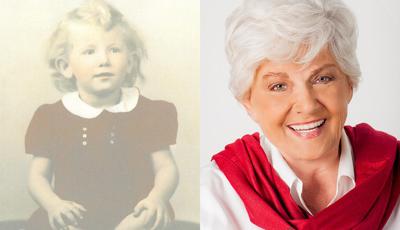

When Barbara Manning was born in 1942, her mother was 15 years old and an alcoholic. Her father, 18, was drafted into World War II. She saw him only twice in her life—once when she was 11 and again at 17. She never learned his name. Manning's mother would lose most of her daughter's childhood to foster care and an orphanage a years-long, traumatic ordeal that has haunted Manning up until now at age 73.
She still feels the residual pain of that time. But she's also learned how to exercise it, too. She wrote a book. It's called Anybody's Daughter - Grow Up With Me in Foster Care (Park Place Publishing). She'll sign it 5-7pm today at Zeph's One Stop in Salinas.
The Carmel resident spoke with the Weekly about her story, divulging some but not all the tough details she chronicles in her book, which takes place on the East Coast.
Manning says she first ended up in foster care because her mother didn't send her to school. When the authorities were alerted to the truancy, they came to her home and found the living conditions rife with abuse and neglect. Manning was sent to a Catholic orphanage while her two younger half-sisters—4 and 2 years old—were sent to elsewhere. She doesn't remember exactly how long they were away.
"There are a lot of blanks in my mind," she says. "When children have trauma, they can disassociate."
At some point they were returned to their mother. But they were together only a year before they were taken away by the State again. They were driven to Camp Lady of the Lake, run by Catholic nuns. One of the most difficult memories is of one nun cutting off her the braids in her hair, which must have felt like a physical manifestation of her childhood being taken away.
"Every time I see a little girl in braids, I remember that," she says.
She and her sisters spent the next two years in that orphanage before their mother convinced the right people that she had stopped drinking. Manning went home with her mother again. She gloated that she would never come back to that place because her mother loved her. But her half-sisters' father kept the younger girls in the orphanage. The sisters would grow separately, and eventually grow apart thereafter.
"I tried," Manning says, "but there wasn't enough of a bond there."
Life with her mother was harrowing. She was still drinking. She brought men by, some of whom tried to molest Manning, who was 11 at the time. It was a fire that broke out that brought the firefighters, and then the authorities, to the home. Manning was removed from her mother's care for good. She found herself back at Camp Lady of the Lake, where she swore she would never return.
"I had to eat crow," she says.
But things were different. During her first stay it had been run by the Grey Nuns of Canada, who she describes as an older, mean and dehumanizing lot. Now it was run by Franciscan nuns, who were younger and more lenient. They allowed piano lessons and ballet.
"They let us be girls," Manning says.
She also bonded with some of them, key adults who would help get Manning through her lonely and sad journey toward adulthood.
"My house mother in the orphanage was Sister Angela," she says. "Somehow I wormed my way into her heart. I became her favorite. She hugged me, touched me, loved me, even though I was an angry teenager. She knew why I was angry."
Sister Angel brought in Father King to act as a father figure to the kids. Manning developed an affirming relationship with him, too. They became surrogate parents.
They were also more committed to finding the orphan girls foster families to live with—boys to work on family farms as laborers, girls to work in family homes as domestics.
"We were slaves. Let's face it. We couldn't do outside school activities. We lived with the families."
But she behaved as best she could and complied, no matter how unfair or cruel the demands. She thought that if she didn't, she would be sent to Marybrook Academy, a sort-of juvenile hall for girls. There, she was sure that she would be killed, or be forced to kill someone to protect herself.
One family she was placed with had 11 kids, and Manning, just a teenager and put up to sleep in the garage with the cars, was expected to be a caretaker. Another family seemed decent enough. But "the lady," as Manning calls her, disapproved of a minor infraction and called a social worker to have her removed.
Manning went on to live in five different foster homes. That's nothing, she says. She's worked with Kinship Center, a California nonprofit that seeks to place kids in permanent homes, for 28 years. Foster kids today are shuffled to a boggling amount of different homes; she encountered one 13-year-old who had been in 43 different foster homes.
Healing came in increments. It started with tragedy.
At age 17, before she could come of age and be emancipated out of the foster care system, Manning's mother died of cirrhosis of the liver. Her drinking killed her. But Manning's own salvation came closer with the tragedy. Knowing that her mother had her own demons helped Manning to understand her mother not blame herself.
"At her funeral, I heard some ladies say 'The poor thing, she never had a chance herself.' Later, when I was with my aunt I asked her what those ladies meant. She told me something that happened to her."
Manning declines to elaborate further.
When she turned 18, she felt suddenly lost and scared. For years she had been told what to do and how to live by foster care guardians, by nuns, by social workers. Now she was on her own.
"Age 18 to 23 is a very precarious time for these kids," she says. "There are a lot of suicides at that age."
But there are bright stories. They go untold because the dark, morbid ones are so compelling. For her, therapy helped her to understand herself.
"A doctor said I had formed a bad habit as a little girl of putting everybody's feelings before my own," she says. "I had to, to survive. I had been doing it so long I had to get therapy at 32 to break that habit, relive the childhood over and over again. It started the healing."
Writing has exercised much of the pain.
The book did not start out as a book. It started as a way to draw out that pain. She wrote in a journal. Then she took a writing class at Hartnell College. Her instructor circled a phrase she wrote in a poem—Manning doesn't remember the phrase now—but she remembers what her instructor wrote to her: "This little girl wants to tell her story."
She started thinking about it in terms of a book. But the story she was letting out was so sad that she didn't think anyone would want to read it.
"The only section I liked was when the child was talking, so I started it all over again and used the voice of a child. I wanted readers to know what it's like to go live with strangers, to not go to the prom because you're working, to be a housekeeper at 14, 15, 16 years old. It was so sad I rewrote it again and put some funny stuff in. Let the reader breathe."
Like one story when, in her freshman year in high school, one nun tried to instill the damnation of hell into their consciousness by decorating the entire classroom in paper mache simulations of flames. Manning says it was unnerving. When that teacher asked the class what they thought, she piped up, "It really looks like hell." Which busted up the class into laughter. Humor as a defense. She wrote it all into the book.
Through the writing, Manning says, "I remember it, but I don't cry about it."
Maybe the most significant healing came when she had her own kids—four of them, one boy and three girls. She realized something about herself.
"I could give them what I didn't have. The most important thing was for me to be there because my mother wasn't. I could have become a doctor or a lawyer, but all I wanted to do was be a mommy."
Her kids, pictured as young adults in the book, all went on to college.
Manning says people can help foster kids by getting involved with Kinship Center, Voices for Children (CASA), or The Epicenter, all in Salinas. There are almost 400,000 foster kids currently in the U.S., according to the Congressional Coalition on Adoption Institute. Her personal message to them is taken from the final few words of her book: "I'm stronger than anything that can happen to me."
Barbara Manning signs her book at Zeph's One-Stop, 1366 S. Main St., Salinas, 5-7pm Friday May 29. For information, call 214-3032.


(0) comments
Welcome to the discussion.
Log In
Keep it Clean. Please avoid obscene, vulgar, lewd, racist or sexually-oriented language.
PLEASE TURN OFF YOUR CAPS LOCK.
Don't Threaten. Threats of harming another person will not be tolerated.
Be Truthful. Don't knowingly lie about anyone or anything.
Be Nice. No racism, sexism or any sort of -ism that is degrading to another person.
Be Proactive. Use the 'Report' link on each comment to let us know of abusive posts.
Share with Us. We'd love to hear eyewitness accounts, the history behind an article.