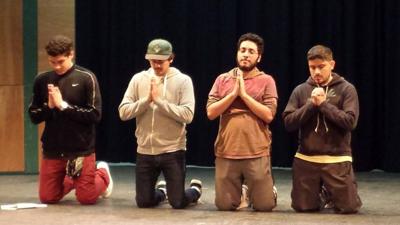

Opening today, Luis "Xago" Juarez and his compadres in the agit-prop hip-hop theater collective Baktun 12 will deliver the third play in their reAlisal series. It's called Mi Abuelito Fue Bracero.
That series began with 2011's reAlisal: Your Neighbor's Story, in which three members of Baktun 12, including Xago, portrayed 40 real-life residents of East Salinas—famous and anonymous—to create a holistic portrait of a place otherwise maligned by stories of gang violence and poverty.
The second piece, reAlisal: Untold Stories of Acosta Plaza was about the housing development officially known as Laurel Townhouses. It played at the Bread Box performance space right in front of the housing projects depicted in the play.
This series has been driven by interviews with East Salinas residents and research, in a documentary method that nearly transcribes real people's stories onto the stage.
Mi Abuelito Fue Bracero (My Grandfather was a Bracero) uncovers hidden stories about the labor program that the U.S. government implemented to lure Mexican men to work in ag fields in the absence of American labor due to World War II.
The idea began with the illness of Xago's father, Luis Juarez Banuelos.
"The play was sparked by a comment he made about his life as a bracero," Xago says.
His father had come to this country in 1951 at age 18 to work as a bracero. Even though the program was supposed to augment ag workers through the lean times of the war, Luis worked off and on under its aegis until 1963. (That's when he went to work for the Spreckles Sugar Company factory for the next 33 years.)
"Growing up, he always glorified those times. He never expressed anything that maybe impacted him in a negative way. It was always about him and the hard work he engaged in. He spoke very proudly of those days."
While battling cancer, Xago was trying to comfort him and convince him that he was going to beat his illness, though it was a tough battle, his father said something in Spanish, maybe half delirious, that would haunt Xago: "Yeah. Tough. Like the life of a bracero."
His father finally lost that battle. But Xago says he carried those words with him. He conducted research to learn more. He and other members of Baktun 12 wrote a Cal Humanities grant to get funding. Then they began interviewing others in the community: men who had worked as braceros, family members of braceros, farmworker advocates.
Xago says the stories followed similar arcs: young men leaving Mexico to come to work in the U.S. to send money home and one day return like prodigal sons. But hardships abounded.
"The living quarters were substandard," Xago says. "The pay was extremely low. These men were basically exploited. They didn't have much advocacy. There was no union organization for these men who were Mexican nationals. They didn't know the language. It made them a lot more vulnerable."
There is a real-life historical event in the play. A 1963 accident near Chualar in which a freight train crashed into a bus carrying 58 bracero workers, killing 32 of them. And Xago says the Bracero Program seeded the subsequent and modern-day continuation of Mexican migrant workers.
But the play's also a work in progress, a one-hour, one-act piece that Xago expects to expand on with more stories, like when advocates began to organize workers prior to the UFW.
The 15 real-life people interviewed are woven by 14 actors (from Baktun 12, El Teatro Alisal and the community) into 40 stage characters along the timeline of one fictional character. It's set in the Mexican state of Michoacan, Santa Clara Valley and Salinas Valley. The play is 90 percent in Spanish, to build a Spanish-speaking audience and to honor the Braceros, who were once exploited for speaking only Spanish.
The play opens today at the Mullins Theater at Alisal High School and runs Friday, Saturday and Sunday, this and next week.
But this Saturday, a special guest panel precedes the show at 7pm. They include Senor Barroso; Rosa Riva, family service advocate for the Alisal School District; Jesus Lopez, outreach officer for California Rural Legal Assistance; Alegria de la Cruz, Legal Director for San Franciso's Center on Race, Poverty and the Environment; Anna Caballero, Secretary of California Business, Consumer Services and Housing Agency; and Juan Martinez, community activist and artist.
"This is a really important time in U.S. history that needs a lot more reflection," Xago says. "The conditions that existed then, in many ways, has not changed for those who do farm labor work."
After the play, the players will ask the audience several questions to inspire them to action.
Did the play make me want to tell my family history? Conduct historical research? Participate in or support community theater? Work for social justice? Honor our elders? Ensure a better future for the next generation?
It sounds like the purpose and the mission of the play itself.
Mi Abuleito Fue Bracero plays 7pm Thursday, Friday and Saturday and 2pm Sunday, June 18-28. Alisal High School, Mullin Theater, 777 Williams Road, Salinas. $10 donation (optional). 204-8797.


(0) comments
Welcome to the discussion.
Log In
Keep it Clean. Please avoid obscene, vulgar, lewd, racist or sexually-oriented language.
PLEASE TURN OFF YOUR CAPS LOCK.
Don't Threaten. Threats of harming another person will not be tolerated.
Be Truthful. Don't knowingly lie about anyone or anything.
Be Nice. No racism, sexism or any sort of -ism that is degrading to another person.
Be Proactive. Use the 'Report' link on each comment to let us know of abusive posts.
Share with Us. We'd love to hear eyewitness accounts, the history behind an article.