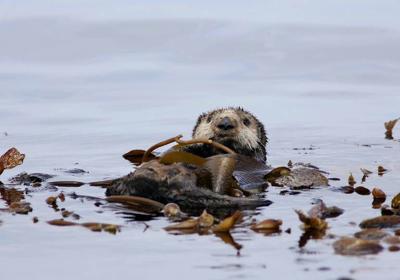

Call it a comeback.
Today the U.S. Geological Survey and its partners released news that will thrill sea otter lovers, but comes with a caveat.
The results of the 2016 sea otter census are in, demonstrating the population of Enhydra lutris nereis is growing.
The Monterey Bay Aquarium is reporting that for the first time since censuses have been gathered, southern sea otters’ numbers have exceeded 3,090.
If the count exceeds 3,090 for three consecutive years, U.S. Fish and Wildlife Service may remove southern sea otters from the “threatened” list under the Endangered Species Act.
Clear weather and calm seas factored into the big numbers observed, as did an abundance of a prime sea otter snack, sea urchins.
However, the increase comes in tandem with a decline in the northern and southern range for the southern sea otter, which worries experts like Andrew Johnson, the lead manager of the Aquarium's Sea Otter Program.
(For more on the changing insight into otters and the territory they cover, also check out recent cover story Otter Eden: How two volunteers changed our understanding of sea otters.")
“We can’t help but feel a sense of cautious optimism at this upward trend in the sea otter population along California’s central coast,” Johnson says, in a statement from the Aquarium. “However, we remain troubled by the apparent inability of these animals to expand their numbers in the northern and southern ends.
"Once sea otters’ range expands, recolonizing historical habitats throughout California, we’ll see similar ecosystem benefits that sea otters have brought to kelp forests and estuaries.”
More from the Aquarium's Science and Conservation department report appears here:
This year’s survey results suggest an increasing trend over the last five years of more than 3 percent per year.
The population index, a statistical representation of the entire population calculated as the three-year running average of census counts, has climbed to 3,272, up from 2,939 in 2013.
The growth is accounted for by an unexpected jump in numbers in the center of the sea otter’s range, an area that spans the Californian coast from Monterey south to Cambria.
“We believe the high count this year is partly explained by excellent viewing conditions, but it also appears to reflect increased food availability in the range center,” says Dr. Tim Tinker, a research ecologist who leads the USGS sea otter research program. “The boom in sea urchin abundance throughout northern and central California has provided a prey bonanza for sea otters, and that means more pups and juveniles are surviving to adulthood.”
While the overall population index continues to trend upward, the northern and southern subsets of the population continue a negative five-year decline, dropping 2.5 percent and 0.6 percent per year.
“We are still seeing large numbers of stranded otters near the range peripheries, a high percentage of which have lethal shark bite wounds,” says Mike Harris, a biologist with the California Department of Fish and Wildlife. “These deaths may explain the lack of population growth in those areas.”
Declines at the range ends have implications for the long term outlook for sea otter recovery. “Negative population trends at the edges of the range are probably responsible for the lack of range expansion over the last decade,” explained Tinker. “These are the portions of the population that typically fuel the colonization of new habitats.”
In addition to the sea otter population along the mainland coast, the USGS also surveys the subpopulation at San Nicolas Island in the southern California Bight.
This population, established by translocation in the late 1980s, struggled at low numbers through the 1990s, but over the last decade has been growing rapidly with a mean growth rate of 13 percent per year.
“The sea otters at San Nicolas Island continue to thrive, and some may eventually emigrate to and colonize other Channel Islands in southern California,” says Brian Hatfield, the USGS biologist who coordinates the annual census.
Since the 1980s, USGS scientists have computed the annual population index and evaluated trends in the southern sea otter.
To reach the optimum sustainable population level under the Marine Mammal Protection Act, which is the number of animals that will result in the maximum productivity of the population while considering carrying capacity and ecosystem health, the southern sea otter population would likely have to reach as many as 8,400 animals in California.


(0) comments
Welcome to the discussion.
Log In
Keep it Clean. Please avoid obscene, vulgar, lewd, racist or sexually-oriented language.
PLEASE TURN OFF YOUR CAPS LOCK.
Don't Threaten. Threats of harming another person will not be tolerated.
Be Truthful. Don't knowingly lie about anyone or anything.
Be Nice. No racism, sexism or any sort of -ism that is degrading to another person.
Be Proactive. Use the 'Report' link on each comment to let us know of abusive posts.
Share with Us. We'd love to hear eyewitness accounts, the history behind an article.