
The latest indicator of shifting ocean temperatures is hard to miss, even if it's only an inch long.
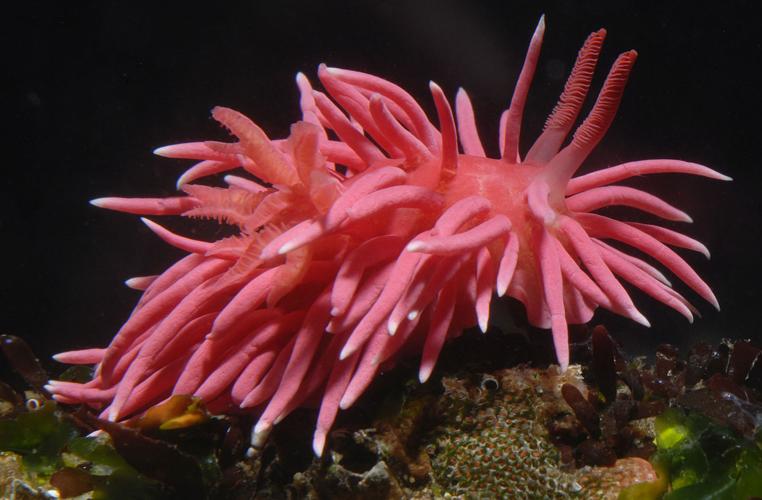
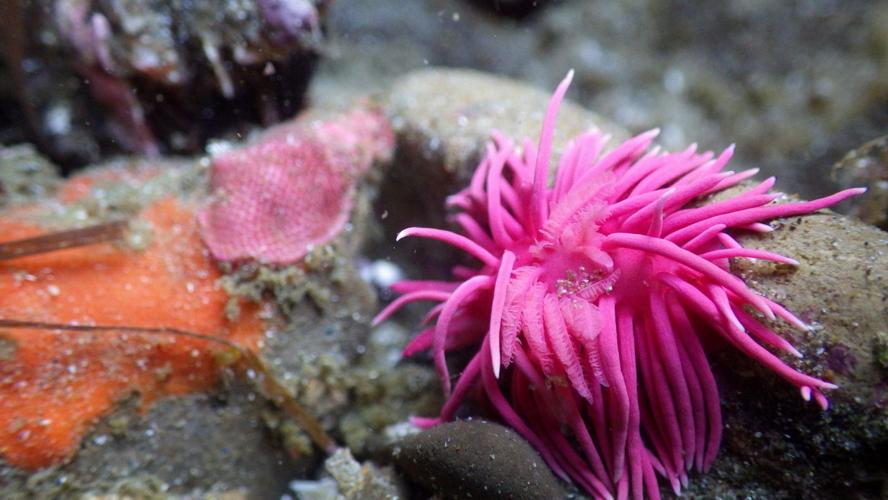
That's because the sea slug appearing more and more in tide pools along the central and northern California coast is electric pink, and covered with what looks like thick hairs or tentacles (that are actually called cerata).
The Hopkins rose nudibranch (aka Okenia rosacea) normally plugs along southern California shores and occasionally visits central California, but it rarely ventures north of San Francisco.
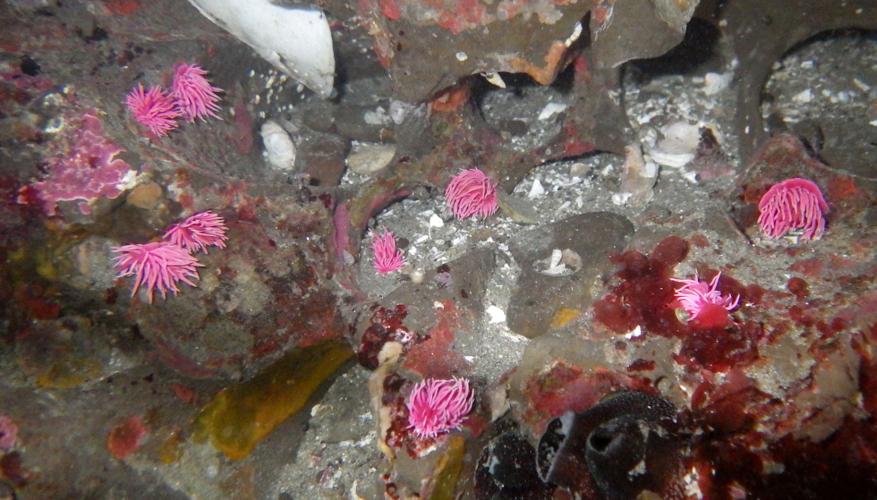
In the past few weeks, however, researchers have counted dozens of sea slugs per square meter in some tide pools from San Luis Obispo all the way up to Humboldt Counties. That's according to a report out today from UC Santa Cruz, with researchers from UC Santa Barbara, Bodega Marine Laboratory and the California Academy of Sciences.
"We haven't seen anything like it in years," says John Pearse, professor emeritus of ecology and evolutionary biology at UC Santa Cruz. "These nudibranchs are mainly southern species, and they have been all but absent for more than a decade."
Other highlights from the report:
• Because they are fast-growing, live for a year or less, and move little as adults, these nudibranchs are potentially useful in tracking relatively rapid changes in ocean conditions. The current population bloom has the researchers wondering if the nudibranchs are signaling, as a sort of zoological semaphore, another major climate shift from cold to warm coastal waters.
• These are the highest numbers and northernmost records of this species seen since the strong El Niños of 1998 and 1983.
• Pearse and other researchers have been conducting surveys of nudibranchs at study sites along the California coast for decades. "What makes this event especially exciting for us is that in 2011 we published a paper in which we predicted that oceanographic conditions like we are now experiencing would be marked by heavy recruitment of these and other nudibranchs. It's just wonderful to see the prediction coming true," Pearse says.
• Unlike the last time Okenia rosacea bloomed on the central coast, the El Niño is weak this time around. According to Jeff Goddard, a project scientist at UCSB's Marine Science Institute, the current population bloom is similar to the one he observed on the Central Coast starting in early 1977. That bloom was also during a weak El Niño, but it happened to coincide with a major climate shift in the eastern Pacific Ocean known as the Pacific Decadal Oscillation. That shift marked the beginning of more than two decades of coastal water temperatures that were elevated compared to the preceding 30 years, triggering range shifts in numerous coastal species, including gastropods, barnacles, fish, and dolphins.
• During those warm decades, fluctuations in the abundance of intertidal adults of Okenia rosacea and other nudibranchs in central California were driven by regional oceanographic influences on currents and larval recruitment. Warm temperatures, northward-directed currents and weak upwelling all contribute to the boom.
• Like the previous population explosions of Okenia rosacea, the current bloom has also been accompanied by other sea slugs normally found farther south, including the bright purple and orange Spanish shawl (Flabellina iodinea) and the California sea hare (Aplysia californica).
• The prey for Hopkins rose nudibranch is a rose-colored encrusting bryozoan on which it feeds during its entire benthic life and from which it derives its pink pigmentation.
• Good locations to view the current bloom of Okenia rosacea in Central California include rocky shore tidepools and underneath ledges at Montaña de Oro and Asilomar State Parks, Scott Creek Beach, Pigeon Point, Pillar Point, and Fitzgerald Marine Reserve.
• Minus tides are the best viewing opportunities—consult a tide table like NOAA's—preferably when both the swell and wind are low.


(0) comments
Welcome to the discussion.
Log In
Keep it Clean. Please avoid obscene, vulgar, lewd, racist or sexually-oriented language.
PLEASE TURN OFF YOUR CAPS LOCK.
Don't Threaten. Threats of harming another person will not be tolerated.
Be Truthful. Don't knowingly lie about anyone or anything.
Be Nice. No racism, sexism or any sort of -ism that is degrading to another person.
Be Proactive. Use the 'Report' link on each comment to let us know of abusive posts.
Share with Us. We'd love to hear eyewitness accounts, the history behind an article.