
Sara Rubin here, looking at the forecast for King Tides—very high highs, and very low lows—with the suggestion that you get outside along the coast to experience it yourself. The high tides are extraordinary displays of ocean power. But I’m most enthusiastic about the low tides, when you can walk (carefully, pretty much every surface is covered in life) into areas normally underwater. Tidepooling is like snorkeling but without getting wet.
During the King Tides last month, I went tidepooling at Carmel Point. At first, I saw the landscape—an expanse of kelp, sea grass, mussels and anemones. After just a minute with a pause and deeper look, every tidepool is teeming with energy and movement. What looks like just a shell is in fact home to a skittering crab.
Lots of what is moving is moving much slower in this invertebrate-dominated realm. There’s an anemone dining, as it wraps its tentacles around a tiny morsel. Sea urchins reveal themselves not to be stationary—there’s a spine poking around. Same for sea stars, which come in different varieties and colors—there are radiant crimson bat stars, and tiny blue six-armed sea stars that can fit on a fingertip.
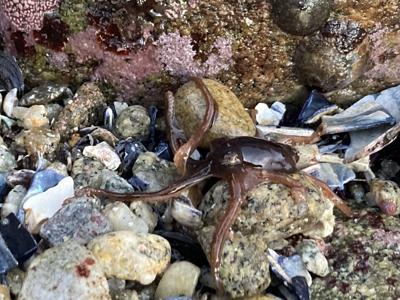
Then, my eyes caught a little ball of slime. It was something weird, unusual, a purplish blob. I leaned down a little closer, and as it moved along the damp ground (not underwater), a tiny octopus came into focus.
I’ve been searching for octopuses ever since I moved to Monterey County, and this species, the Pacific red octopus, is plentiful. But it’s a master at hiding, making it tough to spot. And in a place where charismatic megafauna grabs the attention—whales spouting, sea lions leaping, sea otters slamming shells open against rocks—I might’ve grown distracted in my mission to catch a tiny spot of oozing slime.
But when I did, what a thrill—an eight-armed creature with a body about the size of my thumb, cruising over the surface of rocks and broken shells. Instead of hiding out behind a rock, it flattened itself again into a puddle of slime, and changed color to camouflage, turning from a deep purple in one spot to a mottled tan with gray speckles in another.
“They are really good at camouflage and really good at making themselves really, really small,” says Paul Clarkson, director of husbandry operations at the Monterey Bay Aquarium.
Clarkson estimates the one I saw was a few months old at most. The babies spend their time here in the intertidal zone, then larger adults venture out deeper, hundreds of feet below the surface, and grow up to a tennis ball or orange size.
This wildlife safari is available to all of us, at any low tide (not just King Tides, although those do offer more surface area). There is magic and complexity and drama to discover in the intertidal zone—and it requires no special equipment. (I do recommend sturdy, waterproof shoes, a warm jacket and a headlight, especially for low tides that arrive at dusk.)
Just move with caution, as virtually every bit of surface area is covered with living things. “Walk with respect, knowing that hundreds of thousands of animals make their homes there,” Clarkson says. “Visit like you would a good friend's home.”
I like thinking about tidepooling as visiting a friend’s home—we are welcome to experience the wonder and beauty of a world different than our own.


(1) comment
A great activity for those of us trying to learn to slow down and deepen attention. And a reminder that, though humans think themselves the center of things, the natural world has its own headlines and schedules.
Welcome to the discussion.
Log In
Keep it Clean. Please avoid obscene, vulgar, lewd, racist or sexually-oriented language.
PLEASE TURN OFF YOUR CAPS LOCK.
Don't Threaten. Threats of harming another person will not be tolerated.
Be Truthful. Don't knowingly lie about anyone or anything.
Be Nice. No racism, sexism or any sort of -ism that is degrading to another person.
Be Proactive. Use the 'Report' link on each comment to let us know of abusive posts.
Share with Us. We'd love to hear eyewitness accounts, the history behind an article.