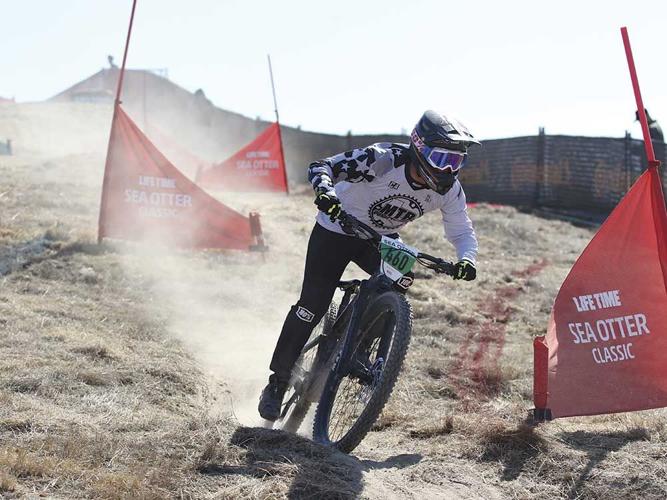
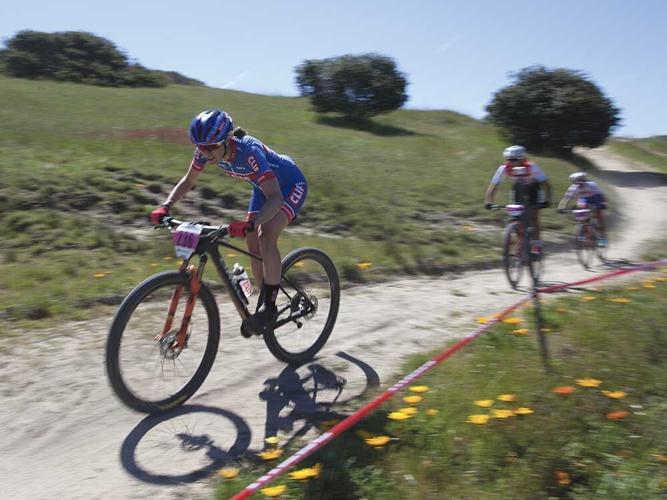

The Sea Otter Classic officially started in 1993, almost 30 years ago, but it was born two years earlier when – before it was rebranded – the event was called the Laguna Seca Challenge.
In the decades since, Sea Otter has become a phenomenon, and in 2019 had more than 70,000 attendees and 9,000 athletes. Arguably, it has become the premier cycling festival on the planet.
And its evolution continues: Last summer, the fitness company Life Time – which owns more than 150 “athletic resort destinations,” per the company’s website – bought the rights to Sea Otter, and it became the biggest of several athletic events the company has acquired in recent years.
On its surface, one might not think that’s a good thing: a corporation bought up an event beloved both locally and throughout the cycling community worldwide. But when looking at from another perspective – where the rubber hits the road (or perhaps the trail in most cases) – the view looks quite different.
That’s because Life Time is trying to elevate the event to another level. While the first Sea Otter Classic under Life Time’s ownership was last fall, it was a downsized affair. The event has historically happened in the spring, but due to Covid, it was canceled in 2020, and in 2021 it was pushed to October to allow a scaled back version.
But Sea Otter is now back in its traditional spot on the calendar and fully revved, perhaps more than ever before.
In an effort to promote off-road cycling, Life Time has launched a Grand Prix – six different races, with separate competitions for men and women, each pitting 30 competitors against other pros and the course. Those that fare well will share $250,000 in prize money, divided evenly between both men and women.
It’s a good-faith effort to make off-road cycling what it has never been before, a bonafide spectator sport. And in order to facilitate that, the company will be filming the signature event – the first race of the six-race Grand Prix – an 80-kilometer race dubbed Fuego, over two 40-kilometer loops on the former Fort Ord property.
There will be fixed cameras. There will be videographers on ATVs and motorcycles with cameras, and there will be drones. There might even be helicopters, but that’s still up in the air (pun intended).
The aim, says Kimo Seymour, Life Time’s president of media and events, is to create a docuseries of the Grand Prix season that will hopefully get picked up by a streaming platform. Seymour estimates the project will be completed by December.
“It’s new territory” Seymour says. “I don’t know that anybody’s tried this or done it successfully in the U.S.”
The concept of a successful Grand Prix extends beyond the course. Seymour says a key requirement is that the athletes mix with fans – Life Time wants the audience to feel invested in the riders.

One of those athletes is Alex Wild, who lives in San Jose and both works for and is sponsored by Specialized, a bike company based in Morgan Hill. For Wild, one thing that makes this year unique is that it’s the “first time there’s been a series for so many different types of racing.”
Ostensibly, the Life Time Grand Prix presented by Mazda has three mountain bike races and three gravel bike races (the Fuego being one of the former), but in reality, it’s harder to define. That variety, Wild says, is what makes it intriguing.
“You could probably justify using four different bikes across these events. That’s interesting,” Wild says, adding – for the gearheads out there – “You could geek out on equipment as well.”
Given that he has a full-time job, Wild might be at a disadvantage in this year’s Grand Prix, but professional rider Sarah Sturm – a privateer – isn’t so sure. She says Wild is on his game. That being said, she adds, “He’s an anomaly.”
Sturm, who lives in Durango, Colorado, is excited that the Grand Prix series as a whole includes both mountain bike and gravel bike races. Some riders specialize in one or the other, so the series challenges the spectrum of talent.
The Fuego 80k will be the first race of the Life Time Grand Prix presented by Mazda, but it won’t be closed off to amateurs. “Anybody that wants to throw their leg over a bike can line up right next to the pros,” Seymour says. “But they don’t usually hang with the pros very long.”
That checks out. Sturm, when explaining how she arrived at the top level, says, “I just happen to be very good at doing it for a long time, and suffering.”
Both Sturm and Wild want to see the sport grow into a spectacle. And Seymour seems to be on the same page – he wants to make off-road cycling a spectator sport, and believes it can and should be one.
“I’m making that a personal mission to make that happen,” he says.


(0) comments
Welcome to the discussion.
Log In
Keep it Clean. Please avoid obscene, vulgar, lewd, racist or sexually-oriented language.
PLEASE TURN OFF YOUR CAPS LOCK.
Don't Threaten. Threats of harming another person will not be tolerated.
Be Truthful. Don't knowingly lie about anyone or anything.
Be Nice. No racism, sexism or any sort of -ism that is degrading to another person.
Be Proactive. Use the 'Report' link on each comment to let us know of abusive posts.
Share with Us. We'd love to hear eyewitness accounts, the history behind an article.