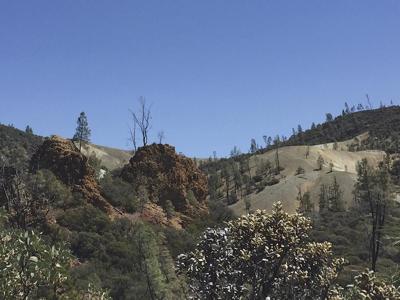

Bring your pickax and shovel on a camping trip or a hike, and turn your gaze to the ground—all of a sudden you’re on a mission of recreational mining, more commonly called “rockhounding.” There are colorful and semiprecious stones all around us, and on many public lands, they are available to legally pick up and carry home. If you’ve ever noticed a pretty rock and put it in your pocket, you’ve been rockhounding. But this activity can also be elevated to a more serious commitment; learn the specific rocks you’re looking for and how to identify them in the wild, then take them home and tumble them for a cleaner, shinier look. Rockhounds love the Clear Creek Management Area in San Benito County, overseen by the U.S. Bureau of Land Management’s regional office in Marina. Here, amid otherworldly hills, watchful rockhounds search for more than 150 semi-precious minerals and gemstones including jadeite, cinnabar, tremolite, topazite, neptunite and the California state gem, benitoite, which is incredibly rare and found only in a few places in the world. (Benitoite was discovered in San Benito County in 1907.) “It’s the thrill of the hunt, getting out in nature with friends or not,” says rockhound Stan Richardson from Sacramento. “Much like an Easter egg hunt.” Before rockhounding, check in with land managers, including BLM, about required permits. [SR]


(0) comments
Welcome to the discussion.
Log In
Keep it Clean. Please avoid obscene, vulgar, lewd, racist or sexually-oriented language.
PLEASE TURN OFF YOUR CAPS LOCK.
Don't Threaten. Threats of harming another person will not be tolerated.
Be Truthful. Don't knowingly lie about anyone or anything.
Be Nice. No racism, sexism or any sort of -ism that is degrading to another person.
Be Proactive. Use the 'Report' link on each comment to let us know of abusive posts.
Share with Us. We'd love to hear eyewitness accounts, the history behind an article.