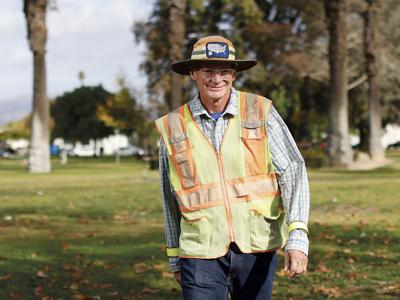

Phillip Deutschle is a California native who has traveled and taught around the world, from Botswana to Bolivia, Denmark, the Navajo Nation and Salinas.
“As a science teacher, I could get a job anywhere,” Deutschle points out. He taught both science and astronomy with Salinas Union High School District and continues to lead astronomy classes at Hartnell College.
Deutschle retired from SUHSD and took a break from teaching last year. But he did not use the time to rest. He decided to walk across the U.S.
Being a marathon runner in his spare time, he knew that he could handle the stroll. And since he would meet a lot of people along the way, he wanted his journey to have a purpose. So Deutschle decided to bring awareness to the 988 National Suicide Prevention Lifeline, a 24-hour crisis line.
He had a powerful reason to do so. His father and older brother both died by suicide.
“He [brother Cecil] was my hero,” Deutschle says. “He taught me chemistry, taught me how to use a slide rule.” Deutschle notes that decades ago mental health was a taboo subject. Fortunately a lot has changed since then. He observes that more people open up about their mental health struggles, especially since the pandemic.
During his trek, he distributed cards from California to New York sharing the 988 number, his name and the phrase “protect your mental health and live your dreams.” Deutschle, who doesn’t own a car, planned his route based on cycling maps, and every 500 miles he would receive a pair of shoes in the mail. In total he used seven pairs to walk across the country. “My brain is still walking,” Deutschle says.
Weekly: What was your favorite part of the trip?
Deutschle: The area I enjoyed the most was going back to the Navajo Nation. It was easy to camp just off the side of the road in the sand. I was able to see my old school and visit colleagues and friends of mine there. And it felt very comfortable – very comfortable, because I spent years there. So it felt like home.
What is your takeaway from this?
The value of thinking of one day at a time. I was so filled with anxiety, because we’re worried about tomorrow and the next day and the week after that, and how’s this going to turn out, and you have to be aware of those things.
But we don’t live next week – we live right now. You need to do what’s required. When it comes down to living and how you feel, it’s got to be just based on right now.
Why teach astronomy?
There’s always something fascinating going on. It’s got all the extremes. And it’s the ultimate wilderness. We haven’t been there except to the moon and send little spacecraft here and there. And wherever you are, you can look at the sky. So it’s always available.
Have any discoveries excited you?
One that blew my mind is when we discovered that the expansion of the universe is accelerating and that would be the same as if you took a ball and you throw it up in the air. Normally, you throw up a ball, the air goes up, it slows down and falls back. But imagine you threw a ball in the air and it just kept going faster and faster and faster, and just zipped away from you. That’s what the universe is doing – and that doesn’t make any sense at all. Nobody has the slightest idea how this could be happening.
How does travel change your view of the world?
It broadens you. It’s a matter of, on one level, recognizing that foods and cultural activities and languages and dress can be very, very different, but at the same time, our core values are so similar. Everybody wants to take care of their children. Everybody wants to be good to the people around them. And by looking at that, it’s not such a big jump to live in another country.
So you don’t experience cultural shock?
In America, children are taught from the very beginning you sit alone at your desk and do your work and don’t share it with anybody else, because that’s cheating. In Nepal, for example, the kids learn that helping people around is all good. So what we would consider cheating was just helping your friends. Everyone reads aloud and writes aloud, which is really good for your brain, because you learn things much better when you use the other side of the brain. But that means if you’ve got a classroom of students, they’re all reading the questions to the test and speaking their answers out loud as they’re writing them.


(0) comments
Welcome to the discussion.
Log In
Keep it Clean. Please avoid obscene, vulgar, lewd, racist or sexually-oriented language.
PLEASE TURN OFF YOUR CAPS LOCK.
Don't Threaten. Threats of harming another person will not be tolerated.
Be Truthful. Don't knowingly lie about anyone or anything.
Be Nice. No racism, sexism or any sort of -ism that is degrading to another person.
Be Proactive. Use the 'Report' link on each comment to let us know of abusive posts.
Share with Us. We'd love to hear eyewitness accounts, the history behind an article.