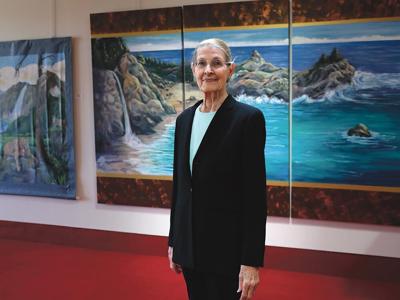

Linda Pedrazzini Hevern, 80, has been an artist and art educator for most of her life. She is the key person behind the multi-artist project exhibited in 2022 as Retrospective: Arts As Healing in Juvenile Justice at the Walter Lee Avery Art Gallery in Seaside City Hall. Hevern was the person who worked with the artists – incarcerated youth via Monterey County Probation Department’s Youth Center – for eight years, developing the program from scratch.
Initially trained as a marine biologist, Hevern pursued art all her life. She ended up becoming a specialist in teaching others how to use art to crack trauma, start the healing process and – through collaboration – make the first step back to society.
The intense part of the journey, Hevern says, began after her cancer diagnosis in 1994, when she first had to develop “healing modalities for myself.” Soon she was showing others how to self-heal through art, doing public workshops for cancer survivors in senior houses and hospices. In the process, she did work in organizational development, acquired a master’s degree in creative interdisciplinary arts, taught scuba diving and worked with countless groups, from homeless people to residents of psychiatric facilities.
The program at the Youth Center was made possible by the California Arts Council JUMP StArts. Hevern and her team lead students to develop skills in painting, mixed media, multimedia and design while learning to reduce anxiety, communicate feelings, develop empathy and respect others.
Weekly: Should we start with you as an artist?
Linda Pedrazzini Hevern: I myself started with oil, moved to acrylics, and then to graphics. But the more I was teaching others, the less I was concentrating on my own art.
Tell us about your first exposure to art and the world.
My grandmother was a painter. I used to watch her paint. I remember mother was curious about the government. She took us to see McCarthy’s hearings when we were in D.C. My father was an Air Force pilot who worked overseas. I went to school in Norway and it was a great experience with arts and culture – I’ve seen fjords, but also the parks and statues they have, how much they cared about culture. But it was also an isolating experience for us children. The Cold War was raging. I was 16 when I got back to the U.S.
It’s interesting that you ended up helping children of that age.
Yes, of course it was a long road to teaching art at Probation. At first, I was asked to come to work with students at a regular school. They had difficulties after seeing their friend being shot. That was an important moment for me.
And how did your work with the Probation Department start?
I was invited to a city of Salinas meeting. I remember that I was very concerned. It was maybe 2009. It was a crisis, so many kids were dying from gang violence. I met with the probation chief. I told them, I’m proposing art as a solution. [Laughs.] After that, I worked with Behavioral Health and they guided me to the Youth Center.
And what did you find there?
Those kids had no exposure, no ways for opening their minds. They haven’t seen the ocean. A lot of it started with just asking them what they would like to do. Maybe building the sculpture? Those kids are actually very intuitive, very creative. We’ve done mask-making from the very beginning. Symbols are so powerful. They seize the imagination and move people. One boy, Omar, once told me: “My hands just know what to do.” We got him a scholarship before his mother took him away from Salinas.
What’s the first step?
We worked in rotating groups. There was always someone from the previous group. Those boys would become leaders of the new group. They would show what is possible just by doing this. The new kid would see the guy next to him is doing this. The skills start to build up. That’s why collaborative works [group paintings, murals] are so important to us – the face-to-face contact, the graduation ceremony.
What is the future of the program?
That’s the problem. I hope the program will continue in some form. There is no funding like we had back in 2013, and the Youth Center has a new team in charge. So there are some administrative problems. So much of it is relationships.


(0) comments
Welcome to the discussion.
Log In
Keep it Clean. Please avoid obscene, vulgar, lewd, racist or sexually-oriented language.
PLEASE TURN OFF YOUR CAPS LOCK.
Don't Threaten. Threats of harming another person will not be tolerated.
Be Truthful. Don't knowingly lie about anyone or anything.
Be Nice. No racism, sexism or any sort of -ism that is degrading to another person.
Be Proactive. Use the 'Report' link on each comment to let us know of abusive posts.
Share with Us. We'd love to hear eyewitness accounts, the history behind an article.