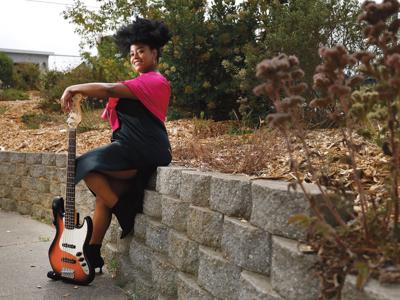

From a young age, growing up in Cuba, Celia Jimenez knew she wanted to be a musician. She began with piano lessons at the age of 5.
“In Cuba, music is a highly respected career and you dedicate yourself to it from childhood,” Jimenez observes.
But her career was almost derailed. When Jimenez was just 10, a music school was prepared to deny her enrollment, considering her hands too small. Fortunately, a bassoon instructor recognized Jimenez’s talent.
When Jimenez was 18, she learned how to play electric bass. “That was sort of my gateway to the world and to many musical opportunities,” she says.
Jimenez was part of the Cuban-Canadian band Jane Bunnett & Maquequew for nearly a decade. They were nominated for the Grammy for Best Latin Jazz Album in 2018.
But her interests extend beyond music. Jimenez moved to the Peninsula to study translation and interpretation at Middlebury Institute of International Studies and now translates content for the Monterey Bay Aquarium.
Still, she continues to play music with various groups including Yeobo, a psychedelic rock band based in Santa Cruz, and is venturing into composing.
Weekly: First, you’ve got a great name. Are you named after Celia Cruz, by any chance?
Jimenez: I have the same name as Celia Cruz, an iconic figure in Cuban music. It is a happy coincidence. My sister’s name is Carmen, and my mom wanted a name that started with that letter as well.
Who is your favorite Cuban artist?
Does it have to be just one?
[Laughs] You can name as many as you want.
My all-time favorite artist is also a bassist, composer and singer – a multi-instrumentalist talent. His name is Alain Pérez. I love his music; in fact, it has inspired me to compose and to try out new ways of playing the bass. There’s also a young contemporary artist named Cimafunk. As the name suggests, it’s a blend of Cuban music and funk. He’s a genius and is really making waves right now. And among the classics, there’s Isaac Delgado – a Cuban salsa and timba artist who is one of the best voices in that genre in Cuba. I’ve liked him since I was a little girl, ever since my mom used to listen to him. Then I started listening to him, too – and I still do.
How do Cuban timba and salsa differ?
Cuban timba is rhythmically more intricate, more elaborate and differs from salsa. Salsa would be like Marc Anthony. Cuban timba would be Alain Pérez, Habana D’Primera – which is musically top notch. It is super, super elaborate. All the instruments are there, all the instruments play a fundamental role. It is something that is well thought out and it is also for dancing, not just for listening. I would say that Cuban timba is like jazz to dance to.
What do you feel when you step onto a stage?
It’s the best feeling in the world – especially because reaching that stage takes many, many hours of dedication and preparation. My next step in this evolution is to take on a dedicated role as a bassist and composer. I am working on releasing my single later this summer.
Any sneak peek?
It’s Cuban music, but it’s not salsa. It’s like a blend of punk and Cuban timba. It has deep Cuban roots – Spanish lyrics and instrumentation typical of the genre, such as Cuban percussion, bass, piano, horns and vocals.
How did you end up in the U.S.?
I left Cuba in late 2016 or early 2017. It happened through music, because I was on tour with a Canadian band.
Cuba is a country where, unless you live there or have family there, you cannot understand the day-to-day decline, and that is why people leave.
Do you miss it at all?
Everything reminds me of Cuba because my whole family is there. That’s where I came from. I think that if my family were here, I wouldn’t miss Cuba so much.
I do whatever is within my means to help them, because life here isn’t easy either. You think, “I’m going to the United States,” but when you arrive, it’s a different kind of trauma, it’s a completely different experience. You constantly need a job to pay your rent and cover your basic needs. That’s fine, of course, but you’re coming from a country where that simply doesn’t exist. So, it’s about getting used to that without a support system. Being an immigrant isn’t easy. People do it because it is in human nature to want to progress.


(0) comments
Welcome to the discussion.
Log In
Keep it Clean. Please avoid obscene, vulgar, lewd, racist or sexually-oriented language.
PLEASE TURN OFF YOUR CAPS LOCK.
Don't Threaten. Threats of harming another person will not be tolerated.
Be Truthful. Don't knowingly lie about anyone or anything.
Be Nice. No racism, sexism or any sort of -ism that is degrading to another person.
Be Proactive. Use the 'Report' link on each comment to let us know of abusive posts.
Share with Us. We'd love to hear eyewitness accounts, the history behind an article.