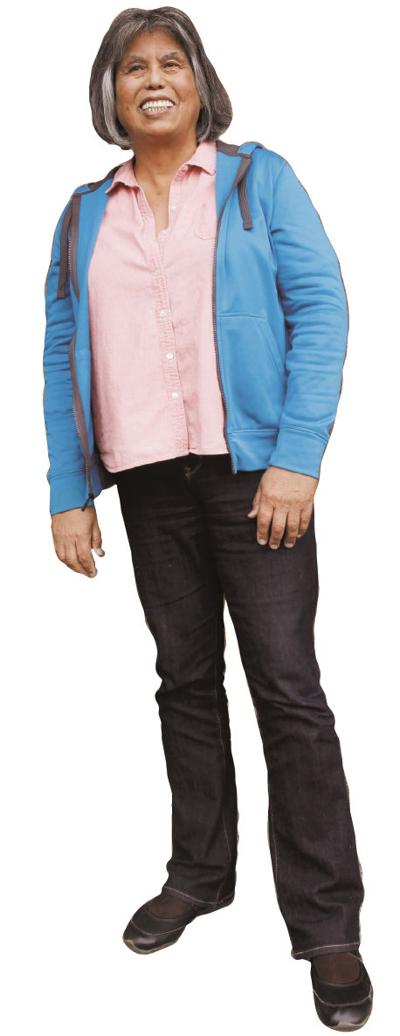


When Cameron Garcia steps out of her sea foam green Fiat, she dwarfs the tiny Italian car with her statuesque 6-foot-tall figure. Despite her height, she’s not at all daunting to approach. She even urges strangers to call her Lola Cam, or Grandma Cam in Tagalog.
In part, the title is literal – she has three grandchildren – but she’s also earned the title by sharing her wisdom as a trans woman of color with a younger generation through the Rainbow Speakers and Friends, a local volunteer group of members who share their experiences in the LGBTQ+ community.
The Weekly caught up with Garcia, 67, at her usual coffee and lunch haunt, Coffee Mia in Marina, days before she was set to speak at the Peninsula Pride Celebration.
Weekly: Do you think there’s a difference in the way trans people are perceived in different cultures?
Garcia: I think so. When people know that I’m Filipino, especially other Asians, they think, “Oh, you don’t have any troubles as a trans person, because it’s ‘accepted’ in the homeland.” I guess they get that perception from old wives’ tales or from folklore they may have heard from the region. Bakla (gay or effeminate) were often seen as sacred – people who werebakla are associated with having a third eye or were considered shamans. It really is just a way of saying they were “different,” gender-wise. But that doesn’t mean we don’t have struggles today, especially living in another country.
Did you always know you were transgender?
Sort of. There wasn’t a word for it then. But I was a rough-and-tumble kid and hung out with boys. I just happen to wear women’s clothing.
Tell me a little bit about your time in the military.
I joined the Army from 1969-71 and I was stationed in Germany. I was on the team that handled the Pershing Missile System. My team made sure the Soviets didn’t invade. If [the Soviets] tried anything, they would run into a radioactive cloudburst. It was a suicide mission though – if we denotated the missiles, they’d eventually fire back at us too.
Why did you join the Army in the first place?
Well, it was either that or get drafted into Vietnam. I wanted some control over my future, so I asked where could I go that wasn’t Vietnam. Plus, I liked the uniforms.
What was life like for you in the Army?
A lot of queer men joined the Army because it was the opposite of what they were supposed to be doing. They call it hyper-masculinization. If you do the opposite of feminine behavior, like put yourself on the front lines or in a special task force, it’s hard for people to talk.
But I remember people who would just disappear when I was working in Fort Ord. They’d just be discharged without a word. Half the people I worked with disappeared, including the entire Russian translation class. There was definitely a witch hunt in the ’70s.
I was never caught. I got away with a lot. At some point I had the barracks to myself. I would go to the Post Exchange and buy a pair of nylons to wear in my room. No one would question it because if you had to spit shine your shoes, you’d do it with nylons. I wasn’t putting on drag shows like some of the other guys.
When I hung out with the other guys, we went drinking, smoking and we went to bars. They’d comment on a girl, wondering what she was wearing underneath her clothes. I’d look at a girl and wonder if I could fit into her underwear.
You often speak at panels in schools. What are people most curious about when you speak at an event?
I was at Everett Alvarez High School and it’s interesting because I always get picked for the most questions in the panel. I think most youth generally know being gays and lesbians, but they’ve never seen a trans person, let alone an Asian one. They want to know about my dating life or if I am lesbian. I have to explain to them I’m a post-menopausal woman, who’s married – I’m not dating! I also have to explain that I’m not lesbian. I’m what they call a “chemically-enhanced woman,” who has a wife.
What role do you play in the LGBTQ+ movement?
I think there are two types of activism. There’s the kind you’re out there in the street shouting, and then there are people like me who can talk about how it was back in the day. My biggest role now is to make people understand that people of color have different issues, and more so when they’re transgendered.


(1) comment
Each to their own but personally, enjoying wearing women's clothing doesn't justify altering one's physical attributes.
Welcome to the discussion.
Log In
Keep it Clean. Please avoid obscene, vulgar, lewd, racist or sexually-oriented language.
PLEASE TURN OFF YOUR CAPS LOCK.
Don't Threaten. Threats of harming another person will not be tolerated.
Be Truthful. Don't knowingly lie about anyone or anything.
Be Nice. No racism, sexism or any sort of -ism that is degrading to another person.
Be Proactive. Use the 'Report' link on each comment to let us know of abusive posts.
Share with Us. We'd love to hear eyewitness accounts, the history behind an article.