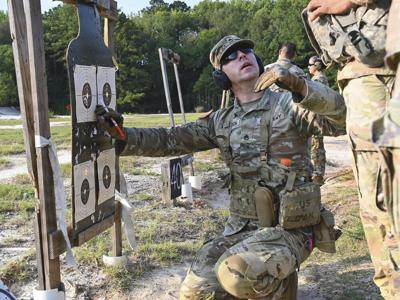

The competition is not televised nationally. There are no accolades from fans. But few events are as demanding as the U.S. Army’s annual Drill Sergeant of the Year.
Staff Sgt. Sean Warnock of the 229th Military Intelligence Battalion, based in Monterey, was one of 14 drill sergeants selected to take part in the 2026 competition, held at Fort Jackson in South Carolina. The winner is determined after 34 separate contests – physical, tactical and instructional – over 72 hours, judged by a panel of senior non-commissioned officers.
While Staff Sgt. Noel Berges earned Drill Sergeant of the Year honors with Sgt. 1st Class Kevin Harrington receiving Army Reserve recognition, Warnock was not disappointed in the outcome.
“I knew the first day when I walked into the room – I thought, ‘He’s going to win,’” Warnock says. “[The judges] picked well.”
Warnock grew up in Salem, Oregon. Not one to be stuck behind a desk, he opted to join the Army in 2015. He serves as an intelligence collector – a role he will return to after his term as a drill instructor ends.
Weekly: I can’t imagine a competition for drill sergeants.
Warnock: Drill sergeants are in charge of training. But who is the most effective? The events are objective and cover the whole cycle of training. It’s a very close competition.
What is the hardest part of your job?
Every drill sergeant will give a different answer. It may be the paperwork. Soldiers have an idea based on something before they joined on how things work. You have to bridge that gap between Hollywood and reality. But you make sure all the soldiers are taken care of so they can focus on their job.
How about the biggest reward?
Seeing the growth. I had a soldier who couldn’t shoot. I spent an hour working with him. Seeing him have that a-ha moment – seeing the little moments add up, that is rewarding. Now I can rely on you – that is what we’re here for.
It may be a bit more of a challenge to teach me to hit a target.
I guarantee I can do it.
You mentioned relying on the others.
That camaraderie is really unique. I think that is one of the most valuable things. When you speak with veterans, it’s what they miss the most.
Why choose the Army?
I originally wanted to go Air Force, because when I was young I was interested in aviation engineering. But the Air Force recruiting office was closed. The Army, Navy and Marines – and I think Coast Guard, too – offices were in a row. I thought, “I’m going to compare my options.” I went in the Army recruiting office and had a two-hour conversation. It came down to a guarantee of what my job would be.
The cycle of training. How does that work for drill sergeants?
Usually you are seeing zero-10 weeks, or 11 week to completion. You don’t get to see the whole spectrum. There are different specialties for drill sergeants. It’s very different for different locations. Every field has its own requirements for instruction.
From what I know, drill sergeants in the old days could be very sarcastic.
It’s changed a lot. We have people who volunteer, who want something from their service. So you don’t need to force someone to comply, they want to do it. You don’t have to be Full Metal Jacket.
The instructors before were random. The workload is heavy, the hours are long, you didn’t get to see family. The solution was to create a drill sergeant school and make sure the people are of sufficient caliber and can deal with the stress.
How do you spend your spare time?
When I was in Kansas I would go to the archery range. I might not even change out of my uniform. I’d get home, grab my bow and do it for hours. Here the range is not as close. So I’ll hop on my bike and make a day of it.
You were at Fort Riley? My uncle wrote a song about the base.
[Laughing] I’m sure it was flattering.
The last line is “Running through the prairie grass chased by ticks and fleas.”
We didn’t get fleas, but the ticks exploded on us. Fort Riley wasn’t that bad.
Will you miss being a drill sergeant?
Probably. Your unit makes a bigger difference than your job. You might work 14-16 hours a day, but you look at everything and think, “I actually did something.”


(0) comments
Welcome to the discussion.
Log In
Keep it Clean. Please avoid obscene, vulgar, lewd, racist or sexually-oriented language.
PLEASE TURN OFF YOUR CAPS LOCK.
Don't Threaten. Threats of harming another person will not be tolerated.
Be Truthful. Don't knowingly lie about anyone or anything.
Be Nice. No racism, sexism or any sort of -ism that is degrading to another person.
Be Proactive. Use the 'Report' link on each comment to let us know of abusive posts.
Share with Us. We'd love to hear eyewitness accounts, the history behind an article.